Dtriction
- 1
- 0
There is a graph showing n on its x-axis and its total stopping time on its y axis.
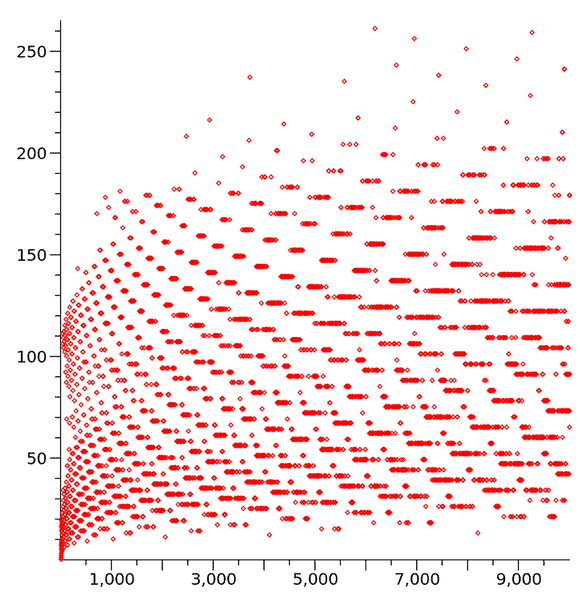
From here we can see that the points on the graph are not random at all; they have some kind of geometric pattern that is due to the 3x+1 in the odd case and x/2 in the even case. I have seen many attempts to prove the Collatz Conjecture but all that I have seen do not make any reference to the geometric patterns in the above graph. What if we work on establishing how the two cases' formulae relate to the above graph's geometric patterns and then extrapolate it? Might it be possible to find out something new from the formulae that would be really not apparent without this graph? Wouldn't it transform the original conjecture into a geometric problem, a new way of looking at it which may provide fresh new insights?
This method should work not for just the Collatz Conjecture,if I guess correctly. A math problem that could be graphed in some way would turn it into geometric problems which then could be solved/used to obtain new insights by geometry,wouldn't it?
From here we can see that the points on the graph are not random at all; they have some kind of geometric pattern that is due to the 3x+1 in the odd case and x/2 in the even case. I have seen many attempts to prove the Collatz Conjecture but all that I have seen do not make any reference to the geometric patterns in the above graph. What if we work on establishing how the two cases' formulae relate to the above graph's geometric patterns and then extrapolate it? Might it be possible to find out something new from the formulae that would be really not apparent without this graph? Wouldn't it transform the original conjecture into a geometric problem, a new way of looking at it which may provide fresh new insights?
This method should work not for just the Collatz Conjecture,if I guess correctly. A math problem that could be graphed in some way would turn it into geometric problems which then could be solved/used to obtain new insights by geometry,wouldn't it?