Can violet lasers trick our eyes into seeing white?

  • Context: Undergrad 
  • Thread starter Thread starter Daniel Petka
  • Start date Start date
  • Tags Tags
    Center Color
Click For Summary

Discussion Overview

The discussion revolves around the perception of color, specifically how violet lasers may trick the human eye into seeing white. Participants explore the mechanisms of color perception, the interaction of light with surfaces, and the physiological responses of cone cells in the eyes. The scope includes theoretical considerations and personal observations related to light intensity and color perception.

Discussion Character

  • Exploratory
  • Technical explanation
  • Debate/contested

Main Points Raised

  • Some participants propose that violet light activates not only blue cone receptors but also red and potentially green receptors at higher intensities, leading to a perception of white.
  • Others suggest that the light may be converted to longer wavelengths by the wall, affecting the perceived color.
  • One participant argues that the beam remains violet while the diffuse reflection appears white, indicating a change in the spectrum upon reflection.
  • Another participant clarifies that the spectrum does not change through diffuse reflections and that a single wavelength (405nm) can appear white when sufficiently powerful.
  • Fluorescence is mentioned as a process where high-energy light may convert to lower-energy light, contributing to color perception.
  • Discussion includes the role of cone cells in the eye, noting that a bright enough violet laser can overload signals from all cone types, resulting in the perception of white.
  • Some participants express uncertainty about the relationship between intensity and color perception, suggesting that the output signal may change without altering the absorption spectrum.

Areas of Agreement / Disagreement

Participants do not reach a consensus; multiple competing views remain regarding the mechanisms behind the perception of white from violet lasers and the role of intensity and reflection.

Contextual Notes

Limitations include assumptions about the interaction of light with surfaces, the dependence on specific conditions of observation, and unresolved details regarding the physiological responses of the eye to varying light intensities.

Daniel Petka
Messages
147
Reaction score
16
Violet itself is weird, because it lays at the other side of the spectrum than red, yet it can be easily mimicked with red and blue. The more powerful the violet light, the more it resembles white.

My hypothesis: Violet tricks our eyes by activating not only blue, but also red and... with more power even green receptors.

(Please prove it wrong if its possible)
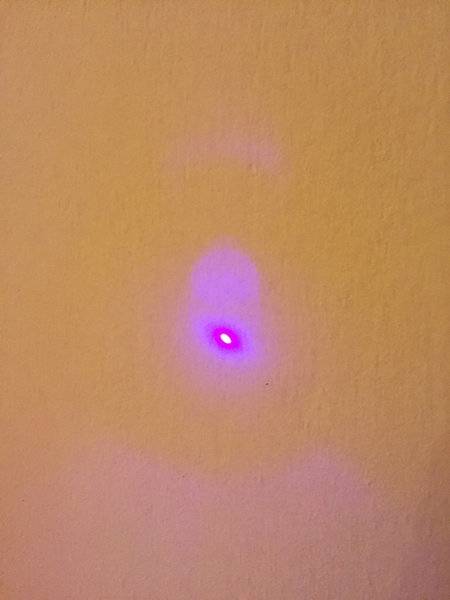
IMG_9747.JPG

(Photo: middle white just like in reality (actually closer to cyan cause the wall is yellow, no idea why- pure observation- comment if you know y :p))

Observation: I've been playing with (not too powerful) lasers since I was a kid. One thing I noticed, was the unexpected color of the dot's center. It mostly seemed to be white- just like a camera picks it up. The red lasers couldn't achieve it, all I got from fairly powerful pointers (~100mW) was yellow in the middle. The green, however glowed clear white in the center of the dot.
There's more- the violet laser is not bright- even higher powers of 405nm can't outshine cheap green lasers. The dot though fairly change color with increasing power. That means violet laser dot looks kinda white; in a yellow environment almost cyan.

Thanks for reading this nonsense. ;)

I'll be happy if you prove my hypothesis wrong.
 
Science news on Phys.org
Daniel Petka said:
My hypothesis: Violet tricks our eyes by activating not only blue, but also red and... with more power even green receptors.
Or the light converted to longer wave lengths by the wall.
 
Daniel Petka said:
My hypothesis: Violet tricks our eyes by activating not only blue, but also red and... with more power even green receptors.

(Please prove it wrong if its possible)
Please remember that we do not allow personal speculation (although this is simple enough that it should be addressed fairly quickly). And it is not our job to prove you wrong -- that is not how the PF works.
 
A.T. said:
Or the light converted to longer wave lengths by the wall.

Nope, the beam Looks violet too!
 
Daniel Petka said:
Nope, the beam Looks violet too!
If the beam looks violet, while the diffuse reflection looks white, then eventually the spectrum changes on reflection.
 
A.T. said:
If the beam looks violet, while the diffuse reflection looks white, then eventually the spectrum changes on reflection.

I guess I didn't express myself correctly.
The spectrum does NOT change through diffuse reflections. I checked it twice through a prism. It's still one single wavelength (405nm) that looks white when it's more powerful than usual.
 
Btw in your approach you forgot something: the beam is violet because it's simply less concentrated than the dot. That's the thing I've been talking about the whole time .

However you're not completely wrong. What you're talking about is fluorescence where high energy light (for example uv, or violet) gets converted to low energy light (green light)
 
Last edited:
It has to do with how our eyes work. The colours we see are signals from cone cells:
https://en.wikipedia.org/wiki/Cone_cell
287px-Cones_SMJ2_E.svg.png


Image sensors in cameras work similarly.
you can see that each absorption profile is a finite width, so your 405nm laser can actually trigger very small amounts of signal for your green and red (M and L) cone cells. If it is bright enough, all cells' signals are overloaded so you essential clip all the colour signals to the same strength, resulting in the perception of white colour.
Now for red lasers, you can also see that it really doesn't trigger much of any signal for the blue cone cell, probably the reason why you haven't been able to see a white centre.
 
Thanks wukunlin. I also had this picture in mind. Eventually it's maybe possible that the graph changes with increasing intensity.
 
  • #10
Well, it's not really the absorption spectrum that is changing, but the output signal changed because they are hitting their respective maxima, and changing the frequency distribution
 

Similar threads

  • · Replies 40 ·
2
Replies
40
Views
4K
  • · Replies 2 ·
Replies
2
Views
2K
  • · Replies 20 ·
Replies
20
Views
4K
  • · Replies 36 ·
2
Replies
36
Views
11K
  • · Replies 23 ·
Replies
23
Views
10K
  • · Replies 21 ·
Replies
21
Views
3K
  • · Replies 2 ·
Replies
2
Views
2K
  • · Replies 3 ·
Replies
3
Views
3K
Replies
1
Views
3K