Can we twist the two ends of the wire together?

  • Thread starter Thread starter Shervan360
  • Start date Start date
  • Tags Tags
    Electrical Wire
Click For Summary
SUMMARY

The discussion centers on the feasibility of using two 6 Gauge wires to replace a single 12 Gauge wire for electrical installations. It is established that 6AWG wire can carry the same current as 12AWG wire without the need for paralleling. However, for achieving equivalent resistance to 12AWG, the discussion highlights that two 22 Gauge wires would not suffice due to increased resistance. The NEC allows paralleling conductors under specific conditions, but caution is advised regarding resistance differences that could lead to uneven current distribution.

PREREQUISITES
  • Understanding of American Wire Gauge (AWG) standards
  • Knowledge of electrical resistance and current-carrying capacity
  • Familiarity with local building codes regarding electrical installations
  • Basic principles of electrical wiring and safety
NEXT STEPS
  • Research NEC guidelines for paralleling conductors
  • Learn about the resistance characteristics of different AWG sizes
  • Study the impact of wire gauge on electrical appliance performance
  • Explore local building codes for electrical installations
USEFUL FOR

Electricians, electrical engineers, and DIY enthusiasts involved in wiring projects or seeking to understand the implications of wire gauge on electrical systems.

Shervan360
Messages
26
Reaction score
4
Hello,
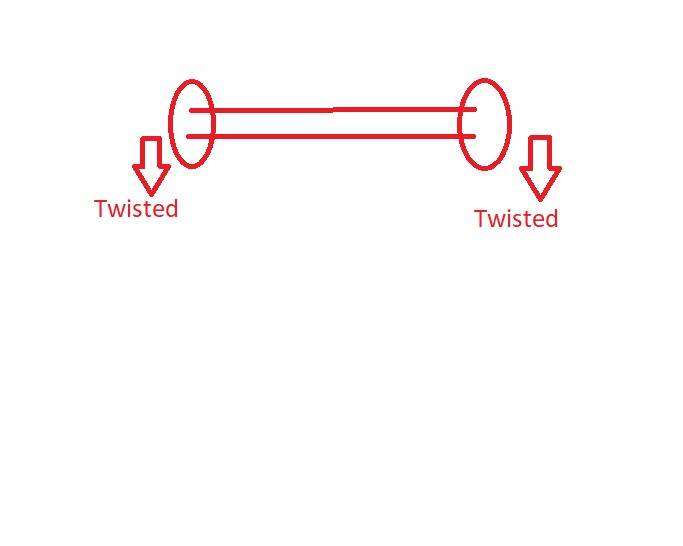
We need 20 meters of 12 Gauge electrical wire but don't have 12 Gauge wire. Can we use two 6 Gauge wires and twist the two ends of the wire together? Is it harmful to electronic appliances? for example, air conditioners

[Mentor Note: original question restored; the OP will post a follow up with a correction in a later reply]

wireees.jpg
 
Last edited by a moderator:
Engineering news on Phys.org
Welcome to PF. :smile:

6AWG wire is thicker than 12AWG wire, so as long as you can deal with the extra size and stiffness, 6AWG wire will easily carry the current of 12AWG wire. No need to double-up anything.

You should always check your local building codes, but it's likely that 12AWG is listed as the minimum size for the wire for this installation. A lower AWG (bigger wire diameter) should generally be allowed as a more expensive alternative.
 
  • Haha
  • Like
Likes   Reactions: Shervan360 and russ_watters
Also, looking at your IP address (Mentors have that superpower), it's strange that you are specifying wire size in American Wire Gauge (AWG) instead if SI units...

https://en.wikipedia.org/wiki/IEC_60228
 
  • Like
Likes   Reactions: Shervan360
berkeman said:
Welcome to PF. :smile:

6AWG wire is thicker than 12AWG wire, so as long as you can deal with the extra size and stiffness, 6AWG wire will easily carry the current of 12AWG wire. No need to double-up anything.

You should always check your local building codes, but it's likely that 12AWG is listed as the minimum size for the wire for this installation. A lower AWG (bigger wire diameter) should generally be allowed as a more expensive alternative.
Excuse me. I edited my question.
 
berkeman said:
Also, looking at your IP address (Mentors have that superpower), it's strange that you are specifying wire size in American Wire Gauge (AWG) instead if SI units...

https://en.wikipedia.org/wiki/IEC_60228
Yes, because I guessed that the respondents live in Western countries.
 
As this thread will be discoverable by posterity, I feel compelled:
Paralleling conductors to meet capacity requirements is theoretically acceptable. In practice it should be done very carefully - any differences in net resistance will result in uneven current distribution across the multiple conductors. US NEC allows it, but only for relatively large conductors and with length/termination similarity requirements.
 
Shervan360 said:
Excuse me. I edited my question.
Please don't do that, it is very confusing for anyone trying to read the thread. I've restored your original question; please post a new reply with your clarification on the size of the wires you are asking about. Thank you.

Shervan360 said:
Hello,
We need 20 meters of 12 Gauge electrical wire but don't have 12 Gauge wire. Can we use two 6 Gauge wires and twist the two ends of the wire together? Is it harmful to electronic appliances? for example, air conditioners

[Mentor Note: original question restored; the OP will post a follow up with a correction in a later reply]
 
Last edited:
Shervan360 said:
Hello,
We need 20 meters of 12 Gauge electrical wire but don't have 12 Gauge wire. Can we use two 6 Gauge wires and twist the two ends of the wire together? Is it harmful to electronic appliances? for example, air conditioners

[Mentor Note: original question restored; the OP will post a follow up with a correction in a later reply]

View attachment 328952
Please see an edited version of my question:

We need 20 meters of 12 Gauge electrical wire but don't have 12 gauge wire. Can we use two 22 Gauge wires and twist the two ends of the wire together? Is it harmful to electronic appliances? for example, air conditioners
 
Shervan360 said:
We need 20 meters of 12 Gauge electrical wire but don't have 12 gauge wire. Can we use two 22 Gauge wires and twist the two ends of the wire together?
If you are trying to achieve the same resistance and current-carrying capability, no.

The resistance of wire is doubled for every 3 AWG increment (it's a log scale). So to get the same resistance as 12AWG by paralleling two wires, what would their AWG need to be?

https://www.daycounter.com/Calculators/AWG.phtml
 
  • Like
Likes   Reactions: Shervan360
  • #10
The Rule of Thumb is easy to remember. The resistance of the American Wire Gauge values approximately doubles every 3. So to replace AWG 12 you can use two AWG 15 or four AWG 18 or eight AWG 21 or ten AWG 22.

AWG 12 = ten AWG 22
0.00521 = 0.053 / 10 for parallel you divide R
[Ohm/m]
Copper
(20 C,68 F)
 

Similar threads

Replies
6
Views
2K
  • · Replies 6 ·
Replies
6
Views
12K
  • · Replies 17 ·
Replies
17
Views
31K
  • · Replies 8 ·
Replies
8
Views
3K
  • · Replies 5 ·
Replies
5
Views
2K
  • · Replies 36 ·
2
Replies
36
Views
6K
  • · Replies 28 ·
Replies
28
Views
33K
  • · Replies 6 ·
Replies
6
Views
2K
  • · Replies 19 ·
Replies
19
Views
4K
Replies
1
Views
2K