Can You Crack This Challenging Indefinite Integral?

Join the discussion
Ask a follow-up here, or get your own question answered by working scientists, mathematicians and engineers — people, not an autocomplete.
Real named experts · corrections over time · the nuance an AI answer skips
4 replies · 1K views
GodsmacK
Messages
4
Reaction score
1
Hello, everyone

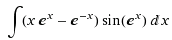
I've trying to solve this integral but it seems like the methods I know are not enogh to solve it. So I'd be glad if you could give me some trick to get into the answer.
Here it is:
33wtvdw.jpg


Thanks in advance!
 
Physics news on Phys.org
Maple knocked it out right away (I have no idea what the details are):

Integral = num/den
where
num =(x*e^x*(tan((1/2)*e^x))^2-x*e^x+2*tan((1/2)*e^x))
den=(1+tan((1/2)*e^x))*e^x

Perhaps having the result in hand will enable you to go back and fill in the gaps.
 
I found it to be e-xsin(ex) - xcos(ex) + c
This was through Wolfram and I would guess integration by parts somehow
 
Hey guys!

I've just solved this thing. In fact, like Charles wrote, it is integration by parts. First you distribute the [itex]\sin(e^x)[/itex] into the parenthesis, then you do the substitution [itex]u=e^x[/itex]. After some steps you shall get something like this:

[itex]I=\int \ln(u) \sin(u)du-\int \frac{\sin(u)}{u^2}du[/itex]

Applying integration by parts:

[itex]I=-\cos(u) ln(u)+\int \frac{\cos(u)}{u}du+\frac{\sin(u)}{u}-\int \frac{\cos(u)}{u}du[/itex]

And there you are... As you see the non-primitive function integral gets cancelled.
 
  • Like
Likes   Reactions: Charles Stark
Eureka! And substituting back reduces it down. Aren't integrals just a blast?