Can You Crack This Challenging Indefinite Integral?

Click For Summary
SUMMARY

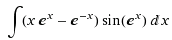
The integral discussed is solved using integration by parts, specifically involving the function e^x and trigonometric functions. The integral is expressed as I = ∫ ln(u) sin(u) du - ∫ (sin(u)/u²) du, where u = e^x. The final result is e - xsin(e^x) - xcos(e^x) + C, confirming the effectiveness of integration by parts in this context. Tools like Maple and Wolfram Alpha were utilized to verify the solution.

PREREQUISITES
  • Understanding of integration techniques, specifically integration by parts.
  • Familiarity with exponential functions and their properties.
  • Knowledge of trigonometric functions and their integrals.
  • Basic skills in using computational tools like Maple or Wolfram Alpha for verification.
NEXT STEPS
  • Study the method of integration by parts in depth.
  • Explore the properties and applications of exponential functions in calculus.
  • Learn about the integration of trigonometric functions and their combinations.
  • Practice using computational tools like Maple and Wolfram Alpha for solving complex integrals.
USEFUL FOR

Students, educators, and professionals in mathematics or engineering fields who are looking to enhance their skills in solving complex integrals and understanding advanced calculus techniques.

GodsmacK
Messages
4
Reaction score
1
Hello, everyone

I've trying to solve this integral but it seems like the methods I know are not enogh to solve it. So I'd be glad if you could give me some trick to get into the answer.
Here it is:
33wtvdw.jpg


Thanks in advance!
 
Physics news on Phys.org
Maple knocked it out right away (I have no idea what the details are):

Integral = num/den
where
num =(x*e^x*(tan((1/2)*e^x))^2-x*e^x+2*tan((1/2)*e^x))
den=(1+tan((1/2)*e^x))*e^x

Perhaps having the result in hand will enable you to go back and fill in the gaps.
 
I found it to be e-xsin(ex) - xcos(ex) + c
This was through Wolfram and I would guess integration by parts somehow
 
Hey guys!

I've just solved this thing. In fact, like Charles wrote, it is integration by parts. First you distribute the \sin(e^x) into the parenthesis, then you do the substitution u=e^x. After some steps you shall get something like this:

I=\int \ln(u) \sin(u)du-\int \frac{\sin(u)}{u^2}du

Applying integration by parts:

I=-\cos(u) ln(u)+\int \frac{\cos(u)}{u}du+\frac{\sin(u)}{u}-\int \frac{\cos(u)}{u}du

And there you are... As you see the non-primitive function integral gets cancelled.
 
  • Like
Likes   Reactions: Charles Stark
Eureka! And substituting back reduces it down. Aren't integrals just a blast?
 

Similar threads

  • · Replies 11 ·
Replies
11
Views
2K
  • · Replies 9 ·
Replies
9
Views
3K
  • · Replies 6 ·
Replies
6
Views
2K
  • · Replies 4 ·
Replies
4
Views
6K
  • · Replies 3 ·
Replies
3
Views
3K
  • · Replies 8 ·
Replies
8
Views
3K
  • · Replies 5 ·
Replies
5
Views
2K
  • · Replies 22 ·
Replies
22
Views
4K
  • · Replies 1 ·
Replies
1
Views
2K
  • · Replies 8 ·
Replies
8
Views
3K