Can you somehow make left handed helix into a right handed?

  • Context: Undergrad 
  • Thread starter Thread starter sol47739
  • Start date Start date
  • Tags Tags
    Helix Mirror image
Click For Summary

Discussion Overview

The discussion centers on whether it is possible to transform a left-handed helix into a right-handed helix (or vice versa) through rotations or other transformations in three-dimensional space. Participants explore the implications of chirality in both mathematical and chemical contexts, as well as the nature of helices and their properties.

Discussion Character

  • Debate/contested
  • Technical explanation
  • Conceptual clarification
  • Mathematical reasoning

Main Points Raised

  • Some participants question whether a left-handed helix can be transformed into a right-handed one through any type of rotation or transformation in three dimensions, suggesting that it cannot be done.
  • Others mention that in four dimensions, such transformations may be possible, indicating a difference in dimensionality affects chirality.
  • One participant notes that certain chemical reactions can invert chirality, but emphasizes that a chiral shape cannot be superimposed onto its mirror image using only rotations and translations.
  • It is pointed out that left-handed and right-handed helices have the same curvature but opposite torsions, which rigid motions preserve, thus preventing transformation between the two types in three-dimensional space.
  • A participant introduces the concept of a natural generalization of a helix to four dimensions, suggesting that a space curve in 4D could have constant curvatures and torsion.
  • Another participant proposes the idea of a 4D lift of an infinitely turning curve on a sphere, drawing an analogy to the helix as a 3D lift of a curve turning on a circle.

Areas of Agreement / Disagreement

Participants express differing views on the possibility of transforming helices between left-handed and right-handed forms, with some asserting it cannot be done in three dimensions while others suggest potential solutions in four dimensions. The discussion remains unresolved regarding the feasibility of such transformations.

Contextual Notes

Participants reference various mathematical and chemical principles, including chirality, torsion, and curvature, but do not reach a consensus on the implications of these concepts for the transformation of helices.

sol47739
Messages
38
Reaction score
3
TL;DR
Can you by any type of rotations or transformations turn a left handed helix into a right handed or vice versa?
Can you by any type of rotations or transformations turn a left handed helix into a right handed or vice versa? If yes why? And if no, why not?
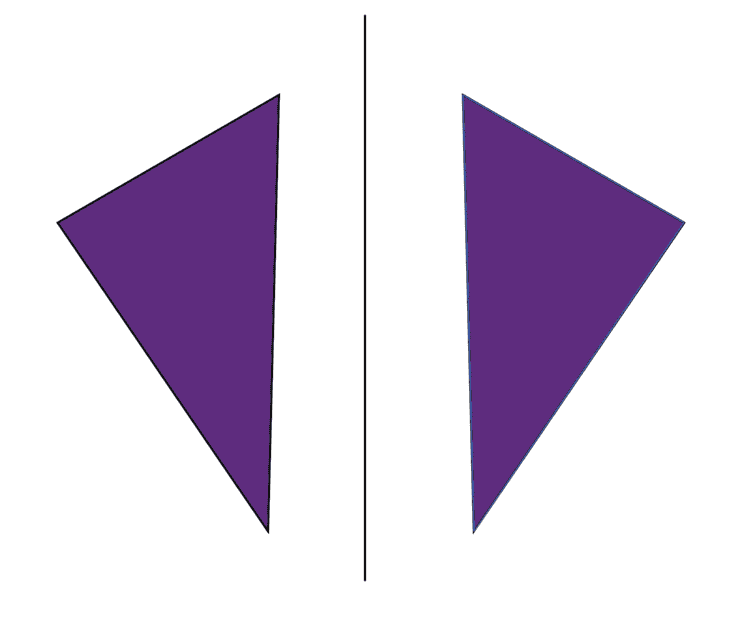
For example if you have a 2 d triangle like the one in the picture:
Bildschirmfoto 2023-04-21 um 13.52.02.png

You can turn it in 3 dimensions 180 degrees in a sense mirroring it and you will get back to the original, but then you have to turn it in 3 dimension in a sense lift it up from the plane and turn it.

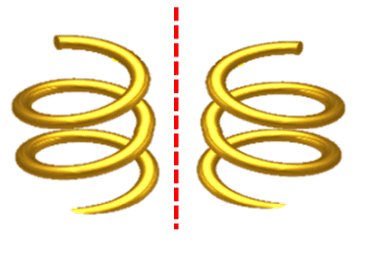
Can you do the same for a helix or not? If you were able to turn it any way you wanted in 3 dimensions as many times as you wanted could you get a left handed screw to become a right handed?
Bildschirmfoto 2023-04-21 um 13.55.50.png
 
Physics news on Phys.org
sol47739 said:
Can you do the same for a helix or not? If you were able to turn it any way you wanted in 3 dimensions as many times as you wanted could you get a left handed screw to become a right handed?
If you could, what would be the point of calling it left-handed?

https://en.wikipedia.org/wiki/Chirality
 
  • Like
Likes   Reactions: TeethWhitener
It's my understanding (admittedly casual amateur) that here are some chemical reactions that do just that. Mad cow disease (Creutzfeldt-Jakob disease) converts the fold direction of a usable prion into one that is unusable and clogs up the brain. I believe that changes it from a left-hand fold to a right-hand fold (or the converse?).
Mathematically, in Geometric Algebra, a reflection can be done this way: Suppose ##\hat {v}## is a unit vector and ##\vec {a}## is a vector. Then ##\hat {v} \vec {a} \hat {v}## is a reflection of ##\vec {a}## across ##\hat {v}##. See An Overview of the Operations in Geometric Algebra at 10:26
 
The thalidomide disaster of the 1950's was due to the wrong chirality of molecules:

https://en.wikipedia.org/wiki/Thalidomide

Originally it was thought the one of of the molecules (R version) was safe and that the (S version) was not. However, they later discovered that the body can convert (R to S or S to R) which made the drug dangerous for certain kinds of conditions including pregnancies used by either men or women.

Thalidomide destroyed many medical assumptions of the time ,including the notion that drugs during pregnancy would not harm the fetus as it could cross the placental barrier, and led to safer more thorough drug testing.
 
  • Like
Likes   Reactions: FactChecker
sol47739 said:
TL;DR Summary: Can you by any type of rotations or transformations turn a left handed helix into a right handed or vice versa?

Can you by any type of rotations or transformations turn a left handed helix into a right handed or vice versa? If yes why? And if no, why not?
For example if you have a 2 d triangle like the one in the picture:View attachment 325219
You can turn it in 3 dimensions 180 degrees in a sense mirroring it and you will get back to the original, but then you have to turn it in 3 dimension in a sense lift it up from the plane and turn it.

Can you do the same for a helix or not? If you were able to turn it any way you wanted in 3 dimensions as many times as you wanted could you get a left handed screw to become a right handed?

View attachment 325220
I believe it can't be done in 3D. I don't know how to prove that though. In 4D it's easy.
 
FactChecker said:
I believe that changes it from a left-hand fold to a right-hand fold (or the converse?).
Not quite. The conformational change is believed to involve an alpha helix to beta sheet transition, rather than a change in the orientation of a helix.

There are chemical reactions that invert chirality (SN2 reactions are a prominent example), but a chiral molecule (or any chiral shape in Euclidean space) cannot be superimposed onto its mirror image using only rotations and translations. Mathematically, chirality requires that the shape's point group not contain an improper axis of symmetry.
 
  • Like
Likes   Reactions: hutchphd, DrClaude and FactChecker
Left handed and right handed helices have the same curvature but have torsions of opposite sign.

Rigid motions of three space preserve curvature and torsion so opposite handed helices cannot be transformed into each other by a rigid motion (a rotation plus a translation).

At every point of a smooth curve that is parameterized by arc length and whose curvature is not zero, there is a plane spanned by its unit velocity vector and its unit normal called the osculating plane.

As a point moves along the curve, this plane rotates infinitesimally toward or away from the normal along an axis that passes through the direction of motion. The torsion of the curve measures the speed and direction of this rotation. If the torsion is positive, as in a right handed helix, the osculating plane turns away from the normal. If it is negative it turns towards it.

This link has an animation of the moving Frenet-Serret frames of reference (the moving positively oriented frame whose axes are lines through the tangent, normal and binormal) on the two helices.

https://mymathapps.com/mymacalc-sample/MYMACalc3/Part I - Geometry & Vectors/CurveProps/Torsion.html
 
Last edited:
  • Like
Likes   Reactions: vanhees71 and TeethWhitener
I was wondering what a natural generalization of a helix to four dimensions might be. A space curve in 4D has two curvatures plus a torsion. One generalization might be a 4D space curve that has constant curvatures and torsion. I wonder what such a curve looks like.

Another might be the 4D lift of an infinitely turning curve on a sphere e.g. a loxodrome in analogy to the helix which is a 3d lift of a curve turning on a circle.
 
Last edited:
  • Like
Likes   Reactions: DrClaude
lavinia said:
Another might be the 4D lift of an infinitely turning curve on a sphere e.g. a loxodrome in analogy to the helix which is a 3d lift of a curve turning on a circle.

This clever idea gets my vote. I never would have imagined such a thing.
 

Similar threads

  • · Replies 3 ·
Replies
3
Views
3K
Replies
5
Views
2K
  • · Replies 11 ·
Replies
11
Views
3K
Replies
7
Views
2K
  • · Replies 40 ·
2
Replies
40
Views
6K
  • · Replies 11 ·
Replies
11
Views
2K
  • · Replies 19 ·
Replies
19
Views
2K
  • · Replies 2 ·
Replies
2
Views
2K
  • · Replies 9 ·
Replies
9
Views
2K
  • · Replies 7 ·
Replies
7
Views
4K