Canonical transformation - derviation problem

Click For Summary
SUMMARY

The discussion focuses on the mathematical principles behind canonical transformations and the derivation of Hamiltonian mechanics as outlined in Florian Scheck's "Mechanics From Newton’s Laws to Deterministic Chaos." It emphasizes that adding the total time derivative of a function M(q,t) to the Lagrangian does not alter the equations of motion, as proven in Proposition 2.10. The action integral remains invariant under this transformation, leading to the conclusion that the variational principle holds true for both the original and modified Lagrangian functions.

PREREQUISITES
  • Understanding of Lagrangian mechanics
  • Familiarity with Hamiltonian mechanics
  • Knowledge of variational principles in physics
  • Basic calculus, particularly integration and differentiation
NEXT STEPS
  • Study Proposition 2.10 in "Mechanics From Newton’s Laws to Deterministic Chaos"
  • Learn about Legendre transformations in classical mechanics
  • Explore the implications of the action principle in physics
  • Investigate generating functions and their role in Hamilton-Jacobi theory
USEFUL FOR

Students and professionals in physics, particularly those studying classical mechanics, as well as researchers interested in advanced topics such as Hamiltonian dynamics and variational calculus.

Vicol
Messages
14
Reaction score
0
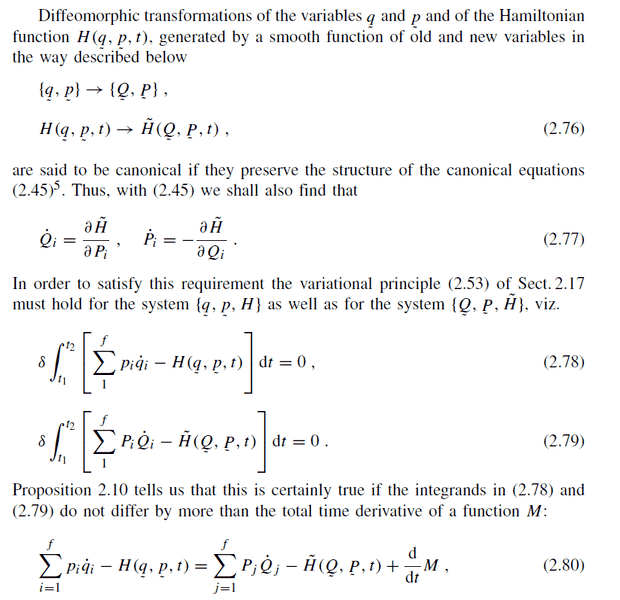
Let me show you part of a book "Mechanics From Newton’s Laws to Deterministic Chaos" by Florian Scheck.
OV5cnfT.png


I do not understand why these integrands can differ by more than time derivative of some function M. Why doesn't it change the value of integrals?

It seems this point is crucial for me to get into generating functions (and then to Hamilton-Jacobi functions) but I won't proceed until I fully understand derviations. So can anyone explain mathematical story of the derviation?
 

Attachments

  • OV5cnfT.png
    OV5cnfT.png
    46.6 KB · Views: 1,218
Physics news on Phys.org
The claim depends on Proposition 2.10 so it is more likely that help can be provided if you can show Proposition 2.10.
 
fMWckum.png
 

Attachments

  • fMWckum.png
    fMWckum.png
    42.6 KB · Views: 952
That's because the Hamiltionian function is defined as the "Legendre Transformation" of the Lagrangian function or, in practice:

$$H = \sum \frac{\partial L}{\partial \dot{q_i}} \dot{q_i} - L $$ so the integrand function in (2.78) is nothing but the Lagrangian function. As you should know and as the proposition 2.10 says (and proves!) adding the total time derivative of a function ##M(q,t)## to the Lagrangian does not affect the motion described by the Lagrangian itself. You can visualize it by this way:

Let ##L(q, \dot{q}, t)## be a Lagrangian function, we now define ##L'(q, \dot{q}, t)= L(q, \dot{q}, t) + \frac{dM(q,t)}{dt}##. We define the action as
$$ S' = \int_{t_1} ^{t_2} L'(q,\dot{q}, t)dt = \int_{t_1} ^{t_2} L(q,\dot{q}, t) dt + \int_{t_1} ^{t_2} \frac{dM(q,t)}{dt} dt = S + M(q_2,t_2) - M(q_1,t_1) = S + constant$$
where clearly ## S= \int_{t_1} ^{t_2} L(q,\dot{q}, t)dt##. Now you can se that the condition ## \delta S' = 0## is perfectly equivalent to ##\delta S=0##.
 
  • Like
Likes   Reactions: Vicol

Similar threads

  • · Replies 6 ·
Replies
6
Views
2K
  • · Replies 1 ·
Replies
1
Views
1K
  • · Replies 2 ·
Replies
2
Views
669
  • · Replies 17 ·
Replies
17
Views
4K
Replies
2
Views
9K
  • · Replies 1 ·
Replies
1
Views
3K
  • · Replies 3 ·
Replies
3
Views
4K
  • · Replies 1 ·
Replies
1
Views
3K
  • · Replies 4 ·
Replies
4
Views
5K
Replies
1
Views
4K