Capacitance of a spherical capacitor

Click For Summary
SUMMARY

The discussion focuses on calculating the capacitance of a spherical capacitor, specifically addressing the influence of dielectric materials on the electric field and potential difference. The capacitance formula derived is C = 4πε₀εᵣ(R₂R₁)/(R₂ - R₁), where ε₀ is the permittivity of free space, εᵣ is the relative permittivity of the dielectric, and R₁ and R₂ are the inner and outer radii of the spherical capacitor. The use of Gauss's law is emphasized for determining the electric field within the dielectric and the relationship between charge and electric field strength.

PREREQUISITES
  • Understanding of Gauss's Law in electrostatics
  • Familiarity with the concept of capacitance and its formulas
  • Knowledge of dielectric materials and their properties
  • Basic calculus for evaluating integrals in electric field calculations
NEXT STEPS
  • Study the derivation of Gauss's Law and its applications in electrostatics
  • Explore the effects of different dielectric materials on capacitance
  • Learn about the energy stored in capacitors and its relation to capacitance
  • Investigate advanced capacitor configurations and their applications in circuits
USEFUL FOR

Physics students, electrical engineers, and anyone involved in the design and analysis of capacitors and electrical circuits will benefit from this discussion.

Guillem_dlc
Messages
188
Reaction score
17
Homework Statement
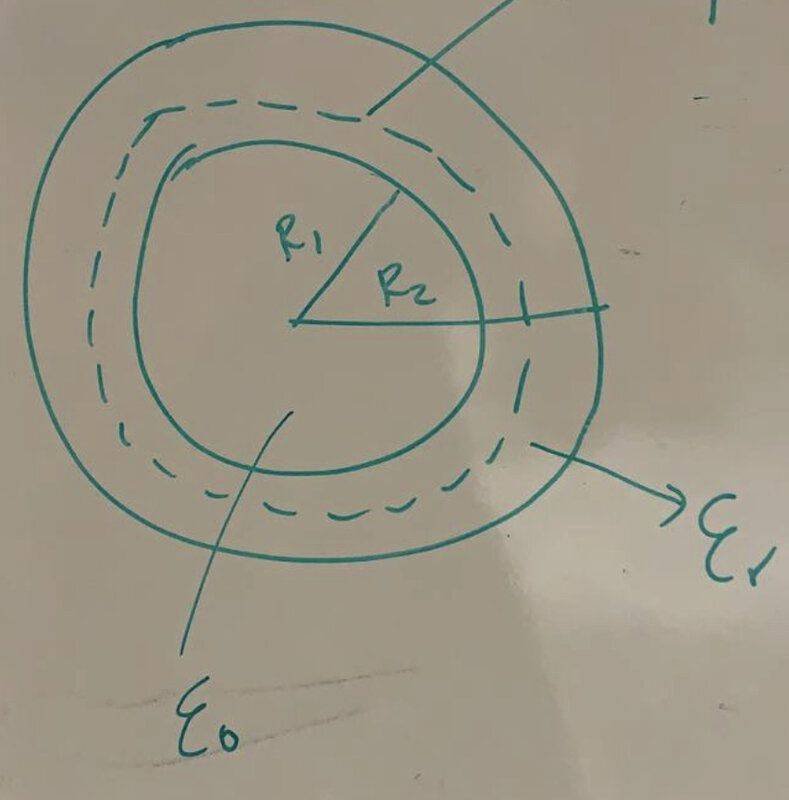
A spherical capacitor is formed by two thin conductive layers, spherical and concentric, of radius [itex] R_1 [/itex] and [itex] R_2>R_1 [/itex], between which we have placed a dielectric material of relative permittivity [itex] \varepsilon_r [/itex]. Knowing that the inner layer has an [itex] Q [/itex] charge, idetermines the capacity of the capacitor and the total energy stored.
Relevant Equations
Gauss Law
When I try to do Gauss, the permeability is not always that of the free space, but it varies: up to a certain radius it is that of the void and then it is the relative one. How can I relate them? I'm trying to calculate the capacity of a spherical capacitor.

The scheme looks like this: inside I have the free space and between the plates of the capacitor I have the dielectric material.
67D98992-D759-4157-BF39-9E70AA815294.jpeg


The broken lines represent the Gaussian surface.
 
Physics news on Phys.org
What is the result if it were space ( ε0) between the spherical shells?
 
The vacuum doesn't matter because it contains no charge. The capacitor consists of two conducting plates with the space between them filled completely with the dielectric. Use a Gaussian surface completely inside the dielectric. Or you can find the capacitance with no dielectric between the shells and then multiply it by the dielectric constant.
 
I think I have the solution. Is that right?
<br /> \left.<br /> \phi =\oint \vec{E}\cdot d\vec{S}=\oint E\cdot dS\cdot \underbrace{\cos 0}_1=E\oint dS=E\cdot S \atop<br /> \phi =\dfrac{Q_{enc}}{\varepsilon_0 \varepsilon_r}=\dfrac{Q}{\varepsilon_0 \varepsilon_r}=\dfrac{\sigma \cdot S}{\varepsilon_0 \varepsilon_r}<br /> \right\} E\cdot S=\dfrac{\sigma S}{\varepsilon_0 \varepsilon_r}\rightarrow E=\dfrac{\sigma}{\varepsilon_0 \varepsilon_r}=\dfrac{Q}{4\pi R^2 \varepsilon_0}<br />
C=\dfrac{Q}{V_2-V_1}
V_2-V_1=-\int_{R_1}^{R_2} \vec{E}\cdot d\vec{l}=-\int_{R_1}^{R_2}E\cdot \overbrace{dl\cdot \cos \theta}^{dR}=-\int_{R_1}^{R_2}\dfrac{Q}{4\pi R^2 \varepsilon_0 \varepsilon_r}dR=\dfrac{Q}{4\pi \varepsilon_0 \varepsilon_r}-\int_{R_1}^{R_2} \dfrac{1}{R^2}dR
because Q is constant as it has been transferred to us by an external field/generator. Therefore, it is invariant. V varies due to distance. Then
V_2-V_1=\dfrac{Q}{4\pi \varepsilon_0 \varepsilon_r}\left( -\dfrac{1}{R_2}+\dfrac{1}{R_1}\right) \rightarrow C=\dfrac{4\pi \varepsilon_0}{\left( -\frac{1}{R_2}+\frac{1}{R_1}\right)}=\boxed{4\pi \varepsilon_0 \varepsilon_r\dfrac{R_2R_1}{R_2-R_1}}
 
That looks about right.
 
  • Like
Likes   Reactions: Guillem_dlc

Similar threads

Replies
6
Views
627
Replies
4
Views
2K
Replies
2
Views
2K
  • · Replies 12 ·
Replies
12
Views
3K
Replies
3
Views
2K
Replies
5
Views
675
  • · Replies 8 ·
Replies
8
Views
2K
Replies
3
Views
2K
Replies
14
Views
2K
Replies
1
Views
2K