Capacitance vs. Distance of separation

Click For Summary
SUMMARY

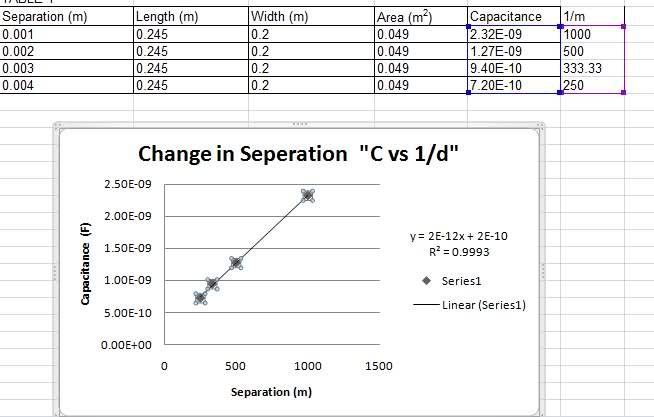
The discussion centers on the relationship between capacitance (C) and the distance (d) between capacitor plates, highlighting that capacitance is inversely proportional to distance, expressed as C ∝ 1/d. The user initially graphed capacitance against 1/d and observed a positive slope, which aligns with the theoretical expectation that as distance increases, capacitance decreases. The confusion arose from the instructor's suggestion of a negative slope, which is incorrect in this context. The correct interpretation is that the graph of C vs. 1/d should indeed show a positive slope, confirming the inverse relationship.

PREREQUISITES
  • Understanding of capacitance and its formula, C = ε(A/d)
  • Familiarity with graphing concepts and independent vs. dependent variables
  • Basic knowledge of dielectric materials and their role in capacitors
  • Experience with Excel for data visualization and graphing
NEXT STEPS
  • Study the derivation of the capacitance formula, C = ε(A/d)
  • Learn about the effects of dielectric materials on capacitance
  • Explore graphing techniques in Excel for scientific data
  • Investigate common misconceptions about capacitance and distance in physics
USEFUL FOR

Students studying physics, particularly those focusing on electromagnetism, educators teaching capacitance concepts, and anyone interested in understanding the mathematical relationships in capacitor behavior.

Heat
Messages
272
Reaction score
0
[SOLVED] Capacitance vs. Distance of separation

Homework Statement


Hi, I am suppose to make a capacitance vs (1/d) graph. I understand that the relationship between the capacitance and distance between the plates is inversely proportional and that it does not produce a straight line.
My instructor mentioned that when graphing the C vs 1/d graph it would have a negative slope, but when plotting the point in excel I get a graph with positive slope.
The Attempt at a Solution


y2nn4.jpg

1/d is on the x-axis and C is on the y axis. Does this graph seem correct, or should I go with the graph that has the negative slope which I can only get by using a C vs d relationship.
 
Physics news on Phys.org
In general the independent variable (the variable which you are controlling) is plotted on the x-axis and the dependent variable (the variable that you are measuring) is plotting on the y-axis. So assuming that you varied that distance and measured the capacitance (as I imagine you did), then your plot is correct.

Since (as you correctly say), C\propto 1/d and all of the constants are positive, your gradient will also be positive. Perhaps your instructor misspoke or you misheard.
 
Last edited:
thank you for your help.
 
1/D is not intuituve

I grant you the formula for determining capacitance, but I would think that increasing distance would increase the ability of the plates to hold charge as it would increase the insulation of the dielectric and thus decrease the possibility of short across the dielectric and thus increasing the voltage across the plates. Why is C inversely proportional to distance and not directly proportional?
 
The book claims the answer is that all the magnitudes are the same because "the gravitational force on the penguin is the same". I'm having trouble understanding this. I thought the buoyant force was equal to the weight of the fluid displaced. Weight depends on mass which depends on density. Therefore, due to the differing densities the buoyant force will be different in each case? Is this incorrect?

Similar threads

  • · Replies 9 ·
Replies
9
Views
485
  • · Replies 16 ·
Replies
16
Views
1K
  • · Replies 2 ·
Replies
2
Views
5K
  • · Replies 9 ·
Replies
9
Views
2K
Replies
2
Views
2K
Replies
4
Views
1K
  • · Replies 1 ·
Replies
1
Views
2K
Replies
5
Views
2K
Replies
44
Views
3K
  • · Replies 10 ·
Replies
10
Views
2K