Capacitance vs. Distance of separation

Click For Summary

Homework Help Overview

The discussion revolves around the relationship between capacitance and the distance of separation between capacitor plates. The original poster is tasked with creating a graph of capacitance versus the inverse of distance (1/d) and is exploring the implications of this relationship.

Discussion Character

  • Conceptual clarification, Problem interpretation

Approaches and Questions Raised

  • The original poster attempts to understand the graphing of capacitance against 1/d, questioning the slope of the graph based on their instructor's comments. Some participants clarify the relationship and confirm the original poster's approach to plotting the variables. Another participant raises a conceptual question about the inverse relationship, suggesting a misunderstanding of the underlying physics.

Discussion Status

The discussion is active, with participants providing clarifications regarding the graphing approach and the nature of the relationship between capacitance and distance. There is no explicit consensus, but guidance has been offered regarding the correct plotting of the variables.

Contextual Notes

Participants are navigating assumptions about the relationship between capacitance and distance, with some confusion regarding the implications of increasing distance on capacitance. The original poster is also working within the constraints of their homework assignment.

Heat
Messages
272
Reaction score
0
[SOLVED] Capacitance vs. Distance of separation

Homework Statement


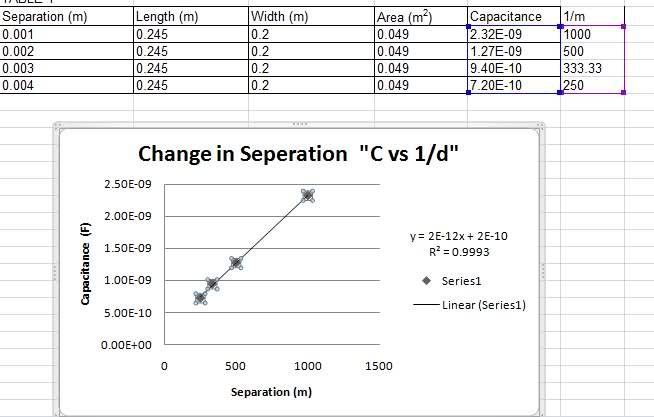
Hi, I am suppose to make a capacitance vs (1/d) graph. I understand that the relationship between the capacitance and distance between the plates is inversely proportional and that it does not produce a straight line.
My instructor mentioned that when graphing the C vs 1/d graph it would have a negative slope, but when plotting the point in excel I get a graph with positive slope.
The Attempt at a Solution


y2nn4.jpg

1/d is on the x-axis and C is on the y axis. Does this graph seem correct, or should I go with the graph that has the negative slope which I can only get by using a C vs d relationship.
 
Physics news on Phys.org
In general the independent variable (the variable which you are controlling) is plotted on the x-axis and the dependent variable (the variable that you are measuring) is plotting on the y-axis. So assuming that you varied that distance and measured the capacitance (as I imagine you did), then your plot is correct.

Since (as you correctly say), [itex]C\propto 1/d[/itex] and all of the constants are positive, your gradient will also be positive. Perhaps your instructor misspoke or you misheard.
 
Last edited:
thank you for your help.
 
1/D is not intuituve

I grant you the formula for determining capacitance, but I would think that increasing distance would increase the ability of the plates to hold charge as it would increase the insulation of the dielectric and thus decrease the possibility of short across the dielectric and thus increasing the voltage across the plates. Why is C inversely proportional to distance and not directly proportional?
 

Similar threads

  • · Replies 9 ·
Replies
9
Views
1K
  • · Replies 16 ·
Replies
16
Views
2K
  • · Replies 2 ·
Replies
2
Views
6K
  • · Replies 9 ·
Replies
9
Views
2K
Replies
2
Views
2K
Replies
4
Views
1K
  • · Replies 1 ·
Replies
1
Views
2K
Replies
5
Views
2K
  • · Replies 10 ·
Replies
10
Views
3K
Replies
44
Views
4K