Automotive Car water pump barrier to flow when off?

Click For Summary
When a car is parked and not running, the centrifugal water pump does not completely seal off the coolant flow between the radiator and engine, allowing for potential mixing and leaks. There are no one-way valves in the automotive cooling system, meaning coolant can flow in either direction when the pump is inactive. If there is a leak in the engine side, the radiator coolant level can decrease, as the pump does not act as a barrier. Symptoms of a cylinder head gasket leak can include discolored spark plugs and coolant contamination in the oil. A pressure test or compression test is recommended to diagnose the issue accurately, as the current mechanic's methods may be inadequate.
  • #31
Note my car has no heater (because in my place the temperature never gets below 15 degree celsius) and my reservoir (or overflow tank) is at the side (not on top).
Or here is a very simple description. The engine is not turned on.. it is left cold parked for one day. When I opened it. The level will be:
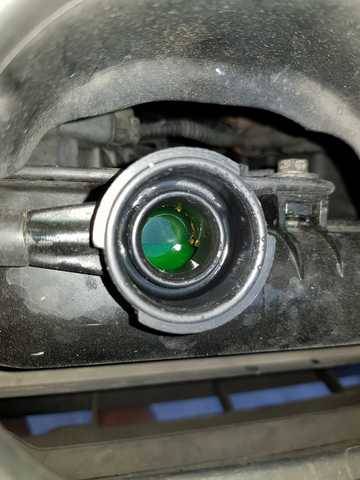
WDJx3H.jpg


Then I manually add about 5cc/5ml of coolant above to make it reach the base of the filler neck:
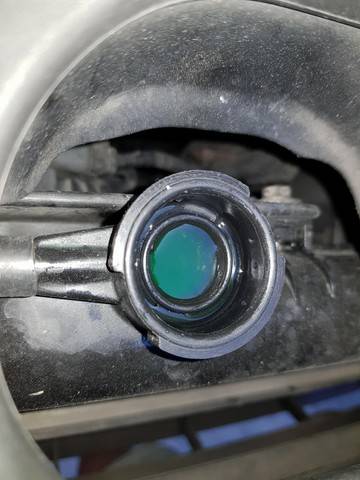
0o4mho.jpg


Then I closed the radiator cap. And still not turning on the engine and the car is still cold. After 2 hours. The level will drop back to the one in the first picture and for a day or two. It will remain that way. It means the coolant is not leaking inside.

The mystery. Where did the coolant go? Let's take this example where the engine is not warmed or get turned but left cold in parking overnight.
 

Attachments

  • WDJx3H.jpg
    WDJx3H.jpg
    21.3 KB · Views: 497
  • 0o4mho.jpg
    0o4mho.jpg
    25 KB · Views: 490
Last edited:
Engineering news on Phys.org
  • #32
This is the second situation that actually happened too. The car and engine was left cold (turn off) overnight. Then in the morning the coolant level is settled below filler neck as the following picture shows:

Zm6okX.jpg


Now after turning on the engine for just 10 seconds. The radiator coolant fills up to the filler neck after I turn off engine and opened radiator cap immediately and remains so in this level. You can't say for that 10 seconds it sucks the coolant from the reservoir.

cwmwpq.jpg


So what happened? This may be rocket science.. but there may be lots of rocket scientists here anyway.. :) Thanks.
 

Attachments

  • Zm6okX.jpg
    Zm6okX.jpg
    36.4 KB · Views: 533
  • cwmwpq.jpg
    cwmwpq.jpg
    36 KB · Views: 537
  • #33
Ketch22 said:
These are legendary for being difficult to bleed the air from.
This is not surprising. it's like (upside down) designing a drainage system with no dips in it but it's a minor design constraint compared with other requirements. Bubbles will congregate in high spots and the system and gradually be swept out. Air will also dissolve in the coolant when it's cold and boil out when it's hot and that will be a gradual leeching mechanism but it may take many cycles of 'breathing' before all traces are gone. I well remember the old system in which there was no reservoir at all and you had to check fairly often if you wanted to be sure that the level was high enough. The 'new' automatic top-up system was a great invention.
PS Aren't modern hoses wonderful?
 
  • Like
Likes bluecap
  • #34
Maybe the most logical explanation is there is air still inside the coolant system even in new cars? Where does the air usually hide in the CRV 2004 model? And what is the best way to bleed the air out of the coolant system?
 
  • #35
we rebuild our race car engines s many times over the years. In all automobile cooling systems there are many many air pockets present when you do the initial coolant fill. You have to ' burp ' the radiator hose with the engine running and the radiator cap removed. You will see air bubbles at the open radiator cap opening and you squeeze the rubber radiator hose many times until the system flows with zero air bubbles. This assumes you have no leaks from the head gasket. It also held to park the car so the front of the car is uphill. Gravity will help move the air bubbles to the top of the engine. You may have to add as much as a liter (quart ) of coolant.
 
  • Like
Likes bluecap

Similar threads

  • · Replies 8 ·
Replies
8
Views
6K
  • · Replies 3 ·
Replies
3
Views
3K
  • · Replies 19 ·
Replies
19
Views
4K
  • · Replies 7 ·
Replies
7
Views
12K
  • · Replies 3 ·
Replies
3
Views
2K
  • · Replies 11 ·
Replies
11
Views
11K
  • · Replies 8 ·
Replies
8
Views
2K
  • · Replies 3 ·
Replies
3
Views
4K
  • · Replies 1 ·
Replies
1
Views
3K
Replies
3
Views
17K