Pressure Switch to Diaphragm Flow Switch

Click For Summary

Discussion Overview

The discussion revolves around the operation and design of diaphragm flow switches compared to traditional pressure switches, particularly in the context of water flow and pressure dynamics in a water heater system. Participants explore the principles of fluid mechanics, including Bernoulli's principle, and seek to understand why diaphragm flow switches respond to flow rather than static pressure.

Discussion Character

  • Exploratory
  • Technical explanation
  • Conceptual clarification
  • Debate/contested

Main Points Raised

  • Some participants describe how traditional pressure switches operate under maximum pressure when there is no flow, while diaphragm flow switches behave oppositely, only activating with flow.
  • One participant questions the design of diaphragm flow switches, asking what allows them to respond only to flow and not to static pressure, despite being connected to the same water source.
  • Another participant suggests that the diaphragm's sensitivity to flow velocity rather than static pressure could be explained by fluid mechanics and Bernoulli's principle, noting that high velocity can exert force on the diaphragm even when pressure is low.
  • Concerns are raised about the lack of familiarity among engineers with diaphragm flow switches, and one participant shares a link to a product that uses a similar principle, indicating that such designs may not be widely adopted.
  • Participants express curiosity about the theoretical aspects of diaphragm flow switches and seek clarification on the principles involved, including the relationship between pressure and flow velocity.

Areas of Agreement / Disagreement

Participants express varying degrees of understanding and hypotheses regarding the operation of diaphragm flow switches, with no consensus reached on the exact principles that govern their functionality. The discussion remains exploratory and unresolved in terms of definitive explanations.

Contextual Notes

Participants reference fluid mechanics concepts, including Bernoulli's principle, but acknowledge that their understanding may be incomplete or based on assumptions that are not fully explored. The discussion includes practical experiences with specific devices, which may influence their interpretations.

Who May Find This Useful

This discussion may be of interest to engineers, students, and hobbyists involved in fluid dynamics, water heating systems, and those curious about the mechanics of flow switches.

Secan
Messages
141
Reaction score
11
I recently came across a Diaphragm flow switch whose operation many engineers are not familiar with.

First. Supposedly in a normal pressure switch. The pressure will be a maximum when there's no flow, precisely because at zero flow there is no pressure drop anywhere in the system, so the pressure here will be full mains pressure. When the shower-head is on and there's flow, the pressure here will drop.

But in the diaphragm flow switch. It's the opposite. What is in the design in the diaphragm flow switch such that when there is no flow (pressure maximum), pressure won't push the pin. The pin will only extend when there is flow. Let's get back to basic first.

This is the schematic of a pressure switch.
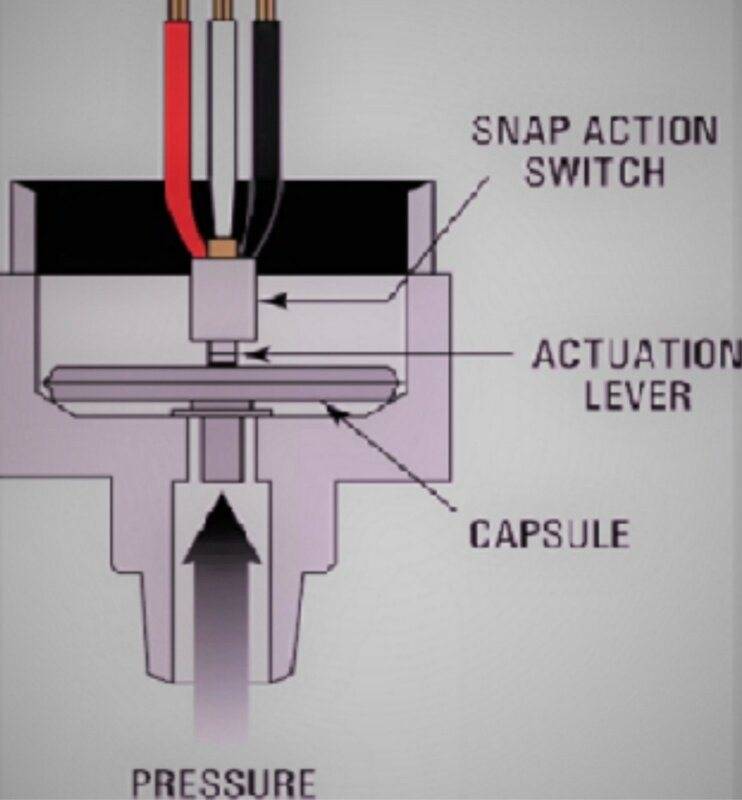
pressure switch 0.jpg


What would happen if the inlet tube is made narrow? Would the pressure still the same given the source has the same pressure? Or would the pressure in the inlet be lesser?
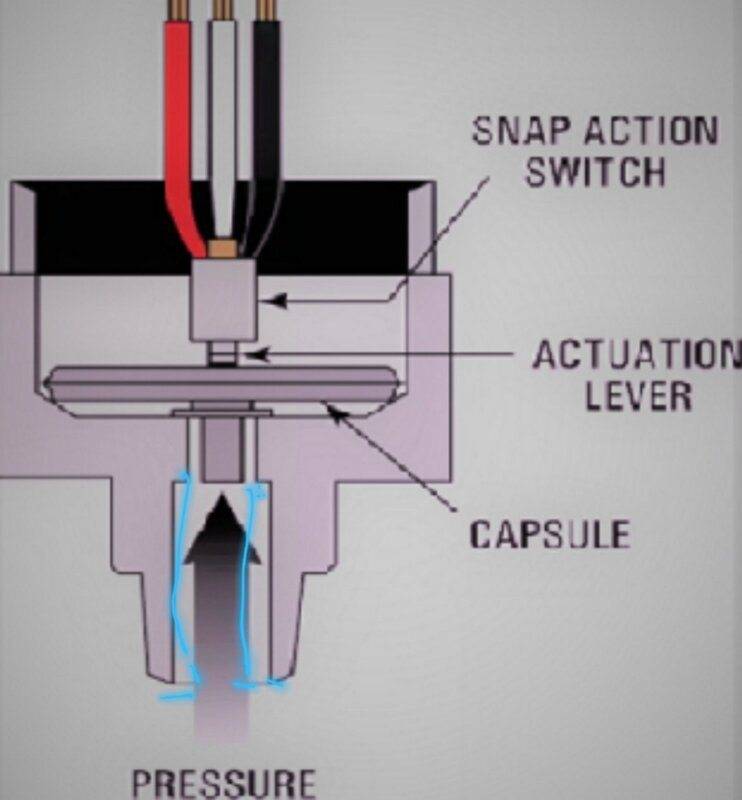
pressure switch 1.jpg


Now supposed you create another hole at the right side of it or an outlet causing a water flow.
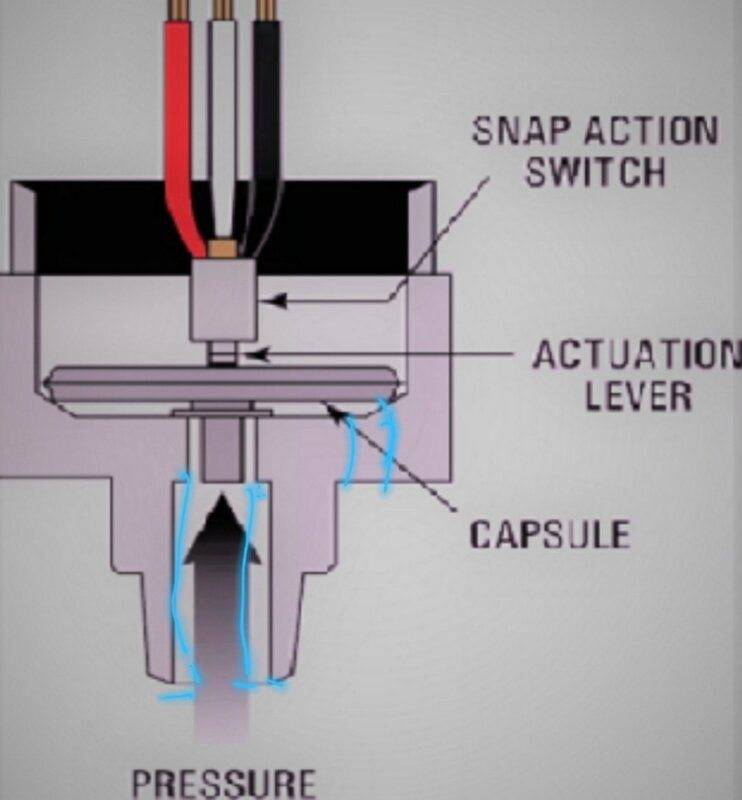
pressure switch 2.jpg


What will happen? The piston will move if there is water flow. But if the 2nd hole or outlet is blocked. Will the piston still move from the perhaps poorer pressure?

In an actual device I encountered. The diaphragm no longer move if there is no water flow. Even if the pressure of the source is the same. Somehow it converts pressure right at that junction into velocity via the Bernoulli principle? i haven't seen this explained elsewhere and just want to confirm.

I want to understand the theoretical side of it.

To illustrate the above. In the following youtube video you can see the pin of the flow switch diaphragm extended when the faucet is flowing (the valve is after the flow or pressure switch) and pin returns when faucet is closed (but pressure maximum since there is supposedly no pressure drop).


Attachments

  • pressure switch 1.jpg
    pressure switch 1.jpg
    37.1 KB · Views: 280
Last edited:
Engineering news on Phys.org
Ok, i'll start from the beginning. I have this water heater where it needs stronger water flow to turn on. Other brand of heater requires only a few volume of water. I have already replaced it with a new one. And open it up to learn some new physics principle. Don't worry, i won't use the product again as it's already tempered so will just keep it as collection.

water heater schematic.jpg


Whenever there is water flow, the white thing has this pin that pushes on the switch which turns on the heater. The control valve or faucet is in the outlet on the left. But here is the thing. When valve or faucet turns off in the outlet the full water main is still connected to the white thing. So it is at maximum pressure the rest of time. Yet it doesn't trigger the diaphragm, only with water flow. The mystery is why.

Since I'll no longer use the water heater and bought a new one. I took it apart. Here is inside the white thing.

inside flow switch 1.jpg


more details

inside flow switch 2.jpg


Pink label shows the water flow path inside.
water flow inside.jpg
Here is video showing strong water flow inside.

Here is separate video illustration showing that when there is flow, pin extends. When no flow yet main water on and pressure maximum, diaphragm doesn't extend or pin doesn't move.

You are familiar with a normal pressure switch that looks like, isn't it (see first message).Supposedly in a normal pressure switch. The pressure will be a maximum when there's no flow, precisely because at zero flow there is no pressure drop anywhere in the system, so the pressure here will be full mains pressure, and the piston or diaphragm or pin will extend. When the shower-head is on and there's flow, the pressure here will drop.

But in this flow switch diaphragm. It's the opposite. What is in the design in the diaphragm such that when there is no flow (pressure maximum), pressure won't push the pin. The pin will only extend when there is flow.

Some kind of Bernoulli principle, etc.

Here is the theory. Pls correct if wrong or right.

Diaphragm can be designed either sensitive to velocity of the water flow or static pressure. But here is what is confusing. Bernoulli principle can convert pressure to velocity based of laws of conservation of energy. But the source or main pressure is the same. So does it make sense for some diaphragm to respond to flow velocity only and not pressure? What another principle i missed that can make the actual device only move the diaphragm with water flow and not with pressure? (both from same source and same original source pressure)
 
Last edited:
Well i think the key to understanding it is via fluid mechanics esp. Hydraulics and Bernoulli principle. Imagine a very big diaphragm in the left. Since only small area touch it. Force is small. And if there is a flow. Velocity is large while pressure is small. So i guess velocity from flow can push the diaphragm that the pressure can't.

20200922_145813.jpg


Anyway my diaphragm flow switch is ruined because when i tried to screw it. The plastic threads got destroyed. Should have used my torque screwdriver.

Besides it. Checking the whole world wide web. There is one another product using the same principle.

20200922_151852.jpg


https://www.dhsspares.co.uk/product/potterton-10-18676-diaphragm-flow-switch.-1120050

"Product Information: This part is located around the flow switch section. The flow switch acts as a safety mechanism. It is a switch with an in-built sensor that sits in the pipework for both the domestic hot water and heating systems. When the pump is powered up, the flow switches senses this movement and feeds the information back to the electronic control, allowing the ignition sequence to progress. The flow switches purpose is to make sure that the burner cannot switch on if the system is dry or low on water."

I don't know why no other products use this and many engineers not familar with it. If you have idea. Let me know.
 
Just to share. This is my new tankless water heater and note the very small flow switch shown in green arrow at bottom. This is the normal elsewhere compared to the big white one in my broken unit. I guess its vintage so kept it for collection.

20200924_125624.jpg
 

Similar threads

  • · Replies 19 ·
Replies
19
Views
1K
Replies
0
Views
2K
  • · Replies 45 ·
2
Replies
45
Views
7K
  • · Replies 7 ·
Replies
7
Views
2K
  • · Replies 11 ·
Replies
11
Views
4K
  • · Replies 31 ·
2
Replies
31
Views
5K
  • · Replies 3 ·
Replies
3
Views
2K
  • · Replies 5 ·
Replies
5
Views
2K
Replies
5
Views
4K
Replies
13
Views
4K