Casey's thread of annoying Linear Algebra questions

Click For Summary
SUMMARY

This discussion centers on self-learning linear algebra using Sharipov's "Linear Algebra and Multidimensional Geometry." The participant expresses frustration with the material and seeks clarification on concepts such as the total preimage in mathematical functions. Key insights include that the total preimage of a point y is the set of all solutions x for the equation y = f(x), and that prior knowledge of functions and basic set theory is sufficient for understanding linear algebra, without the need for calculus.

PREREQUISITES
  • Understanding of functions and their properties
  • Basic knowledge of set theory
  • Ability to perform operations with real numbers
  • Familiarity with the concept of vector spaces
NEXT STEPS
  • Explore the concept of total preimages in mathematical functions
  • Study the definition and properties of vector spaces
  • Learn about continuous functions and their characteristics
  • Investigate alternative linear algebra resources, such as Sergei Treil's materials
USEFUL FOR

Students and self-learners of mathematics, particularly those interested in linear algebra and its foundational concepts.

Saladsamurai
Messages
3,009
Reaction score
7
So, I am attempting to learn linear algebra on my own and I am using Sharipov's "Linear Algebra and Multidimensional Geometry" since mathwonk is always ranting and ravong about it.

So far, I hate it. Clearly I am not a mathematician at heart.

I thought I could periodically post questions in this thread (instead of starting a new one every time). My questions might seem dumb to some of you, but take it easy on me:shy:.

So since the edit button only works for 30 minutes now (lame), when I ask a new question, I will head it like this: NEW QUESTION: that way it will be easy to spot my latest entry.

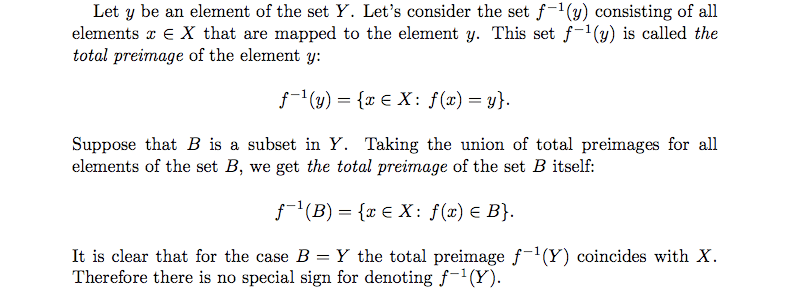
Hopefully this works out, but more like is that people will just get annoyed with me. So here we go:smile:NEW QUESTION What is this all about?
Picture1-13.png


I mean if the set f^{-1}(y) is just X, why do we need a name for this? Can someone tell me what the total preimage is in laymen's terms?

Thanks!:redface:
 
Physics news on Phys.org
http://img253.imageshack.us/img253/2554/preimagery4.png
 
Last edited by a moderator:
learning math is not meant to be suffering. use whatever book you enjoy. try the book by sergei treil on his webpage at the brown math dept, if sharipov is too dry for you.

enjoy!and the total preimage (under f) of a point y is the set of all solutions x of y = f(x).

so finding a total preimage is finding all solutions of a problem.
 
One place where the idea of a preimage is useful is in the definition of a continuous function: A function f:X\rightarrow Y is said to be continuous if f^{-1}(U) is an open set for every open U\subset Y.

If X=Y=\mathbb R (or more generally, when X and Y are metric spaces), then the definition above is equivalent to the one you're familiar with.

Also, the preimage of y is not X. For example, if f:\mathbb R\rightarrow\mathbb R is defined by f(x)=x^2, then f^{-1}(1)=\{-1,1\}.
 
mathwonk said:
learning math is not meant to be suffering. use whatever book you enjoy. try the book by sergei treil on his webpage at the brown math dept, if sharipov is too dry for you.

enjoy!


and the total preimage (under f) of a point y is the set of all solutions x of y = f(x).

so finding a total preimage is finding all solutions of a problem.

Thanks! I'll check that one out and see how it is.
:smile:
 
hello all I also have an annoying question, I also d like to attempt to learn some linear algebra on my own, I was wondering what do I need to previously know in order to start learning it? Do I need any calculus or it would be ok with just to know high school algebra?
 
You don't need calculus. You need to understand what functions are and have some idea what sets are to understand the definition of a vector space, and you need know how to add and multiply real numbers (e.g. rules like (a+b)(c+d)=ac+ad+bc+bd). But that's it.
 
Fredrik said:
You don't need calculus. You need to understand what functions are and have some idea what sets are to understand the definition of a vector space, and you need know how to add and multiply real numbers (e.g. rules like (a+b)(c+d)=ac+ad+bc+bd). But that's it.

thanks a lot :wink:
 

Similar threads

  • · Replies 3 ·
Replies
3
Views
3K
  • · Replies 12 ·
Replies
12
Views
2K
  • · Replies 2 ·
Replies
2
Views
2K
  • · Replies 3 ·
Replies
3
Views
912
  • · Replies 1 ·
Replies
1
Views
2K
  • · Replies 4 ·
Replies
4
Views
2K
  • · Replies 1 ·
Replies
1
Views
3K
  • · Replies 5 ·
Replies
5
Views
2K
  • · Replies 12 ·
Replies
12
Views
3K
  • · Replies 2 ·
Replies
2
Views
2K