Cauchy Riemann conditions/equation

  • Context: Graduate 
  • Thread starter Thread starter MartinV05
  • Start date Start date
  • Tags Tags
    Cauchy Riemann
Click For Summary
SUMMARY

The discussion centers on the Cauchy-Riemann conditions, which establish the equality of differentials of a complex function f(z) with respect to its real part x and imaginary part iy. Participants clarify that x and y are not independent variables but rather components of the single complex variable z. The proof relies on the limit definition of the derivative, demonstrating that as h approaches 0, the limits must converge regardless of the path taken in the complex plane. This highlights the unique two-dimensional nature of complex differentiation compared to one-dimensional real differentiation.

PREREQUISITES
  • Understanding of complex variables and functions
  • Familiarity with the concept of limits in calculus
  • Knowledge of differentiation in both real and complex contexts
  • Basic grasp of the Cauchy-Riemann equations
NEXT STEPS
  • Study the Cauchy-Riemann equations in detail
  • Explore the implications of complex differentiability
  • Learn about the geometric interpretation of complex functions
  • Investigate the relationship between complex analysis and real analysis
USEFUL FOR

Mathematicians, students of complex analysis, and anyone interested in understanding the foundations of complex differentiation and the Cauchy-Riemann conditions.

MartinV05
Messages
23
Reaction score
0
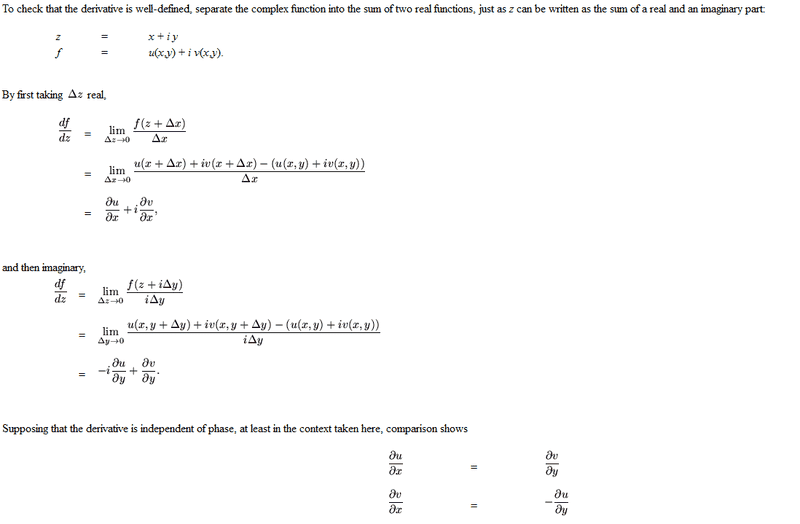
In the proof of the the Cauchy-Riemann's conditions we have and equality between differentials of the same function (f(z)) by x(real part) and by iy(imaginary part?).
Why do we "say" that both differentials should be equal when it's normally possible to have different differentials according to the variable used?

Picture related (the equality in the last part):
a1sffr.jpg
 
Physics news on Phys.org
There is only one variable here- z. And the derivative is with respect to that variable. "x" and "y" are not independent variables, they are the real and imaginary parts of the single variable z.

Here they are just taking the limit in "\lim_{h\to 0}(f(z+h)- f(z))/h" as h approaches 0 in different ways. If the limit itself exists, then the limit as h approaches 0 in any way must be the same. You can do the same in differentiation of functions of a real variable- the limits as h goes to 0 "from above" and "from below" must be the same. It is the fact that the complex plane is two dimensional while the real line is only one dimensional the gives more restrictions on the complex derivative.
 
So no matter how z changes (whether real or imaginary) the limit should be the same, because they both actually complete the other "higher" variable. I know the that approaching from 0- and 0+ should be the same with limits in real variables, but never would have thought of this in that way. Think you!
 

Similar threads

  • · Replies 8 ·
Replies
8
Views
877
  • · Replies 3 ·
Replies
3
Views
3K
  • · Replies 23 ·
Replies
23
Views
3K
  • · Replies 9 ·
Replies
9
Views
2K
  • · Replies 1 ·
Replies
1
Views
3K
  • · Replies 3 ·
Replies
3
Views
4K
  • · Replies 19 ·
Replies
19
Views
2K
  • · Replies 4 ·
Replies
4
Views
2K
  • · Replies 27 ·
Replies
27
Views
2K
  • · Replies 6 ·
Replies
6
Views
3K