Centre of mass of a hollow pyramid

Click For Summary
SUMMARY

The center of mass (CoM) of a uniform square-based pyramid with height H and base length B is calculated using the equation $$CoM = \frac{H}{4}$$. For a hollow pyramid with height h and base length b, the CoM can be derived by treating the hollow section as a pyramid of negative density. The final expression for the CoM of the hollow pyramid is $$CoM = \frac{B^2 H^2 - b^2 h^2}{4(B^2 H - b^2 h)}$$, confirming that the masses of the respective components significantly influence the CoM calculation.

PREREQUISITES
  • Understanding of center of mass calculations in three-dimensional geometry
  • Familiarity with integral calculus and volume integrals
  • Knowledge of density concepts in physics
  • Ability to manipulate algebraic expressions involving geometric dimensions
NEXT STEPS
  • Study the derivation of the center of mass for different geometric shapes, focusing on pyramids
  • Learn about the implications of negative density in physics and its applications
  • Explore integral calculus techniques for calculating volumes and centers of mass
  • Investigate the effects of varying densities on the center of mass in composite shapes
USEFUL FOR

Students and professionals in physics, engineering, and mathematics who are involved in geometric analysis and center of mass calculations, particularly in the context of complex shapes like hollow pyramids.

subzero0137
Messages
91
Reaction score
4
Question: Calculate the centre of mass of a uniform, square-based pyramid of height H and base length B (taking the centre of the base as the origin). Hence, or otherwise, derive an expression for the centre of mass of such a pyramid with a pyramid-shaped hollow cavity (of height h and base length b) inside, as shown:
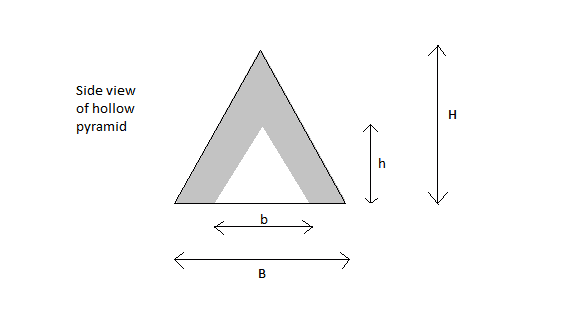
0yqhvCy.png


Key equation: $$CoM = \frac {\int z \, dm} {\int\, dm} = \frac {\int zρ \, dV} {\int\, dV}$$Attempt: By symmetry, the CoM must lie on the line connecting the apex and the centre of the base, let's call this the z axis. By considering horizontal slices parallel to the base, of thickness dz and area xy, ##dV = xydz = \frac {B^2} {H^2} (H - z)^2 dz,## therefore

$$CoM = \frac {\int_0^H zρ \frac{B^2}{H^2} (H - z)^2 \, dz} {\int_0^H ρ \frac{B^2}{H^2} (H - z)^2 \, dz} = \frac {H} {4}$$

However I don't know how to get an expression for the hollow/cavity pyramid. I was told to treat the hollow as being a pyramid of negative mass but I'm unsure as to how to go from there.
 

Attachments

  • 0yqhvCy.png
    0yqhvCy.png
    2 KB · Views: 1,231
Physics news on Phys.org
Center of masses add linearly (e.g. as vectors). You can treat the hollow pyramid as made out of two parts, a full pyramid and a smaller full pyramid with negative density, calculate the center of mass for both separately, then combine them to one object that looks like the pyramid you want.
 
mfb said:
Center of masses add linearly (e.g. as vectors). You can treat the hollow pyramid as made out of two parts, a full pyramid and a smaller full pyramid with negative density, calculate the center of mass for both separately, then combine them to one object that looks like the pyramid you want.

So the centre of mass for the smaller pyramid would be ##\frac {h} {4}##, but I get this result regardless of the sign in front of density so I'm still confused. How would I combine them into one object, by simply adding them? So ##CoM = \frac {H} {4} + \frac {h} {4}##?
 
subzero0137 said:
So the centre of mass for the smaller pyramid would be ##\frac {h} {4}##, but I get this result regardless of the sign in front of density so I'm still confused. How would I combine them into one object, by simply adding them? So ##CoM = \frac {H} {4} + \frac {h} {4}##?

Physically, you are subtracting the smaller pyramid from the larger pyramid. Not adding it.

Another way to look at it is that if S is the hollow pyramid, P the big pyramid and p the small pyramid, then

##P = S + p##

This avoids the concept of negative densities.
 
PeroK said:
Physically, you are subtracting the smaller pyramid from the larger pyramid. Not adding it.

Another way to look at it is that if S is the hollow pyramid, P the big pyramid and p the small pyramid, then

##P = S + p##

This avoids the concept of negative densities.

So it would be ##CoM = \frac {H} {4} - \frac {h} {4}##? But this seems counter intuitive because it's shifting the CoM closer to the base whereas most of the mass is near the top of the hollow pyramid?
 
subzero0137 said:
So it would be ##CoM = \frac {H} {4} - \frac {h} {4}##? But this seems counter intuitive because it's shifting the CoM closer to the base whereas most of the mass is near the top of the hollow pyramid?

Are the masses of the respective components important?
 
PeroK said:
Are the masses of the respective components important?

I'm assuming yes, or it is the volume that is important? I'm struggling to understand why it would shift down and not up if it is hollow from the bottom?
 
subzero0137 said:
I'm assuming yes, or it is the volume that is important? I'm struggling to understand why it would shift down and not up if it is hollow from the bottom?

The vector quantity is actually the product of a mass by its centre of mass. E.g. if you have two masses, mass ##M## at the origin and mass ##m## a distance ##x## from the origin, then the centre of mass of the system is ##\frac{mx}{M +m}##.

By your method it would always be ##x##, regardless of the masses.
 
Ps The general case for a system of masses is:

##\vec{r} = \frac{\sum m_i \vec{r_i}}{\sum m_i}##

Which, of course, for a continuous mass distribution leads to the integral form you quoted in your original post.

And, if we let ##m = \sum m_i## then we have:

##m\vec{r} = \sum m_i \vec{r_i}##

Which is the vector sum of moments (mass times centre of mass).
 
  • #10
PeroK said:
The vector quantity is actually the product of a mass by its centre of mass. E.g. if you have two masses, mass ##M## at the origin and mass ##m## a distance ##x## from the origin, then the centre of mass of the system is ##\frac{mx}{M +m}##.

By your method it would always be ##x##, regardless of the masses.

Okay, I think the equation makes sense as you put it. Just to confirm, it is H/4 - h/4 in this case, right? I think I'm just having a hard time understanding it intuitively because from the diagram it looks like the pyramid is heavier at the top in hollow case.
 
  • #11
subzero0137 said:
Okay, I think the equation makes sense as you put it. Just to confirm, it is H/4 - h/4 in this case, right? I think I'm just having a hard time understanding it intuitively because from the diagram it looks like the pyramid is heavier at the top in hollow case.

No..The equation must involve the mass of each component. You can't simply add centre of mass vectors. See my posts above.
 
  • #12
subzero0137 said:
Key equation: $$CoM = \frac {\int z \, dm} {\int\, dm} = \frac {\int z\rho \, dV} {\int \rho\, dV}$$

Let's start from here to explain what the others are saying and how it affects your situation (I have added a missing ##\rho## in your denominator).

In general, the structure of both your numerator and denominator are the same so let us work with a more general integral of the form
$$
I[f] = \int \rho(\vec x) f(\vec x) dV,
$$
where ##f(\vec x) = 1## in the denominator and ##f(\vec x) = \vec x## in the numerator (##z## in the case you are just interested in the vertical position of the CoM). Your CoM expression is now
$$
\vec x_{\rm CoM} = \frac{I[\vec x]}{I[1]}.
$$
Let us now name some volumes, call the space occupied by the hollow pyramid ##\Omega_1##, the space of the hole ##\Omega_2## and the combined pyramid (i.e., without the hole) ##\Omega = \Omega_1 + \Omega_2##. Since you only have non-zero density in ##\Omega_1##, it holds that
$$
I[f] = \int_{\Omega_1} \rho f \, dV.
$$
However, it is easier for you to compute the integral over the full ##\Omega## and the integral over ##\Omega_2## is just the same as a rescaling of the ##\Omega## integral as they are both full pyramids. You therefore note that
$$
\rho \int_{\Omega} f\, dV = \int_{\Omega_1} \rho f\, dV + \int_{\Omega_2} \rho f\, dV = I[f] + \rho \int_{\Omega_2} f\, dV.
$$
Solving for ##I[f]##, we find that
$$
I[f] = \int_{\Omega} \rho f\, dV - \int_{\Omega_2} \rho f\, dV.
$$
Note here how the first term is the term you wold have for the denominator/numerator if you were computing the CoM for the full pyramid and the second the term you would have for the denominator/numerator if you were computing the CoM for the hollow part. Also note that you have to do the subtraction separately for the numerator and for the denominator.

Since your density is constant, you can also take ##\rho## out of your integrals and cancel them, then you will use the volumes rather than the masses, but you must use them separately in the numerator/denominator.
 
  • #13
Orodruin said:
Let's start from here to explain what the others are saying and how it affects your situation (I have added a missing ##\rho## in your denominator).

In general, the structure of both your numerator and denominator are the same so let us work with a more general integral of the form
$$
I[f] = \int \rho(\vec x) f(\vec x) dV,
$$
where ##f(\vec x) = 1## in the denominator and ##f(\vec x) = \vec x## in the numerator (##z## in the case you are just interested in the vertical position of the CoM). Your CoM expression is now
$$
\vec x_{\rm CoM} = \frac{I[\vec x]}{I[1]}.
$$
Let us now name some volumes, call the space occupied by the hollow pyramid ##\Omega_1##, the space of the hole ##\Omega_2## and the combined pyramid (i.e., without the hole) ##\Omega = \Omega_1 + \Omega_2##. Since you only have non-zero density in ##\Omega_1##, it holds that
$$
I[f] = \int_{\Omega_1} \rho f \, dV.
$$
However, it is easier for you to compute the integral over the full ##\Omega## and the integral over ##\Omega_2## is just the same as a rescaling of the ##\Omega## integral as they are both full pyramids. You therefore note that
$$
\rho \int_{\Omega} f\, dV = \int_{\Omega_1} \rho f\, dV + \int_{\Omega_2} \rho f\, dV = I[f] + \rho \int_{\Omega_2} f\, dV.
$$
Solving for ##I[f]##, we find that
$$
I[f] = \int_{\Omega} \rho f\, dV - \int_{\Omega_2} \rho f\, dV.
$$
Note here how the first term is the term you wold have for the denominator/numerator if you were computing the CoM for the full pyramid and the second the term you would have for the denominator/numerator if you were computing the CoM for the hollow part. Also note that you have to do the subtraction separately for the numerator and for the denominator.

Since your density is constant, you can also take ##\rho## out of your integrals and cancel them, then you will use the volumes rather than the masses, but you must use them separately in the numerator/denominator.

Thanks, I managed to obtain the follow expression for the CoM of the pyramid with the cavity:
$$CoM = \frac {B^2 H^2 - b^2 h^2} {4(B^2 H - b^2 h)}$$

Is this correct?
 

Similar threads

  • · Replies 20 ·
Replies
20
Views
3K
  • · Replies 18 ·
Replies
18
Views
2K
  • · Replies 4 ·
Replies
4
Views
7K
Replies
1
Views
2K
Replies
7
Views
2K
Replies
17
Views
2K
  • · Replies 6 ·
Replies
6
Views
5K
  • · Replies 7 ·
Replies
7
Views
3K
  • · Replies 5 ·
Replies
5
Views
7K
  • · Replies 7 ·
Replies
7
Views
6K