Changing the interval of integration

Click For Summary
SUMMARY

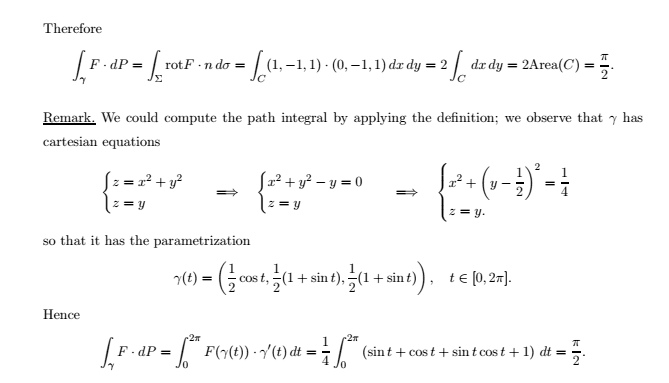
The discussion focuses on the integration intervals used in two methods: Green's theorem and path integration. The first method integrates over the interval [0, π] using Green's theorem, while the path integration method integrates over [0, 2π]. Participants clarify that the value of an integral remains consistent regardless of the parametrization chosen, emphasizing that the surface calculation in Stokes' theorem is performed over [0, π]. This highlights the importance of understanding the relationship between different integration techniques in vector calculus.

PREREQUISITES
  • Understanding of Green's theorem
  • Familiarity with Stokes' theorem
  • Knowledge of path integration techniques
  • Basic concepts of parametrization in calculus
NEXT STEPS
  • Study the applications of Green's theorem in vector calculus
  • Explore Stokes' theorem and its implications in higher dimensions
  • Learn about parametrization techniques in path integrals
  • Investigate the relationship between different integration methods in calculus
USEFUL FOR

Students and professionals in mathematics, particularly those studying vector calculus, as well as educators seeking to clarify integration techniques and their applications.

Amaelle
Messages
309
Reaction score
54
Homework Statement
look at the image
Relevant Equations
Green theorem
Greetings Dear community!
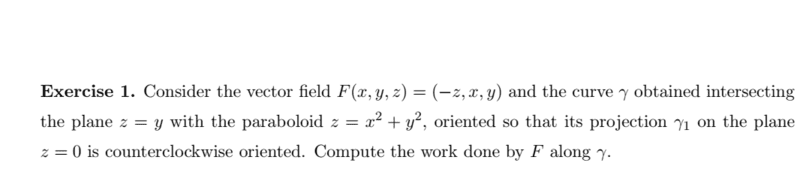
1639929093312.png


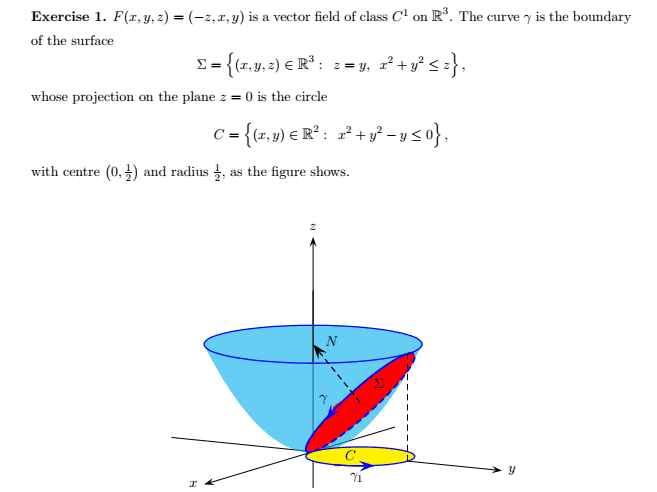
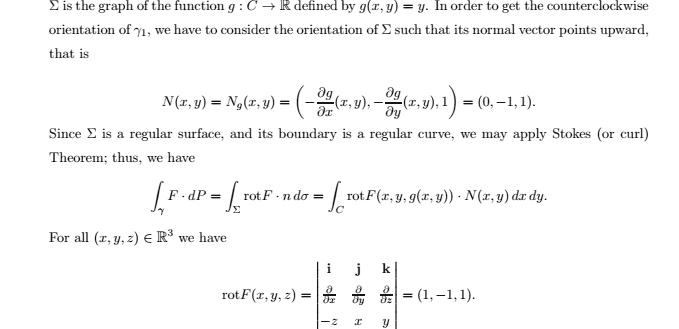
Here is the solutions using two different methods: the first method is the Green theorem and the second is the simple path integration method:


My question is why they integrate over [0.2pi] in the path integration method while they integrate within [0. pi] in the green method (I do agree with it)?
1639929213117.png

1639929237337.png

1639929264541.png

thank you!
 

Attachments

  • 1639929171596.png
    1639929171596.png
    18.9 KB · Views: 148
Physics news on Phys.org
They don’t seem to be using any parametrization at all when applying Stokes’ theorem.

The value of an integral does not depend on the parametrization. You could have picked a parameter taking values in ##[-200.5,\pi]## and you would get the same result (although a bit more annoying expressions for the differentials).
 
for the stock theroem they calculate the surface by integrating from [0 ,pi], this is why i don't understand why they didn't do the same for the path integral
 

Similar threads

Replies
2
Views
2K
Replies
3
Views
2K
  • · Replies 7 ·
Replies
7
Views
2K
  • · Replies 9 ·
Replies
9
Views
1K
Replies
7
Views
2K
  • · Replies 6 ·
Replies
6
Views
1K
  • · Replies 2 ·
Replies
2
Views
1K
  • · Replies 16 ·
Replies
16
Views
3K
  • · Replies 3 ·
Replies
3
Views
2K
  • · Replies 3 ·
Replies
3
Views
2K