Charges betweenand outside parallel sheets

Click For Summary

Homework Help Overview

The discussion revolves around the electric field generated by two parallel sheets of charged plastic, one with a negative surface charge density and the other with a positive surface charge density. Participants are exploring how to calculate the electric field vector at various points between and outside the sheets, using concepts from electrostatics.

Discussion Character

  • Exploratory, Conceptual clarification, Mathematical reasoning, Assumption checking

Approaches and Questions Raised

  • Participants discuss the application of Gauss's Law and the derivation of electric field equations for uniformly charged planes. There are questions about how these principles apply to the specific setup of the two charged sheets. Some participants suggest using superposition to find the resultant electric field.

Discussion Status

There is an ongoing exploration of the concepts involved, with some participants suggesting alternative approaches and questioning the applicability of capacitor equations due to the unequal charge densities. Guidance has been offered regarding the use of individual plate equations and the superposition principle, but no consensus has been reached.

Contextual Notes

One participant notes that Gauss's Law has not been covered in their class yet, indicating a potential gap in foundational knowledge that may affect the discussion. There is also a mention of homework constraints regarding the use of specific equations.

Linus Pauling
Messages
187
Reaction score
0
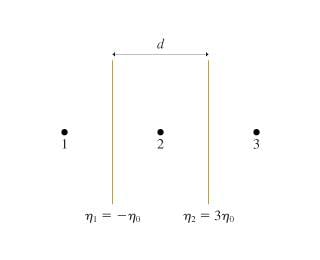
1. You've hung two very large sheets of plastic facing each other with distance d between them, as shown in the figure . By rubbing them with wool and silk, you've managed to give one sheet a uniform surface charge density n_1 = -n_o and the other a uniform surface charge density n_2 = 3n_o .
27.P48.jpg


What is the field vector at each point? Give answer as a multiplier of n_o/epsilon_o.


2. E_cap = n/epsilon_o


3. So, for an ideal capacitor, E in between the two sheets is simply n/epsilon_o, and is zero outside because E_+ and E_- or of equal magnitude but opposite sign. So in this case, is the multiplier 4 for point 2, -2 for point 1, and 2 for point 3?
 
Physics news on Phys.org
Draw appropriate Gaussian surfaces and use Gauss's Law to see what is happening.
 
The electric field given by a uniformly charged infinit plane is given by
[tex]\[<br /> E = \frac{\sigma }{{2\varepsilon _0 }}<br /> \][/tex]
This can be derived from Gauss' law
 
netheril96 said:
The electric field given by a uniformly charged infinit plane is given by
[tex]\[<br /> E = \frac{\sigma }{{2\varepsilon _0 }}<br /> \][/tex]
This can be derived from Gauss' law

And how does it apply to the current situation?
 
Actually, we haven't covered Gauss' Law in class yet. Should I just read ahead to make my life easier?
 
I suggest against using any capacitor specific equations for this problem. The reason is those equations were derived assuming that there is an equal and opposite charge on each plate. 'Doesn't really apply here. Here, you should use the similar equation for a single plate (which is where the equation for the capacitor was derived from, btw.) which is

[tex]E= \frac{\sigma} {2 \epsilon _0}[/tex],

where [tex]\sigma[/tex] is the surface charge density.

I suggest working with each plate individually and using superposition to find the end result. This can be done separately for each point.
 
kuruman said:
And how does it apply to the current situation?

Just use superpositon principle
I think you should read Gauss' law in advance to make your life easier
 

Similar threads

  • · Replies 26 ·
Replies
26
Views
3K
  • · Replies 4 ·
Replies
4
Views
6K
  • · Replies 10 ·
Replies
10
Views
5K
Replies
11
Views
4K
Replies
9
Views
2K
Replies
9
Views
4K
  • · Replies 6 ·
Replies
6
Views
2K
  • · Replies 4 ·
Replies
4
Views
3K
  • · Replies 4 ·
Replies
4
Views
2K
  • · Replies 7 ·
Replies
7
Views
2K