Charges on inner and outer shell

  • Context: Graduate 
  • Thread starter Thread starter gracy
  • Start date Start date
  • Tags Tags
    Charges Shell
Click For Summary

Discussion Overview

The discussion centers around the behavior of charges on concentric conducting shells, particularly focusing on when charges develop on an inner shell due to the presence of charges on an outer shell. Participants explore concepts related to electric fields, potential differences, and charge redistribution in both conductive and non-conductive shells.

Discussion Character

  • Exploratory
  • Technical explanation
  • Conceptual clarification
  • Debate/contested

Main Points Raised

  • Some participants question why no charge develops on the inner shell when the outer shell is charged, suggesting that the inner shell is isolated and cannot gain charge.
  • Others argue that the electric field inside the conducting shell is zero, which means no force is exerted on the electrons of the inner shell, preventing charge redistribution.
  • It is noted that when the inner shell is earthed, it can develop charge (Q2) to maintain zero potential, raising questions about how this charge affects the potential and the conditions under which it occurs.
  • Participants discuss the implications of charge distribution on non-conducting shells, noting that non-uniform charge distributions can create electric fields inside the shell, contrary to the behavior of conductive shells.
  • There is a debate about the conditions under which the electric field inside a shell is zero, with some asserting that it depends on the symmetry of charge distribution and the presence of external charges.
  • Some participants clarify that for a conductive shell, placing a charge nearby can cause the charges on the shell to redistribute, potentially leading to a non-zero electric field inside.

Areas of Agreement / Disagreement

Participants express multiple competing views regarding the behavior of charges on the shells and the conditions affecting electric fields. The discussion remains unresolved, with no consensus on the specific conditions under which charges develop on the inner shell or the implications of charge distribution.

Contextual Notes

Participants highlight limitations in understanding the implications of charge redistribution, the role of grounding, and the effects of external charges on electric fields within shells. There are unresolved questions regarding the assumptions made about charge behavior in different scenarios.

gracy
Messages
2,486
Reaction score
83
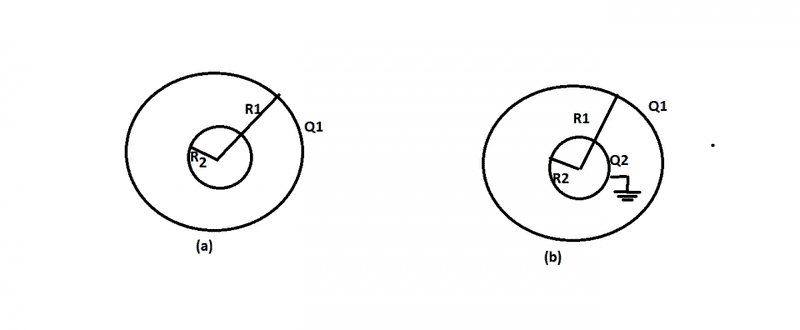
Figure (a)shows two concentric conducting shells .Some charge Q1 is given to the outer shell.No charge is developed on the inner shell.I want to know why?When charge is on inner sphere ,charges also develop on outer shell then why not charge develops on inner shell when there are charges on outer shell?But when we see (b)we get to know there is a case when inner shell does develop charges due to charges present on outer shell.
I want to know when charges develop on inner shell due to charges on outer shell and when they don't?
I hope it's not confusing!:smile:
sph.png

In the figure (b),the inner shell is earthed and hence some charges Q2 is developed on it so that it's potential becomes zero.
I did not understand the underlined sentence.
My understanding(may be wrong):I know earthed conductor is always at zero potential due to flow of charge either from the Earth to conductor or from conductor to earth.So that means charge has to be there on the earthed shell in order to be at zero potential so that charges (if negative)can flow to the Earth or charges(if positive)get neutralized by flow of negative charges from Earth to conductor.But then ,both of these conditions result in zero charges but that was the case initially there was no charge on the inner shell (see a)then how for being at zero potential Q2 has to be there on the inner shell?in other words how presence of Q2 on inner shell results in zero potential of it?
 
Last edited:
Physics news on Phys.org
gracy said:
Figure (a)shows two concentric conducting shells .Some charge Q1 is given to the outer shell.No charge is developed on the inner shell.I want to know why?
From where could it gain charge if it is isolated?
gracy said:
When charge is on inner sphere ,charges also develop on outer shel
No, the outer shell stays neutral. There is only redistribution of charge that happens. The charged inner shell develops electric field around itself, that exerts force on the free electrons of the outer shell, and they will be displaced.
gracy said:
then why not charge develops on inner shell when there are charges on outer shell?
The inner shell is isolated, how could it get charge? No charge redistribution either, as the electric field inside the conducting shell is zero. No force is exerted on the electrons of the inner shell.

gracy said:
But when we see (b)we get to know there is a case when inner shell does develop charges due to charges present on outer shell.
I want to know when charges develop on inner shell due to charges on outer shell and when they don't?
I hope it's not confusing!:smile:
In the figure (b),the inner shell is earthed and hence some charges Q2 is developed on it so that it's potential becomes zero.
I did not understand the underlined sentence.

If the inner shell is earthed it is connected to an infinite source of charge. If the outer sell is positively charged it has positive potential. The inner shell is at zero potential, and the potential is also zero at infinity. There is potential difference between the shells, that means electric field exists between them, so there is force on the electrons of the both shells. From the earth, electrons will move to the surface of the inner shell, and the same number of electrons of the outer shell move to the outer surface of it, making its positive charge distributed between the inner and outer surfaces.
 
I wanted to understand "redistribution of charge properly.
I Happened to visit the following thread
https://www.physicsforums.com/threads/nonconducting-shells.380647/
I have to ask a question based on it.
But as the thread has been closed I am asking that here.
I did not understand the following line of @collinsmark post #16
"Also, if the non-conducting, spherical shell's charge distribution is not uniform (not spherically symmetric), then there will be an electric field inside the shell even if the shell is the only charge around. "

Did he mean
"Even if the non-conducting, spherical shell's charge distribution is not uniform (not spherically symmetric) but there are some charges (or even a point charge)around the shell(either inside or outside of the shell)then in that case there will be electric field inside the shell.
 
No, I think he meant just charges on the shell. For a cavity contained inside a conductive shell, the field inside is zero no matter the shape of the shell. The charge will distribute itself to ensure zero field inside. If the shell is non-conductive. the charge cannot move and only for some symmetric distributions on charge on the insulator the field may be zero.

If there is a charge inside the cavity, it is a trivial thing that the field is not zero.
 
  • Like
Likes   Reactions: gracy
nasu said:
If there is a charge inside the cavity, it is a trivial thing that the field is not zero.
If there is a charge inside the cavity of a non conducting shell,it is a trivial thing that the field is not zero.
Right?
 
This is true for conductive shell too.
If you put charge inside, the field does not have to be zero.
Think about a charge right in the center of a spherical, empty (otherwise) conductive shell. You can use Gauss' law to calculate the field inside the cavity.
Or look up spherical capacitor for another simple example.
 
  • Like
Likes   Reactions: gracy
nasu said:
For a cavity contained inside a conductive shell, the field inside is zero no matter the shape of the shell.
You meant when cavity does not have any charge inside it?
 
Yes, sure.
 
  • Like
Likes   Reactions: gracy
I am still not clear about post#3.
I think this is what @collinsmark meant in post#16

"If the charge distribution on the shell is uniform and there are no other charges around (neither inside nor outside of the shell), then the electric field within the shell is zero.

But if you place some other charge in the proximity of the shell (for example a point charge outside the shell), the electric field inside the shell is what it would be if the shell was not there, but the other charge was. The electric field attributed to the other charge is still there.

Also, if the non-conducting, spherical shell's charge distribution is not uniform (not spherically symmetric), then there will be an electric field inside the shell even if the shell is the only charge around. "


There are two conditions for electric field to be zero and
hence two conditions for electric field to be non zero these are

1)If the charge distribution on the shell is non uniform

2)When there are charges (or a charge )around i.e either inside or outside of the shell

then it further says even if only one condition is fulfilled i.e 1)If the charge distribution on the shell is non uniform and
And the the second condition is not met
In that case also the electric field would be non zero
no need to get both conditions fulfilled .Right?
 
Last edited:
  • #10
The conditions can be interrelated.

If the shell is non-conducting and the charges are fixed in place then bringing a charge near will not shift the charges on the shell, so their contribution to the field in the interior will still be nil. However, the field from the nearby charge will still fill all of space, including the interior of the shell. So the field inside the shell can be non-zero.

For a conducting shell, placing a charge near it will cause the charges on the sphere to move so that they are no longer uniformly distributed and the shell surrounding the interior is then no longer spherically symmetric; the interloping charge will attract or repel charges on the sphere, and if they are free to move they will do so until they can't move any more (forces balance and an equilibrium is attained). Since the shell's spherical symmetry is broken, there's no guarantee of a zero field inside. **

Keep in mind that electric fields from charges are additive. To find the net field at a given location you sum the contributions from all the charges around. It has been shown that a uniform shell of charge results in a nil electric field in the shell interior; all the contributions of the charges on the shell sum to zero inside the shell. But this does not prevent some other charge's field from also being present in that space.

** edit: nasu and ehild are correct of course (see their posts below this one): There's never a field inside an empty conducting shell. I'm not sure what happened to my thought process to come up with that gem! :oops: The surface charge rearrangement that happens when an external charge is brought near must cancel the field of the external charge for the interior of the conducting shell (else currents would continue to flow in the conductor, which would contradict an equilibrium condition). ehild's Gaussian surface explanation is an excellent way to show and remember this.
 
Last edited:
  • Like
Likes   Reactions: gracy
  • #11
For a conducting shell enclosing an empty cavity, the field inside the cavity is zero. The symmetry is irrelevant
.
 
  • Like
Likes   Reactions: ehild, gracy and BvU
  • #12
nasu said:
For a conducting shell enclosing an empty cavity, the field inside the cavity is zero. The symmetry is irrelevant
.
Nasu is right.
Having a Gaussian surface inside the wall of the conducting shell, the surface integral is zero, as the electric field is zero in a conductor. So the enclosed volume has zero charge. With no charge inside the cavity, there is zero surface charge on the inner surface of the shell.

You know that the charge of the shell is distributed along the outer surface. With no electric field inside the wall, the inner surface of the shell and the cavity "does not know" anyting about the distribution of charge on the outer surface, either it is even or not.
 
  • Like
Likes   Reactions: gracy
  • #13
Closed pending moderation
 

Similar threads

  • · Replies 16 ·
Replies
16
Views
2K
Replies
5
Views
1K
  • · Replies 14 ·
Replies
14
Views
3K
  • · Replies 11 ·
Replies
11
Views
2K
  • · Replies 54 ·
2
Replies
54
Views
7K
  • · Replies 6 ·
Replies
6
Views
2K
  • · Replies 17 ·
Replies
17
Views
3K
  • · Replies 3 ·
Replies
3
Views
2K
  • · Replies 3 ·
Replies
3
Views
1K
  • · Replies 1 ·
Replies
1
Views
3K