Checking if a Graph is Planar - v, e & f

  • Thread starter Thread starter kljoki
  • Start date Start date
  • Tags Tags
    Graph
Click For Summary
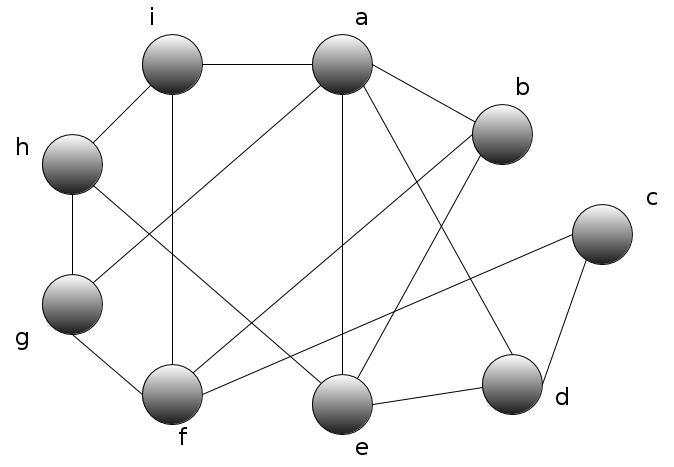
To determine if a graph is planar, the condition v - e + f = 2 must be satisfied, where v is the number of vertices, e is the number of edges, and f is the number of faces. In the discussed graph, with 9 vertices and 15 edges, this results in 8 faces. A suggested method for counting faces involves tracing connections from a starting point and ensuring loops are not recounted. Additionally, checking for the presence of K3,3 or K5 subgraphs can help establish planarity, as their absence indicates that the graph may be planar. Understanding these criteria is essential for analyzing graph planarity effectively.
kljoki
Messages
5
Reaction score
0
Hi
I have this graph
Drawing1 (2).jpg


now i should check if this graph can be planar.

v - number of vertices
e - number of edges
f - number of faces

to be planar it should hold v - e + f = 2 from here f = 2 - v + e = 2 - 9 + 15 = 8
so f = 8 now my question is how to easily count faces (regions bounded by edges, including the outer, infinitely large region) of the graph??
thanks
 
Physics news on Phys.org
couldnt you start with point a and then compile a list of connections that come back to a

a-b-e

a-b-f-i

and continue to point b, c, d ... making sure not to count the same loop again

as an example b-e-a is the same as a-b-e
 
kljoki said:
Hi
I have this graph
View attachment 50059

now i should check if this graph can be planar.

v - number of vertices
e - number of edges
f - number of faces

to be planar it should hold v - e + f = 2 from here f = 2 - v + e = 2 - 9 + 15 = 8
so f = 8 now my question is how to easily count faces (regions bounded by edges, including the outer, infinitely large region) of the graph??
thanks

How about arguing that your graph contains neither a K3,3 nor a K5

as a subgraph? it seems there are not that many cases to consider...
 
I am studying the mathematical formalism behind non-commutative geometry approach to quantum gravity. I was reading about Hopf algebras and their Drinfeld twist with a specific example of the Moyal-Weyl twist defined as F=exp(-iλ/2θ^(μν)∂_μ⊗∂_ν) where λ is a constant parametar and θ antisymmetric constant tensor. {∂_μ} is the basis of the tangent vector space over the underlying spacetime Now, from my understanding the enveloping algebra which appears in the definition of the Hopf algebra...

Similar threads

  • · Replies 1 ·
Replies
1
Views
2K
  • · Replies 2 ·
Replies
2
Views
1K
Replies
4
Views
1K
  • · Replies 4 ·
Replies
4
Views
2K
  • · Replies 4 ·
Replies
4
Views
2K
Replies
1
Views
2K
  • · Replies 5 ·
Replies
5
Views
4K
  • · Replies 6 ·
Replies
6
Views
3K
Replies
8
Views
4K
  • · Replies 22 ·
Replies
22
Views
2K