Chiller power consumption calculation

Click For Summary

Discussion Overview

The discussion revolves around the calculation of heat removed from a chiller system, specifically addressing the role of Coefficient of Performance (COP) and efficiency in these calculations. Participants explore the relationship between chiller load, efficiency, and the conversion of output from BTU/hr to kW in the context of total electrical power consumption for a building.

Discussion Character

  • Technical explanation
  • Debate/contested

Main Points Raised

  • One participant questions whether COP or efficiency impacts the calculation of heat removal from a chiller system, particularly under different load conditions.
  • Another participant asserts that COP is relevant when calculating the work needed to remove heat, indicating a distinction between the heat removal calculation and efficiency considerations.
  • A third participant notes that the calculation discussed pertains only to the water side and does not account for the chiller's efficiency or specifications.
  • One participant confirms that COP varies with load and temperature differences, emphasizing the need for specific data related to the chiller in question.

Areas of Agreement / Disagreement

Participants express differing views on the relevance of COP and efficiency in the calculations, indicating that multiple competing perspectives remain unresolved.

Contextual Notes

There are limitations regarding the assumptions made about the chiller's performance, the definitions of efficiency, and the specific conditions under which the calculations are applied.

bartlino
Messages
3
Reaction score
0
Hello,

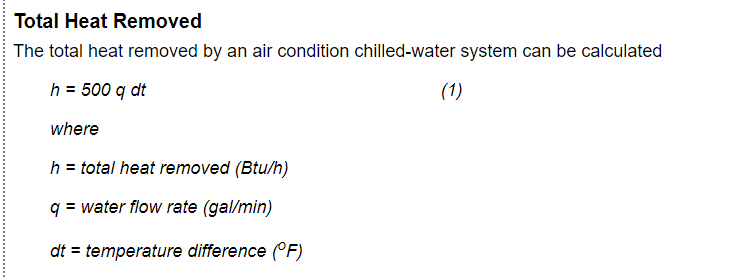
If I am trying to calculate the heat removed from a chiller system through this formula on engineering toolbox.com:
1604506471048.png


Does COP or efficiency of the equipment come into play with this calculation? For example if a chiller is fully loaded isn't it running more efficient for a watt/ton basis? Vs a chiller only running at 50% load, would COP be different?

I am interested in converting the btu/hr output to kW to attempt to relate this to the total electrical power (kW) consumption for a building.

Thanks!
 
Engineering news on Phys.org
bartlino said:
Does COP or efficiency of the equipment come into play with this calculation?
Apparently not. Your link also tells you what it does.

The COP comes in when ##q## is divided by the work needed to effectuate this removal

bartlino said:
I am interested in converting the btu/hr output to kW
Why not simply google "btu/hr output to kW" ?
 
That calculation is for the water side only, not accounting for the type of equipment doing the cooling work, or its efficiency.
Normally, you see the specs of the chiller, then you see whether or not it is able to cool the water as needed by the system.
 
  • Like
Likes   Reactions: russ_watters
bartlino said:
For example if a chiller is fully loaded isn't it running more efficient for a watt/ton basis? Vs a chiller only running at 50% load, would COP be different?

I am interested in converting the btu/hr output to kW to attempt to relate this to the total electrical power (kW) consumption for a building.
Yes, COP varies with load. It also varies with source/sink temperature difference. And it's different for different chillers. So you really need the data for your specific chiller and usage scenario.
 
  • Like
Likes   Reactions: Lnewqban

Similar threads

Replies
9
Views
3K
  • · Replies 4 ·
Replies
4
Views
2K
  • · Replies 3 ·
Replies
3
Views
3K
  • · Replies 22 ·
Replies
22
Views
10K
  • · Replies 23 ·
Replies
23
Views
4K
  • · Replies 7 ·
Replies
7
Views
4K
  • · Replies 4 ·
Replies
4
Views
2K
  • · Replies 2 ·
Replies
2
Views
3K
  • · Replies 10 ·
Replies
10
Views
4K
  • · Replies 10 ·
Replies
10
Views
2K