Choosing an Axis of Rotation for Equilibrium Analysis

Click For Summary
SUMMARY

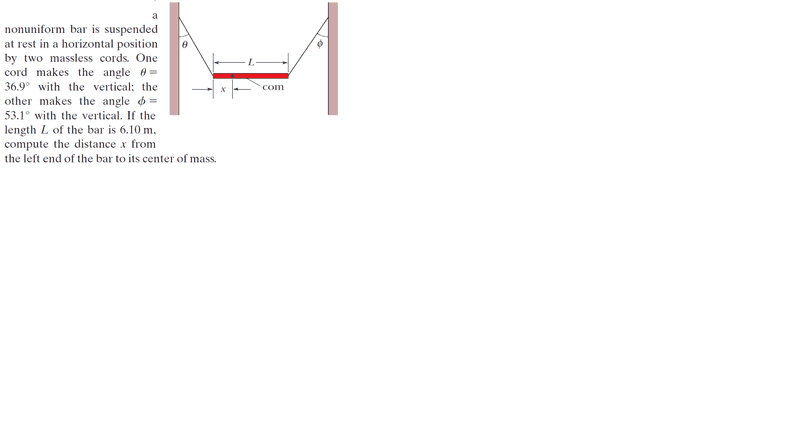
The discussion centers on the selection of an axis of rotation for torque analysis in equilibrium problems, specifically comparing the left-end of a plank to the center of mass (COM) point. Choosing the left-end yields correct results, while using the COM leads to complications due to an excess of unknowns. Participants highlight the challenge of solving for the variable x when using the COM, as it introduces additional angles and unknowns, complicating the analysis. The conclusion emphasizes the importance of selecting an appropriate axis of rotation to simplify calculations in torque analysis.

PREREQUISITES
  • Understanding of torque and equilibrium principles
  • Familiarity with the concept of center of mass (COM)
  • Basic knowledge of solving systems of equations
  • Ability to analyze forces and moments in static systems
NEXT STEPS
  • Study torque analysis techniques using different axes of rotation
  • Learn about the implications of choosing the center of mass in equilibrium problems
  • Practice solving systems of equations with multiple unknowns
  • Explore graphical methods for visualizing forces and moments in static equilibrium
USEFUL FOR

Students and professionals in physics, engineering, and mechanics who are involved in static equilibrium analysis and torque calculations.

Taulant Sholla
Messages
96
Reaction score
5
Homework Statement
I can get the answer to this problem, but...
Relevant Equations
torque and force equilibrium
If I choose my axis of rotation for torque analysis to be the left-end of the plank, I can get the correct results.

If I instead choose the com point -- I run into a dead end. Is there a way of a priori knowing this would happen? Thank you.
Untitled.png
 
Physics news on Phys.org
Taulant Sholla said:
I run into a dead end
Can you show ?
 
Here's my work based on using the COM as my axis of rotation. It seems I can't solve for x this way?
sol.JPG
 
You introduce angles ##a## and ##b## and now have too many unknowns ? Is that what you mean ?

##\ ##
 
I can find angle a and angle b. Despite this it seems I still can't find x from equations 2, 3 and 4.
 
Ok, so you have three equations with three unknowns, so what is going wrong ?

##\ ##
 
I think there are 4 unknowns: Tr, Tl, m and x.
 
cj said:
I think there are 4 unknowns: Tr, Tl, m and x.
Do you need to know m to find x?

(Tr/m), (Tl/m), and x are the unknowns.
 
Ah, yes - I see. Thank you so much for your help!
 
  • Like
Likes   Reactions: BvU

Similar threads

Replies
1
Views
1K
  • · Replies 8 ·
Replies
8
Views
2K
  • · Replies 95 ·
4
Replies
95
Views
6K
  • · Replies 28 ·
Replies
28
Views
2K
Replies
2
Views
2K
  • · Replies 5 ·
Replies
5
Views
3K
  • · Replies 6 ·
Replies
6
Views
2K
  • · Replies 4 ·
Replies
4
Views
1K
  • · Replies 5 ·
Replies
5
Views
2K
  • · Replies 2 ·
Replies
2
Views
2K