Discussion Overview
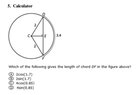
The discussion revolves around the mathematical observation of chord length in relation to a given arc length and radius. Participants explore the relationship between chord length, subtended angle, and arc length, with a focus on deriving the correct expression for chord length.
Discussion Character
- Technical explanation
- Mathematical reasoning
- Homework-related
Main Points Raised
- One participant states that the chord length can be expressed as \(2r\sin{\frac{\theta}{2}}\) and questions the absence of options derived from this equation.
- Another participant suggests calculating the angle \(\theta\) from the arc length using the formula \(s=r\theta\).
- A different participant emphasizes the need to find the angle \(\theta\) to determine the chord length, reiterating that the question specifically asks for chord length.
- One participant proposes starting with the arc-length formula to find \(\theta\) and then applying the law of cosines to derive the chord length.
- Another participant acknowledges the derivation of \(0.85\) from the calculations and suggests that the answer is option D.
- There is a reiteration that the problem is asking for chord length and emphasizes the necessity of knowing \(\theta\) first.
- One participant asserts that for the SAT question, the expression to use is evident, indicating that \(1.7\) is not the required \(\theta\) and that sine should be used.
- A participant clarifies that the initial confusion arose from not having \(\theta\) provided, and instructs on computing \(\theta\) from the given arc length and radius.
Areas of Agreement / Disagreement
Participants express differing views on the necessity of calculating \(\theta\) and the appropriate expressions to use for chord length. There is no consensus on the correct approach or final answer, as multiple interpretations and methods are presented.
Contextual Notes
Participants rely on specific values such as arc length \(s=3.4\) and radius \(r=2\), but the discussion does not resolve the assumptions regarding the subtended angle or the correctness of derived expressions.