CIRCUITS: Three resistors, two Indep. Voltage sources, one Indep. Current source

Join the discussion
Registration is free. Ask a follow-up in this thread, or start your own.
5 replies · 12K views
VinnyCee
Messages
486
Reaction score
0
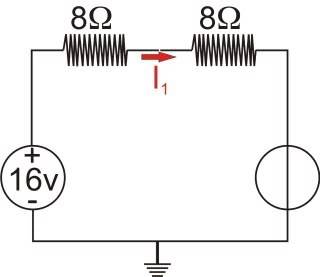
Find I in the circuit using the superposition principle:

PracticeProb4-5Part1.jpg


My work so far:

[tex]I\,=\,I_1\,+\,I_2\,+\,I_3[/tex]
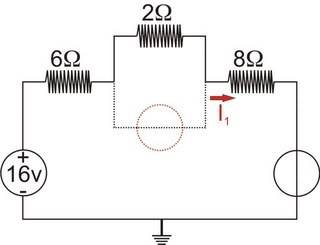
PracticeProb4-5Part2.jpg


This reduces down to:
PracticeProb4-5Part3.jpg


[tex]16\,V\,=\,I_1\,(8\Omega)[/tex]
[tex]I_1\,=\,\frac{16\,V}{8\Omega}\,=\,2\,A[/tex]

PracticeProb4-5Part4.jpg


This reduces down to:
PracticeProb4-5Part5.jpg


[tex]I_2\,=\,-\frac{12\,V}{8\Omega}\,=\,-\frac{3}{2}[/tex]

But how do I solve this circuit?:
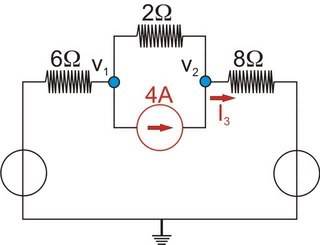
PracticeProb4-5Part6.jpg
 
Last edited:
Physics news on Phys.org
First of all. The equivalent load for the two voltage sources is [tex]16\Omega[/tex] and not [tex]8\Omega[/tex]. So, I1 = 1A and I2 = -3/4A.
For the third circuit, forget the ground. The [tex]6\Omega[/tex] and [tex]8\Omega[/tex] resistors are in series and their series equivalent is in parallel with the [tex]2\Omega[/tex] resistor.
 
The cuurent that I am looking for (I1) is in between the two resistors that are 8-ohms. I know they are in series and combined they are 16-ohm but don't I have to leave them like that to get the right answer since the current is between them?
 
VinnyCee said:
The cuurent that I am looking for (I1) is in between the two resistors that are 8-ohms. I know they are in series and combined they are 16-ohm but don't I have to leave them like that to get the right answer since the current is between them?
That current goes through both resistors. It is OK to keep them separate, but then you have two voltage drops of 8I1 and 8I1. The net effect is the same as one 16 ohm resistor. You do not have to keep them separate; you can always replace a series combination of resistors by one equivalent resistor.
 
OIC - The same current goes through both resistors BECAUSE they are in series!

So that means that:

[tex]I_1\,=\,1\,A[/tex]

[tex]I_2\,=\,-\frac{3}{4}\,A[/tex]

But how do I find [itex]I_3[/itex] in the last circuit?

PracticeProb4-5Part6.jpg
 
Last edited:
SGT said:
For the third circuit, forget the ground. The [tex]6\Omega[/tex] and [tex]8\Omega[/tex] resistors are in series and their series equivalent is in parallel with the [tex]2\Omega[/tex] resistor.

So the circuit would look like this?:

PracticeProb4-5Part7tryagain.jpg


[tex]4\,A\,=\,I_3\,+\,I_3'[/tex]

[tex]14\,\left(4\,A\,=\,\frac{v_1}{2\Omega}\,+\,\frac{v_1}{14\Omega}\right)[/tex]

[tex]v_1\,=\,7\,V[/tex]

[tex]I_3\,=\,\frac{v_1}{14\Omega}\,=\,\frac{(7\,V)}{14\Omega}\,=\,\frac{1}{2}\,A[/tex]

[tex]I\,=\,I_1\,+\,I_2\,+\,I_3[/tex]

[tex]I\,=\,\left(1\,A\right)\,+\,\left(-\,\frac{3}{4}\,A\right)\,+\,\left(\frac{1}{2}\,A\right)\,=\,\frac{3}{4}\,A[/tex]

That is right, thanks everyone!
 
Last edited: