Circular Motion and Tension: Solving for Wire Tension in a Rotating System

Click For Summary
The discussion revolves around calculating the tension in two wires supporting a 340 g sphere that revolves in a horizontal circle at a speed of 7.0 m/s. Key points include determining the sphere's distance from the pole, its acceleration, and the forces required to counteract gravity while producing the necessary acceleration. The forces acting on the sphere include gravity and the tensions in the wires, which need to be resolved into their x and y components. The vertical components must balance out to zero, while the horizontal components must equal the radial acceleration. The participants successfully solved the problem, alleviating the original poster's confusion.
tarheelfan286
Messages
3
Reaction score
0
[SOLVED] circular motion and tension

I could do this easily if it weren't rotating or if it were one wire...but this is kicking my but.

Two wires are tied to a 340 g sphere. Both wires are 1m in length and attached to a pole at lengths of .5m below and above the sphere. The sphere revolves in a hori*zontal circle at a constant speed of 7.0 m/s. What is the tension in each of the wires?
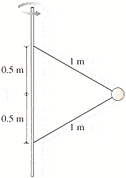
p7-61.gif
 
Physics news on Phys.org
How far is the sphere from the pole?

How fast is it moving?

What is the acceleration of the sphere? (magnitude and direction)

what is the force to produce this acceleration AND counteract gravity.

Now find 2 forces in the direction of the wires that add up to this net force.
 
There are three forces acting on the sphere, mg (gravity) pointed downward and two different tensions T1 and T2 pointed along the wires. Split all of the forces into x and y components. The sum of all the vertical components should equal zero and the sum of the horizontal components should equal the radial acceleration of the sphere.
 
Thanks guys, that's exactly what i needed to figure it out! you saved me a headache on that one.
 
Thread 'Correct statement about size of wire to produce larger extension'
The answer is (B) but I don't really understand why. Based on formula of Young Modulus: $$x=\frac{FL}{AE}$$ The second wire made of the same material so it means they have same Young Modulus. Larger extension means larger value of ##x## so to get larger value of ##x## we can increase ##F## and ##L## and decrease ##A## I am not sure whether there is change in ##F## for first and second wire so I will just assume ##F## does not change. It leaves (B) and (C) as possible options so why is (C)...

Similar threads

Replies
19
Views
3K
  • · Replies 18 ·
Replies
18
Views
2K
Replies
2
Views
1K
  • · Replies 19 ·
Replies
19
Views
2K
Replies
2
Views
2K
  • · Replies 12 ·
Replies
12
Views
3K
  • · Replies 5 ·
Replies
5
Views
1K
  • · Replies 15 ·
Replies
15
Views
6K
  • · Replies 4 ·
Replies
4
Views
3K
  • · Replies 28 ·
Replies
28
Views
3K