Circular Motion: Write expression for the period in terms of r and g

Click For Summary
SUMMARY

The discussion centers on deriving the expression for the period of circular motion in terms of radius (r) and gravitational acceleration (g). A participant expresses confusion regarding the equation ##m_2g=m_1v^2/r##, questioning the relationship between tension and centripetal force. The need for a visual aid, specifically Figure 3, is highlighted to clarify the concepts involved. The dialogue emphasizes the importance of understanding the free body diagram and the forces acting on the system.

PREREQUISITES
  • Understanding of circular motion dynamics
  • Familiarity with free body diagrams
  • Knowledge of centripetal force and tension concepts
  • Basic grasp of gravitational force equations
NEXT STEPS
  • Research the derivation of the period of circular motion using the formula T = 2π√(r/g)
  • Study the relationship between tension and centripetal force in circular motion
  • Examine free body diagrams for different circular motion scenarios
  • Explore the implications of mass and radius on the period of circular motion
USEFUL FOR

Students studying physics, educators teaching circular motion concepts, and anyone interested in understanding the dynamics of forces in circular systems.

ColoradoGrrrl
Messages
1
Reaction score
1
Homework Statement
1. Draw a free body diagram and solve for the centripetal acceleration in terms of θ and g for one person riding on the amusement park ride in Figure 3. A free-body diagram will show that the centripetal force on the rotating mass m1, is provided by the weight of the hanging mass m2. Since those forces must be equal, we can write the equation: m2g = m1v2/r where v is the velocity of m1, and r is the radius of its circular path. Since the magnitude of the velocity is the average distance divided by the average time, we can write the velocity = the circumference / the period, or v = 2πr/T where the period T is the time to complete one revolution. Assume m2 = 4m1. Write an expression for the period in terms of r and g. You should find the mass terms will drop out.
Relevant Equations
m2=4m1
m2g=m1v2/r
v=2piR
I'm not sure if I'm doing this right as far as coming up with the equation they are asking for. I feel the question is poorly worded and the formatting makes their equation notation difficult to understand. Any insight would be very helpful. This is my work so far:
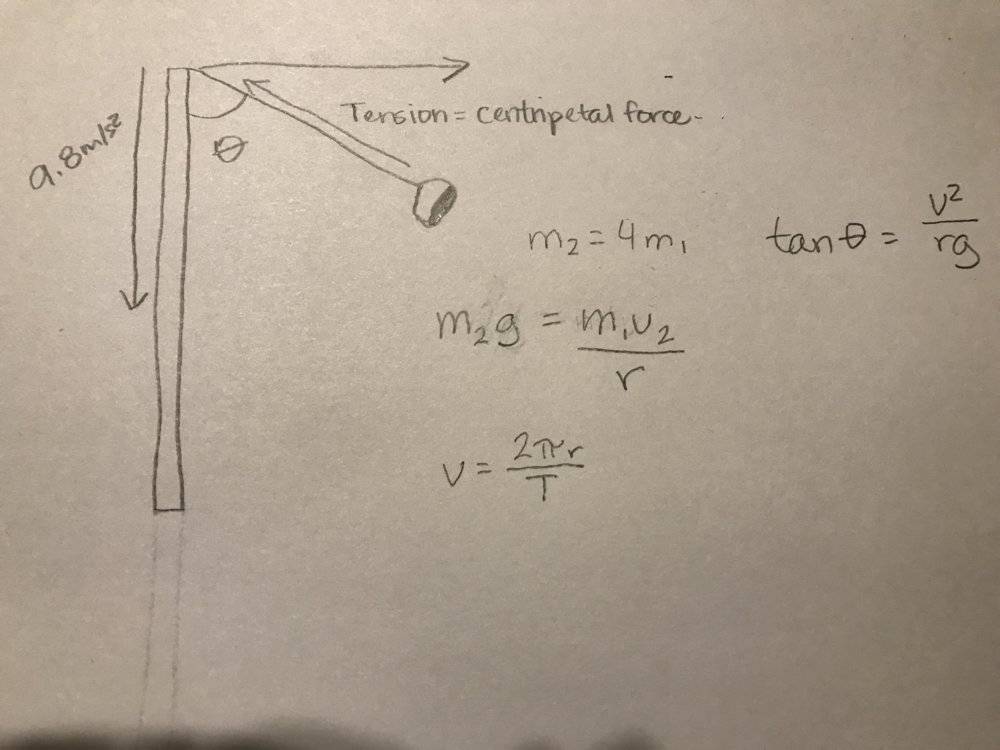
IMG_3631.JPG
 
Physics news on Phys.org
Without Figure 3, I don't understand why ##m_2g=m_1v^2/r##. Could you please provide the figure?
 
What leads you to equate tension with centripetal force? Do they have the same magnitude? Do they have the same direction?

On your free body diagram, what body are you focusing on?
 
The book claims the answer is that all the magnitudes are the same because "the gravitational force on the penguin is the same". I'm having trouble understanding this. I thought the buoyant force was equal to the weight of the fluid displaced. Weight depends on mass which depends on density. Therefore, due to the differing densities the buoyant force will be different in each case? Is this incorrect?

Similar threads

  • · Replies 7 ·
Replies
7
Views
3K
Replies
11
Views
3K
  • · Replies 10 ·
Replies
10
Views
3K
  • · Replies 2 ·
Replies
2
Views
4K
  • · Replies 17 ·
Replies
17
Views
9K
Replies
33
Views
8K
  • · Replies 28 ·
Replies
28
Views
3K
  • · Replies 6 ·
Replies
6
Views
3K
  • · Replies 3 ·
Replies
3
Views
2K
Replies
6
Views
4K