Graduate Coefficients in the linear combination of a k-form

Click For Summary
SUMMARY

The discussion centers on the coefficients in the linear combination of a k-form defined on a smooth manifold M. Participants clarify that while coefficients are generally scalars, they can also be smooth functions when considering the exterior derivative of a k-form. Specifically, the coefficients in the linear combination of k-forms can be expressed as k by k subdeterminants of a matrix formed by the coefficients of the one-forms. The conversation emphasizes the distinction between evaluating forms at a point and the nature of coefficients in different contexts.

PREREQUISITES
  • Understanding of k-forms and their properties in differential geometry.
  • Familiarity with the wedge product and dual spaces in linear algebra.
  • Knowledge of smooth functions and their role in calculus on manifolds.
  • Basic concepts of determinants and their applications in linear algebra.
NEXT STEPS
  • Study the properties of differential forms in the context of smooth manifolds.
  • Learn about the exterior derivative and its implications for k-forms.
  • Explore the concept of determinants and subdeterminants in linear algebra.
  • Investigate the relationship between smooth functions and differential forms in calculus.
USEFUL FOR

Mathematicians, physicists, and students of differential geometry who are working with differential forms, smooth manifolds, and their applications in theoretical contexts.

Maxi1995
Messages
14
Reaction score
0
Hello,
We defined a k-form on a smooth manifold M as a transfromation

Untitled01.jpg

Where the right space is the one of the alternating k-linear forms over the tangent space in p.
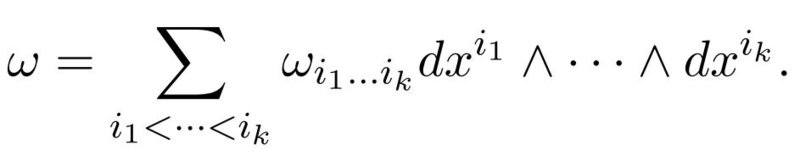
If we suppose we know, that we get a basis of this space by using the wedge-product and a basis of the dual space, then we might get for a given form:
Untitled02.jpg

Can someone explain to me what the coefficient in this linear combination is? I know that they are functions and in some cases scalars. But I don't know the cases. According to the definition at the beginning I suppose, that they are funtions for a given p and become scalars if we have argument values of the tangent space. Is this correct?
Greetings
Maxi
 

Attachments

  • Untitled01.jpg
    Untitled01.jpg
    7.2 KB · Views: 903
  • Untitled02.jpg
    Untitled02.jpg
    7.8 KB · Views: 605
Physics news on Phys.org
You have ##\omega \in \Lambda^k TM## which is a vector space with basis vectors ##dx^{i_1}\wedge \ldots \wedge dx^{i_k}##. Thus the ##\omega_{i_1 \ldots i_k}## are scalars, the coefficients in the linear combination which represents ##\omega ## according to this basis.

The evaluation ##p \longmapsto \omega_p## at a certain point affects only the differential forms, resp. the function those forms apply to, not the scalar coefficients.

E.g. if ##k=1## and ##\omega = 2dx## we get ##p \longmapsto \omega_p = (f \longmapsto 2df_p)## or ##f(p+v)=f(p)+df_p\cdot v + o(v)=f(p)+\frac{1}{2}\omega_p(f)\cdot v+o(v)##. The coefficient is not affected.
 
What fresh says is of course exactly right, but in one special case, you can say more about these coefficients. if you have a set of k one- forms, each written in terms of the n basic one forms dx1,...,dxn, then each of your one - forms needs n coefficients. If you wedge together those k one - forms, you get a k-form expressible in terms of the standard coordinate k-forms, as you have written, with some coefficients you have asked about. Those cofficients in this case are exactly all k by k sub determinants of the n by k matrix of coefficients you began with, the ones expressing the k arbitrary one - forms in terms of the n standard coordinate one-forms. Note there are exactly "n choose k" such k by k subdeterminants.

Indeed if you prove independently that the space of n-forms (at one point) is one dimensional, then one way to define the determinant of a matrix is as the coefficient needed to write the wedge product of its rows in terms of the standard n-form. More abstractly, a linear endomorphism of an n dimensional vector space induces a linear endomorphism of its space of n-linear alternating functions, which must be multiplication by a scalar, which scalar is then defined as the determinant of the original endomorphism.
 
Hello,
thank you for your answer.
@ fresh_42
What is f in your notation? Is it a curve?
I understand what you said about the elements of the basis, thus to say that they are just scalars. But I found in a Wikipedia article (https://en.wikipedia.org/wiki/Differential_form#Differential_calculus) that we might find a linear combination where these factors are smooth functions from $$U \subset \mathbb{R}^n \rightarrow \mathbb{R}$$. Because of this I'm going to add more detail the context in which my question arose.
We defined the outer derivative on $$ \mathbb{R}^n$$ as follows: Let $$w$$ be a k-form on a open set U
Untitled02.jpg

Then we define the exteriour derivative by
Untitled03.jpg

where
Untitled05.jpg

is the (normal) differential of the function $$w_{i_1 \cdots i_k}$$ (Please note that we used here the Einstein notation, so we have a sum over j.).
As you said I expected to be the coefficients scalars, but in this case they are just smooth functions, what puzzled me. Can you explain that to me?
@mathwonk
We had the following:
Untitled06.jpg

Where $$V^*$$ is the dual space and j counts the lines and i the columns. What do you mean by subdeterminants?
Best wishes
Maxi
 

Attachments

  • Untitled02.jpg
    Untitled02.jpg
    7.1 KB · Views: 581
  • Untitled03.jpg
    Untitled03.jpg
    6.9 KB · Views: 546
  • Untitled05.jpg
    Untitled05.jpg
    7.5 KB · Views: 567
  • Untitled06.jpg
    Untitled06.jpg
    8.7 KB · Views: 560
Maxi1995 said:
What is f in your notation? Is it a curve?
A smooth function the differential form ##\omega ## applies to, so in general no curve, simply a variable.

The moment you write ##d\omega## you do no longer consider a certain and thus fixed vector in ##\Lambda^k## but investigate what happens by infinitesimal changes of coordinates. You switch from ## \vec{v}=v_0\vec{e}_0## to ##\vec{v}(t)=v_0(t)\vec{e}_0##. It is literally the transition from algebra to calculus. Of course now you will have to say in which way these coordinates totter, i.e. what is ##t \mapsto v_0(t)## or in general and local coordinates again, what is ##d\omega_{i_1\ldots i_k} = \sum_{j}\dfrac{\partial \omega_{i_1\ldots i_k}}{\partial x^j}dx^j\,.##

If you want to know, why this might confusing you, have a look at the 10 items list at the end of section 1 herein:
https://www.physicsforums.com/insights/journey-manifold-su2mathbbc-part/

I'm not sure whether it will confuses you further or actually be of help, but at least it might serve as a quick reference guide (5 parts):
https://www.physicsforums.com/insights/the-pantheon-of-derivatives-i/
 
Last edited:
Hello,
thank you for your answer, I'm going to read through these pages. I'll give a sign in case of further questions.
 
Hello,
I have another question in this context. Let us say we want to talk about the function as object, thus to say the function itself as element of $$\Lambda ^k V.$$ We derived the coefficients in our proofs by using the smooth k-form itself. We set the coefficients as $$w_{i_1...i_k}=w(e_{i_1},...,e_{i_k})$$. From this and the fact that we made other proofs in $$\Lambda^n V$$ where V was n-dimensional and $$w$$ had the form $$w= f dx_1\wedge...\wedge dx_n$$ with f a smooth function from $$U \subset \mathbb{R}^n \rightarrow \mathbb{R}.$$ I'm still a little bit puzzled, but think this might be caused by vieweing the function as object. Is that right?
 

Similar threads

  • · Replies 7 ·
Replies
7
Views
3K
  • · Replies 10 ·
Replies
10
Views
3K
  • · Replies 3 ·
Replies
3
Views
2K
  • · Replies 73 ·
3
Replies
73
Views
7K
  • · Replies 9 ·
Replies
9
Views
2K
  • · Replies 8 ·
Replies
8
Views
1K
  • · Replies 16 ·
Replies
16
Views
3K
  • · Replies 36 ·
2
Replies
36
Views
5K
  • · Replies 13 ·
Replies
13
Views
3K
  • · Replies 6 ·
Replies
6
Views
3K