Coincidence of asteroid and Russian meteor at same time.

Click For Summary

Discussion Overview

The discussion revolves around the coincidence of the Russian meteor and asteroid 2012 DA14 occurring at the same time, exploring the implications of their differing orbits and the potential effects of close encounters with Earth. Participants consider the theoretical modeling of asteroid orbits and the conditions under which significant alterations could occur due to proximity to Earth.

Discussion Character

  • Exploratory
  • Technical explanation
  • Debate/contested
  • Mathematical reasoning

Main Points Raised

  • Some participants note that the Russian meteor and asteroid 2012 DA14 have very different orbits, with the meteor being part of a larger family of Earth-crossing Apollo asteroids.
  • Bob Clark suggests that simulations could reveal how an asteroid's orbit might change when it passes close to Earth, specifically referencing the potential effects of a meteor passing at a distance of 10 miles.
  • Dave challenges the feasibility of a meteor passing at such a close distance, arguing that it would already be a fireball within the atmosphere and would not be able to orbit.
  • Bob Clark responds by stating that the meteor does not need to be that close initially and that a few tens of miles could still result in significant orbital changes.
  • Dave counters that even a few tens of miles would still be deep within the atmosphere, leading to destruction, unless the meteor follows a very shallow grazing path.
  • Bob Clark references a historical event, the 1972 Great Daylight Fireball, as an example of a meteor that "skipped" in and out of the atmosphere, suggesting this scenario could be relevant to their discussion.
  • Another participant introduces a separate topic regarding comet C/2013 A1 and its potential close encounter with Mars, discussing the rarity of such events and the implications of multiple close encounters occurring in a short time frame.
  • Bob Clark raises concerns about the possibility of a physical phenomenon causing these large, close encounters, suggesting that understanding the dynamics of such events is crucial.

Areas of Agreement / Disagreement

Participants express differing views on the feasibility of a meteor passing close to Earth without being destroyed. While some acknowledge the potential for significant orbital changes, others argue that the conditions described would likely result in the meteor's destruction. The discussion remains unresolved regarding the specifics of these interactions and their implications.

Contextual Notes

Participants reference specific distances and conditions under which meteors might interact with Earth's atmosphere, but there are unresolved assumptions about the dynamics of such encounters and the definitions of "close" in this context.

RGregoryClark
Messages
8
Reaction score
0
Astronomers have calculated that the Russian meteor and asteroid 2012 DA14 have very different orbits:

Astronomers Calculate Orbit of Chelyabinsk Meteorite.
The Chelyabinsk meteorite is from a family of Earth-crossing rocks called Apollo asteroids and there are 80 million others like it, say astronomers.
http://www.technologyreview.com/view/511691/astronomers-calculate-orbit-of-chelyabinsk-meteorite/
Still because of the very unlikely probability of their occurring together purely by chance, I would like to see some simulations of what can happen to an asteroids orbit when it gets as close as the Russian meteor.
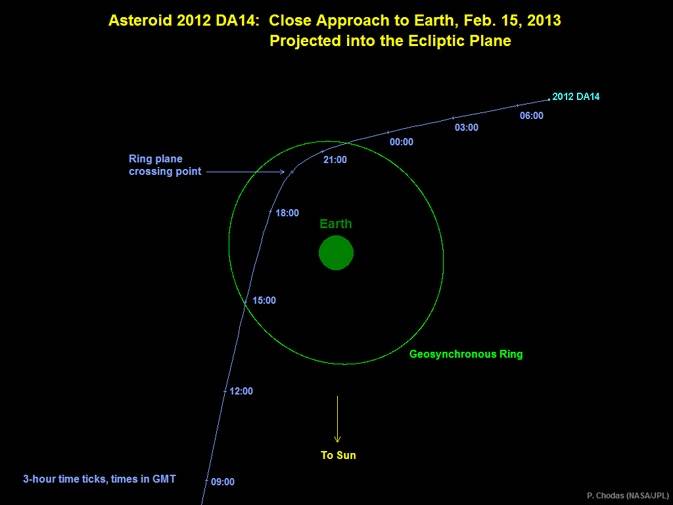
This image shows how greatly the orbit of 2012 DA14 was changed by the close flyby at 17,000 miles away:
trajectory-of-asteroid-2012-da14-for-15feb2013-cnasa-jpl-caltech.jpg


Imagine then how greatly the orbit could be altered if a meteor like the Russian one passed by at only 10 miles away.

For calculating how much the Russian meteor could be changed by a close Earth passage, I'm imaging it initially having close to the orbit of 2012 DA14, but being slightly different so that it skims pass the Earth. We can suppose this skim pass occurs at one of the two points where the 2012 DA14 orbit crosses Earth's orbit, as shown here:

La Sagra Observatory discovers very near-Earth asteroid 2012 DA14.
Posted By Jaime Nomen
2012/03/27 05:20 CDT
"The preliminary orbit shows that 2012 DA14 has a very Earth-Like orbit with a period of 366.24 days, just one more day than our terrestrial year. The orbit is nearly circular but just elliptical enough to jump inside and outside of the path of Earth two times per year. Because objects move faster when they are closer to the Sun, the relative motion is similar to some sports races: when the Earth is on the outer track, it is overtaken by 2012 DA14, but when the asteroid crosses Earth's orbit, Earth overtakes it and passes by. It is during the orbit crossings when the closest encounters occur, and when there is potential for a future impact."
http://www.planetary.org/blogs/guest-blogs/3418.html

For this preliminary calculation we don't need to know an actual date of this skim pass but only that the orbit is close to that of 2012 DA14 before the close skim pass and we want to find out how it looks afterwards.
I'm attempting to model it using a patched conic approximation. Anyone familiar with anymore accurate computer simulation programs to calculate this?


Bob Clark
 
Astronomy news on Phys.org
hi Bob
welcome to PF :)

this statement from you didnt really make sense ?

Imagine then how greatly the orbit could be altered if a meteor like the Russian one passed by at only 10 miles away.


10 miles (16 km) is well inside the atmosphere ... the object is already a fireball
it won't be doing any more orbiting

Dave
 
davenn said:
hi Bob
welcome to PF :)

this statement from you didnt really make sense ?

10 miles (16 km) is well inside the atmosphere ... the object is already a fireball
it won't be doing any more orbiting

Dave

At those prior orbit(s) it doesn't have to be that close. Within say a few tens of miles so that on that final close approach its orbit looks very different than the original orbit.

Bob Clark
 
RGregoryClark said:
At those prior orbit(s) it doesn't have to be that close. Within say a few tens of miles so that on that final close approach its orbit looks very different than the original orbit.

Bob Clark

even a few 10's of miles is still deep inside the atmosphere and is going to meet a firey end

The one exception to that is if it has a VERY shallow grazing path. There was a large meteor seen and photo'ed over western USA back in the early - mid 70's that "skipped" in and out of the atmosphere. It was the middle of the afternoon
I well remember the pics in Sky and Telescope. wonder if google will show a pic ??...

Dang ... took the mention of Sky and Telescope before I found it !
From Wiki
The 1972 Great Daylight Fireball (or US19720810) was an Earth-grazing meteoroid that passed within 57 kilometres (35 mi) of the surface of the Earth at 20:29 UTC on August 10, 1972. It entered the Earth's atmosphere at 15 kilometres per second[2] in daylight over Utah, United States (14:30 local time) and passed northwards leaving the atmosphere over Alberta, Canada. It was seen by many people and recorded on film and by space-borne sensors.[3] An eyewitness to the event, located in Missoula, Montana, saw the object pass directly overhead and heard a double sonic boom. The smoke trail lingered in the atmosphere for a number of minutes.

attachment.php?attachmentid=56405&stc=1&d=1362542833.jpg

(Credit: Antarctic search for meteorites program, Case Western Reserve University, James M. Baker)

cheers
Dave
 

Attachments

  • 1972 earthgrazer meteor.jpg
    1972 earthgrazer meteor.jpg
    61.6 KB · Views: 813
Wow, that's a cool picture. Thanks for the link.
 
  • Like
Likes   Reactions: davenn
youre welcome ...

were you into astronomy a way back then ?
or am I showing my age ?

LOL

Dave
 
davenn said:
youre welcome ...

were you into astronomy a way back then ?
or am I showing my age ?

LOL

Dave

I wasn't alive way back then!
 
I suspect Drak was heavily into astronomy back in 1972 - as in not of this earth.
 
Chronos said:
I suspect Drak was heavily into astronomy back in 1972 - as in not of this earth.

June 4th, 1984, a date that will haunt PF for the rest of its existence. The date I...emerged.
 
  • #10
davenn said:
even a few 10's of miles is still deep inside the atmosphere and is going to meet a firey end

The one exception to that is if it has a VERY shallow grazing path. There was a large meteor seen and photo'ed over western USA back in the early - mid 70's that "skipped" in and out of the atmosphere.

That's the kind of scenario I'm considering. Also, the altitude considered to be "space" is only 60 miles.


Bob Clark
 
  • #11
Assuming comet C/2013 A1 misses Mars by 37,000 km how much delta-v would you need to nudge it to hit Mars?

This might not be purely of academic interest. Already we've seen two Earth encounters whose likelihood together was one in hundreds of millions.

This comet to make a close encounter to Mars is huge. It's bigger than Halley's Comet for example. To put it in perspective it dwarfs the asteroid that wiped out the dinosaurs. Such close encounters to any of the terrestrial planets must be very rare.

For instance the puny, in comparison, asteroid 2012 DA14 would be expected to get so close to the Earth once in 40 years. That such a large comet would get so close to Mars must be much rarer than this. So the chance is less than 1 in 40 in a year. Say it happens for either of two planets; that's a chance of less than 1 in 20 in a year. Say then it happens within a 2 year period; that's 1 chance in 10.

Now the chance of the three encounters occurring within such a close time span is greater than one in several billion. The unlikelihoods begin piling up greater and greater.

Then we are left with the disturbing possibility there is a physical phenomenon causing these large, close encounters. And the possibility arises there is another large, close encounter to the Earth that may be upcoming.

It would really become important to know then not what's the delta-v needed to turn a close miss to an impact, but in fact the reverse. Bob Clark
 
Last edited:

Similar threads

  • · Replies 10 ·
Replies
10
Views
3K
  • · Replies 8 ·
Replies
8
Views
2K
  • · Replies 1 ·
Replies
1
Views
1K
  • · Replies 10 ·
Replies
10
Views
9K
  • · Replies 1 ·
Replies
1
Views
4K
  • · Replies 12 ·
Replies
12
Views
5K
  • · Replies 1 ·
Replies
1
Views
2K
  • · Replies 3 ·
Replies
3
Views
4K
  • · Replies 4 ·
Replies
4
Views
8K
  • · Replies 5 ·
Replies
5
Views
4K