Collimation of an Electron Beam by the Anode of a CRT

Click For Summary
SUMMARY

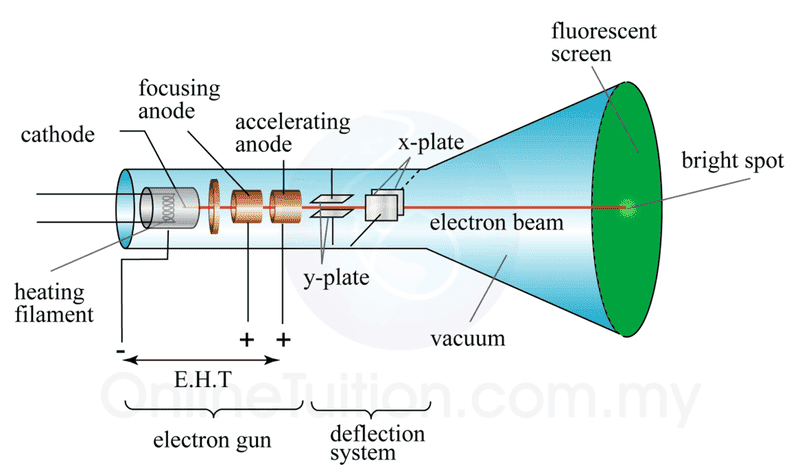
The discussion centers on the function of anodes in a cathode ray tube (CRT) and their role in electrostatic focusing of an electron beam. It is established that each anode operates at a different potential, creating an electric field in the space between them, which influences the path of the electron beam. The middle anode is at a lower potential, allowing the electron beam to align with the CRT axis as it passes through the electrostatic lens formed by the anodes. The focal length of this lens can be adjusted by varying the potential of the middle anode, enabling precise focusing on the phosphor screen.

PREREQUISITES
  • Understanding of cathode ray tube (CRT) technology
  • Knowledge of electrostatic fields and potentials
  • Familiarity with the concept of equipotential surfaces
  • Basic principles of electron dynamics in electric fields
NEXT STEPS
  • Research the design and function of electrostatic lenses in CRTs
  • Explore the mathematical modeling of electron trajectories in electric fields
  • Learn about the impact of varying anode potentials on electron beam focusing
  • Investigate applications of electrostatic focusing in modern electron beam technologies
USEFUL FOR

Electronics engineers, physicists, and students studying electron optics or cathode ray tube technology will benefit from this discussion, particularly those interested in the principles of electrostatic focusing and beam alignment.
Zahid Iftikhar
Messages
121
Reaction score
24
Please help me in understanding the function of anode. As in image attached you see, once the electron beam is emitted from cathode and filtered by grid, it enters into the one or series of anodes. As anode is positively charged, so, to my understanding it has no electric field inside its hollow space. If the electron beam enters into this region, it should have experienced any force. Then how is beam focused? Please help me and oblige. High regards
CRO6.png
 

Attachments

  • CRO6.png
    CRO6.png
    35.2 KB · Views: 1,450
Physics news on Phys.org
Google electrostatic focusing of electron beam
 
BvU said:
Google electrostatic focusing of electron beam
What is the reply?
 
There is electric field inside each of the prefocusing, focusing and accelerating anode. That is because each anode is at a different potential, so there is electric field in the space between those three anodes, and this electric field fringes into the hollow space of each anode.
 
Zahid Iftikhar said:
What is the reply?
Do you want me to click on the link for you ? What is unclear in the explanation
Electrostatic Focusing System
Electrostatic-Focusing-of-CRT-300x139.jpg

Electrostatic Focusing

An electrostatic focusing system is shown in figure. Electrostatic lens consists of three anodes, with the middle anode at a lower potential than the other two electrodes.

In figure two anodes and its electrostatic lines and equipotential surfaces are shown. A pd is kept between these two electrodes so that an electric field is generated between them. Spreading of electric field is caused because of repulsion between electric lines. If equipotential lines are drawn, as shown in figure, they would bulge at the centre of the two anodes. As we know that electrons move in a direction opposite to that of electric field lines and equipotential surfaces are perpendicular to the electric field lines so force on the electron is exerted in the direction normal to the equipotential surface.

Equipotential-lines-on-CRT-300x163.jpg


Electrons entering at the centre line of the two anodes experience no force but electrons displaced from the centre line experience a force normal to the direction of equipotential surface and deflect, as shown in figure. An equi potential surface is shown, in which an electron with velocity V1 and at an angle θ. to the normal of equipotential surface enters and experiences a force in a direction normal to the equipotential surface. Thus the velocity of the electron increases to V2. This force on the electron is exerted in the direction normal to equipotential surface so only the normal component of electron velocity V1N increases to V2N and the tangential component of velocity V1T remains the same.

Refraction-of-an-electon-ray-CRT-300x238.jpg


From figure

V1T = V1 sin θ1,

V2T = V2 sin θ2

But V1T = V2T

V1 sin θ1 = V2 sin θ2

Or V2/V1 = sin θ1 / sin θ2

From the above expression it is obvious that equipotential surface acts as a concave lens in geometrical optics. That is why, this focusing system is named as an electrostatic lens. Now if we go back and refer figure, it can be seen that because of middle anode to a lower potential, electron beam coming from the cathode and passing through the first concave electrostatic lens tends to become more aligned with the axis of CRT and when it enters at the second concave electrostatic lens, formed between two anodes at different potentials, it is focused at the phosphor screen. Focal length of the electrostatic lens can lie adjusted by varying potential of middle anode with respect to other two anodes. Thus electron beam can be made to focus at the screen very precisely.
 

Attachments

  • Electrostatic-Focusing-of-CRT-300x139.jpg
    Electrostatic-Focusing-of-CRT-300x139.jpg
    7 KB · Views: 787
  • Equipotential-lines-on-CRT-300x163.jpg
    Equipotential-lines-on-CRT-300x163.jpg
    7.5 KB · Views: 773
  • Refraction-of-an-electon-ray-CRT-300x238.jpg
    Refraction-of-an-electon-ray-CRT-300x238.jpg
    7.1 KB · Views: 924
@BvU , something that I cannot infer directly from the article, is the electric field inside the hollow space of each anode zero (or almost zero)? So the focusing is actually happening in the two spaces in between the three anodes?
 
Yes. The concept is based on curved equipotential surfaces -- between the various anodes.
 
  • Like
Likes   Reactions: Delta2

Similar threads

  • · Replies 9 ·
Replies
9
Views
2K
Replies
66
Views
9K
  • · Replies 32 ·
2
Replies
32
Views
4K
  • · Replies 10 ·
Replies
10
Views
2K
  • · Replies 28 ·
Replies
28
Views
5K
  • · Replies 3 ·
Replies
3
Views
2K
  • · Replies 4 ·
Replies
4
Views
3K
  • · Replies 4 ·
Replies
4
Views
2K
Replies
12
Views
2K
  • · Replies 19 ·
Replies
19
Views
4K