Undergrad Comoving distance and redshift relationship derivation

Click For Summary
SUMMARY

The forum discussion centers on the derivation of the comoving distance and redshift relationship, specifically addressing the absence of a minus sign when substituting da with -a²dz. Participants clarify that the change of variables introduces two minus signs that cancel each other, thus explaining the derivation's integrity. The relationship between scale factor and redshift is emphasized, particularly how a higher redshift correlates with a lower scale factor. The discussion concludes with a consensus on the mathematical reasoning behind the integration limits and their implications.

PREREQUISITES
  • Understanding of cosmological concepts such as redshift and scale factor
  • Familiarity with calculus, particularly integration techniques
  • Knowledge of the Friedmann-Lemaître-Robertson-Walker (FLRW) metric
  • Basic grasp of general relativity principles
NEXT STEPS
  • Study the Friedmann equations and their implications on cosmic expansion
  • Explore the derivation of the General Redshift-Distance Relation in cosmology
  • Learn about the integration of cosmological equations and their limits
  • Investigate the relationship between scale factor and redshift in different cosmological models
USEFUL FOR

Astronomy students, cosmologists, and physicists interested in the mathematical foundations of cosmological models and the relationship between redshift and comoving distance.

DoobleD
Messages
259
Reaction score
20
Hello PhysicsForum,

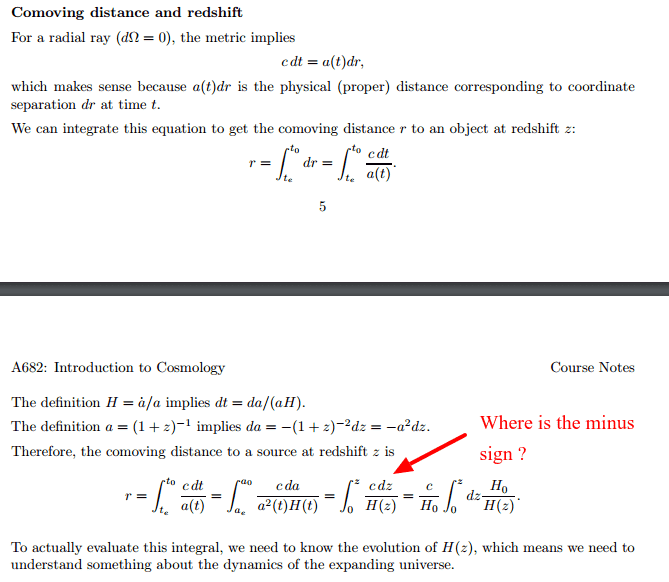
There is something I don't get at the end of this course notes PDF file. In the last section, titled "Comoving distance and redshift", which I have copied below, we have a short derivation of the comoving distance and redshift relation.

Almost all is well, the only thing that troubles me is : why is there no minus sign after da has been replaced by -a2dz ?
notes3_dvi.png


I have searched the web and found almost identical derivations in other courses or publications, but I never read the explanation for why the minus sign drops. I have found what seems to be the source material for most of those derivations : this paper from 93 (see section 6.3, "The General Redshift-Distance Relation" on 3rd page). It is referenced quite often by others when this comoving distance and redshift relationship shows up.

Maybe I am just missing some mathematical trick ? This is not super important of course, but it bugs me.
 
Space news on Phys.org
Could it be because the integration limits have been swapped? (consider what it means when the limits are ##a_e -> a_0##, where e stands for emission, and ##0 -> z##.)
 
  • Like
Likes DoobleD
Bandersnatch said:
Could it be because the integration limits have been swapped? (consider what it means when the limits are ##a_e -> a_0##, where e stands for emission, and ##0 -> z##.)
Yes. The change of variables leads to two minus signs which cancel one another: ##da = -a^2 dz##, and reversing the limits of integration.
 
  • Like
Likes DoobleD
Thank you !

Thay's what I thought, but then it means that the ae limit corresponds to z when you do the change of variable, and a0 to 0 redshift ? Sounds weird, shouldn't it be the other way around ? Since a0 = a(t0) is the expansion when we receive the redshifted signal.
 
DoobleD said:
Thank you !

Thay's what I thought, but then it means that the ae limit corresponds to z when you do the change of variable, and a0 to 0 redshift ? Sounds weird, shouldn't it be the other way around ? Since a0 = a(t0) is the expansion when we receive the redshifted signal.
This is probably easiest to see if you look at the equation for the scale factor in terms of the redshift:
a = {1 \over 1+z}

Here note that for ##z=0##, ##a=1##. That's the current scale factor and redshift. A far-away object, at, say, a redshift of ##z=2## is at a scale factor of ##a=1/3##. The integral above over ##da## would integrate from ##1/3## to 1, while the integral over ##dz## integrates from 0 to 2.
 
  • Like
Likes DoobleD
DoobleD said:
Thank you !

Thay's what I thought, but then it means that the ae limit corresponds to z when you do the change of variable, and a0 to 0 redshift ? Sounds weird, shouldn't it be the other way around ? Since a0 = a(t0) is the expansion when we receive the redshifted signal.
Think of how far you need to look. Higher z is seen farther than lower z, while lower a is seen farther than high a.
 
  • Like
Likes DoobleD
kimbyd said:
This is probably easiest to see if you look at the equation for the scale factor in terms of the redshift:
a=11+za=11+z​
a = {1 \over 1+z}

Here note that for z=0z=0z=0, a=1a=1a=1. That's the current scale factor and redshift. A far-away object, at, say, a redshift of z=2z=2z=2 is at a scale factor of a=1/3a=1/3a=1/3. The integral above over dadada would integrate from 1/31/31/3 to 1, while the integral over dzdzdz integrates from 0 to 2.

Bandersnatch said:
Think of how far you need to look. Higher z is seen farther than lower z, while lower a is seen farther than high a.

Makes sense now. Thank you !
 

Similar threads

  • · Replies 12 ·
Replies
12
Views
2K
  • · Replies 55 ·
2
Replies
55
Views
11K
  • · Replies 3 ·
Replies
3
Views
2K
  • · Replies 32 ·
2
Replies
32
Views
15K
  • · Replies 5 ·
Replies
5
Views
5K
  • Poll Poll
  • · Replies 10 ·
Replies
10
Views
4K
  • · Replies 29 ·
Replies
29
Views
6K
  • · Replies 28 ·
Replies
28
Views
6K
Replies
21
Views
4K
  • · Replies 39 ·
2
Replies
39
Views
8K