Compact Subsets of R .... Sohrab, Proposition 4.1.8 .... ....

  • Context: Undergrad 
  • Thread starter Thread starter Math Amateur
  • Start date Start date
  • Tags Tags
    Compact Subsets
Click For Summary
SUMMARY

The discussion centers on Proposition 4.1.8 from Houshang H. Sohrab's "Basic Real Analysis" (Second Edition), specifically addressing the proof that compact subsets of R are closed and bounded. The key point is the demonstration that the open cover defined as ##\{ ( - \infty, \xi - 1/n ) \cup ( \xi + 1/n, \infty ) \}_{ n \in \mathbb{N} }## lacks a finite subcover when assuming ##\xi \notin K## as a limit point of ##K##. Participants emphasize the necessity of engaging deeply with the proofs and suggest that a finite subcover must have a maximum ##n##, preventing the union from approaching ##\xi## arbitrarily closely.

PREREQUISITES
  • Understanding of limit points in topology
  • Familiarity with open covers and finite subcovers
  • Knowledge of compactness in metric spaces
  • Basic proficiency in real analysis proofs
NEXT STEPS
  • Study the concept of limit points in topology as defined in Sohrab's text
  • Learn about the Heine-Borel theorem regarding compactness in R
  • Explore examples of open covers and their finite subcovers in real analysis
  • Practice constructing rigorous proofs in real analysis
USEFUL FOR

Students of real analysis, mathematicians focusing on topology, and anyone seeking to understand the properties of compact subsets in R.

Math Amateur
Gold Member
MHB
Messages
3,920
Reaction score
48
TL;DR
Question in respect of the proof that compact subsets of R are necessarily closed and bounded ... issue of an open cover with no finite subcover ...
I am reading Houshang H. Sohrab's book: "Basic Real Analysis" (Second Edition).

I am focused on Chapter 4: Topology of R and Continuity ... ...

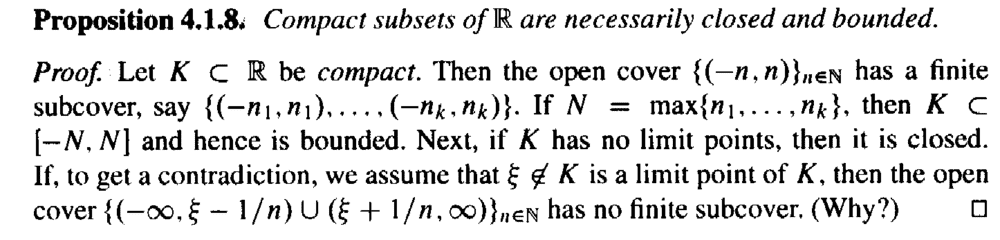
I need help in order to fully understand the proof of Proposition 4.1.8 ...Proposition 4.1.8 and its proof read as follows:
Sohrab - Proposition 4.1.8 ... .png

In the above proof by Sohrab we read the following:

" ... ... If, to get a contradiction, we assume that ##\xi \notin K## is a limit point of ##K##, then the open cover ##\{ ( - \infty, \xi - 1/n ) \cup ( \xi + 1/n, \infty ) \}_{ n \in \mathbb{N} }## has no finite subcover ... ... "
My question is as follows:

How would we demonstrate rigorously that the open cover ##\{ ( - \infty, \xi - 1/n) \cup ( \xi + 1/n, \infty ) \}_{ n \in \mathbb{N} }## has no finite subcover ... ...?
Help will be appreciated ...

Peter
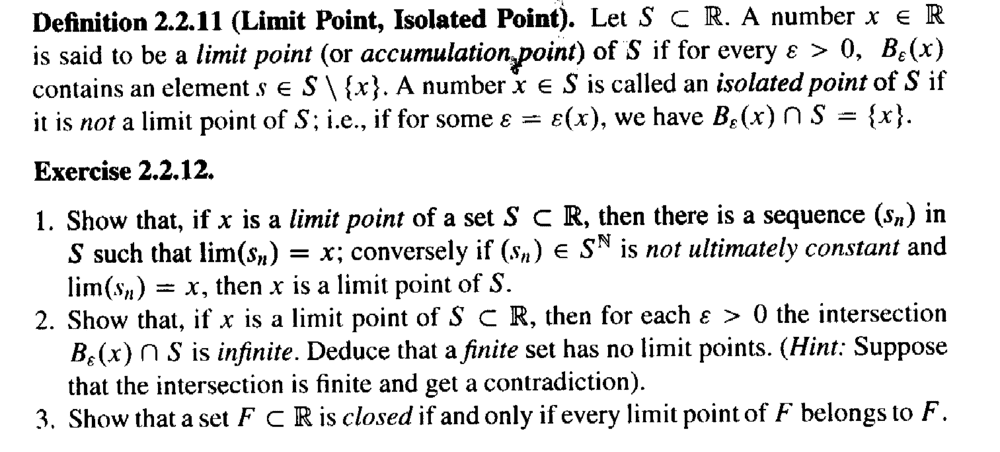
=======================================================================================It may help readers of the above post to have access to Sohrab's definition of a limit point ... so I am providing the relevant text ... as follows ...
Sohrab - Definition 2.2.11 ... Limit Point  ... .png

Hope that helps ...

Peter
 
Physics news on Phys.org
Math Amateur said:
Summary: Question in respect of the proof that compact subsets of R are necessarily closed and bounded ... issue of an open cover with no finite subcover ...
View attachment 245119
In the above proof by Sohrab we read the following:

" ... ... If, to get a contradiction, we assume that ##\xi \notin K## is a limit point of ##K##, then the open cover ##\{ ( - \infty, \xi - 1/n ) \cup ( \xi + 1/n, \infty ) \}_{ n \in \mathbb{N} }## has no finite subcover ... ... "
My question is as follows:

How would we demonstrate rigorously that the open cover ##\{ ( - \infty, \xi - 1/n) \cup ( \xi + 1/n, \infty ) \}_{ n \in \mathbb{N} }## has no finite subcover ... ...?

This should be in homework and you should be presenting your attempt at the solution. One thing you definitely can't learn vicariously is Real Analysis. You have to get stuck into these proofs yourself.
 
  • Like
Likes   Reactions: member 587159
Thanks for the reply PeroK ...

You write:

" ... ... One thing you definitely can't learn vicariously is Real Analysis. ... ... "

I agree ... but I couldn't get a meaningful start on the issue ...

I am still reflecting on the matter and reading other books' similar theorems and proofs to get some ideas ...

Peter
 
Math Amateur said:
Thanks for the reply PeroK ...

You write:

" ... ... One thing you definitely can't learn vicariously is Real Analysis. ... ... "

I agree ... but I couldn't get a meaningful start on the issue ...

I am still reflecting on the matter and reading other books' similar theorems and proofs to get some ideas ...

Peter

You need an idea or strategy for a proof like this. Then , you need to translate the idea into rigorous work.

My first thought was that any finite subcover must have a greatest ##n##, which means the union cannot get arbitrarily close to ##\xi##.
 
  • Like
Likes   Reactions: Math Amateur

Similar threads

  • · Replies 2 ·
Replies
2
Views
2K
  • · Replies 8 ·
Replies
8
Views
3K
  • · Replies 4 ·
Replies
4
Views
2K
  • · Replies 2 ·
Replies
2
Views
2K
Replies
3
Views
2K
  • · Replies 4 ·
Replies
4
Views
2K
  • · Replies 2 ·
Replies
2
Views
1K
Replies
4
Views
2K
  • · Replies 2 ·
Replies
2
Views
2K
Replies
5
Views
2K