Comparison of Different Mammalian Brains

  • Thread starter Thread starter BillTre
  • Start date Start date
  • Tags Tags
    Comparison
Join the discussion
Ask a follow-up here, or get your own question answered by working scientists, mathematicians and engineers — people, not an autocomplete.
Real named experts · corrections over time · the nuance an AI answer skips
11 replies · 4K views
Messages
2,827
Reaction score
12,394
This shows brains from several different (mostly primates and rodents) at the same scale. Obtained from here.
The weight is listed in grams, the (purported) number of neurons is in millions(M). Estimates of neuronal numbers are difficult. Sadly they are not all pointing the same direction.
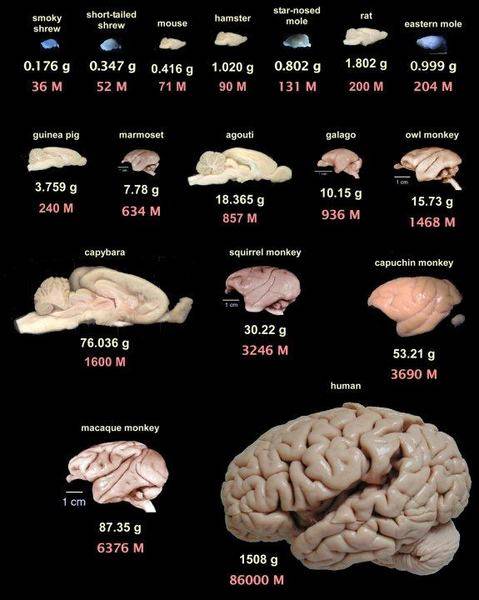
fnhum-03-031-g003.jpg
 
  • Like
Likes   Reactions: jim mcnamara and Drakkith
Biology news on Phys.org
Then there are crows, average sized birds with pea sized brains.
I have seen crows finding a resources such as rubbish bin, and shortly several other crows get invited to the find.
That seems to me to be pretty sophisticated behaviour.
 
Crow are pretty amazing. Some are known for tool use.

I spent a bit of time a couple of years ago watching a couple of crows trying to outsmart each other.
One had a walnut and was trying to drop it on the street to break it, so it could eat the insides. It had to get pretty high to get a good impact.
The other crow was following the first crow around so that it could beat it to the nut when it broke.
The crow with the nut was using a variety of strategies to fake out the second one is it would be the first to the ground where the nut landed.
I never saw them break it open though.
 
There is an old concept: encephalization quotient. This seems to be a pretty good graphic interpretation of that. Thanks.

By 'they are not all pointing in the same direction' I'm guessing you mean mass, e.g., agouti is an outlier. Maybe the neuronal count estimate has a problem?
 
jim mcnamara said:
By 'they are not all pointing in the same direction' I'm guessing you mean mass, e.g., agouti is an outlier. Maybe the neuronal count estimate has a problem?

Nope. Sorry, my poor wording.
The anterior ends of the brains are not all on the left or right side.

Bottom row, anterior is to the: left.
Row above, from left to right, anterior is the: right, left, left
Next row up, anterior is to the: right, left, right, left, left
Top row, anterior is to the: right, right, left, left, right, left, right

It is graphically inconsistent, which really bugs me.

It is interesting though that the agouti has more mass but fewer neurons than the galago or owl monkey.
 
Well, since they could run out and just dissect out the needed brains they probably were stuck with images they already had - although I guess it would have been possible to photoshop some of them. My thinking is that messing with scientific images in that sense is not an ethical approach.

Hmm.
 
I think it would be pretty easy and not affect the integrity of the images to flip them to the opposite direction.
 
Would be interesting to know the extent of synaptic connections in each. The purkinje neuron in the human brain, for example, has about 20,000 connections. I wonder if any of the other mammalian brains come even close to this number. And even more so, how extensive the connections are fed-back in each brain. I went though the article and the number of connections were only mentioned in passing. Seems to me a better ranking of cognition are these two parameters and I suspect the human brain is more so than any other.
 
Lots of (or all) vertebrates have Purkinje cells. They are the main output neuron from the cerebellum. It would not surprise me if other mammals have similar number of synapses on their Purkinje cells.

The cerebellum is a large structure found a the back of the brain in all vertebrates. Most fish have small cerebellums, but it gets really large in mammals and birds. The cerebellum is mostly associated with coordination of muscle activity and dealing with sensory inputs, in particular from ear (hearing), vestibular structures (balance), and the lateral line (only in fish and amphibians). Some fish (such as electro-receptive fish) also have large cerebellums.

The cerebral cortex (in the cerebrum) is what is usually associated with "smarts". It is often compared based on surface area, numbers of layers, neuron count, and synapses.
 
It looks graphically consistent with the way the brains sit inside the skulls of all the animals displayed. Each image looks like an anterior/left to posterior/right perspective to me. All like so:
3D_model_anat_skull_web1.jpg


The ones that seem off, like the squirrel monkey, are because the brain sits that way backwards inside the skull.
product-740-main-main-big-1415040534.jpg
 
Fervent Freyja said:
The ones that seem off, like the squirrel monkey, are because the brain sits that way backwards inside the skull.
There are no brains I know of that sit backwards in their skulls.
The human (and some monkeys) brain would have its spinal cord going in a more downward direction than in most mammals, if it were shown (like it is in the macaque or owl monkey).
The squirrel monkey brain has it anterior to the left. The olfactory bulb is a little blip at the very anterior-most end (left).

Anatomical cues for anterior vs. posterior include the locations of:
Spinal cord (at posterior end, ventral, in many shown extends past the cerebellum).
Cerebellum (small parallel gyri (or gyruses) or branchy cauliflower like structure if sectioned), posterior to the cerebral hemispheres, above the hindbrain/spinal cord.
Olfactory bulb (blob-like structure, very variable sizes and shapes in different species); at anterior end.
Division in the cerebrum between the temporal lobe and pariental/frontal lobes of brain (when shown) slopes up as it goes posterior.

http://www.nature.com/nprot/journal/v2/n11/images/nprot.2007.393-F1.jpg. The cerebrum, cerebral hemispheres, and cerebral cortex are components of the telencephalon in this picture.