Complex Analysis Complex Integration Question

Click For Summary

Homework Help Overview

The discussion revolves around a complex integration problem involving the function z^1/2 and the concept of path independence in contour integration. The original poster expresses confusion regarding the term "principal branch" and its implications for the integration process, particularly in relation to the contour that starts at pi and ends at i on the complex plane.

Discussion Character

  • Conceptual clarification, Assumption checking, Mixed

Approaches and Questions Raised

  • Participants explore the meaning of "principal branch" in the context of complex functions, questioning its relevance to fractional exponents and the specific problem at hand. There is discussion about the definition of the principal branch for both logarithmic and square root functions, as well as the implications for the contour integration.

Discussion Status

The discussion is ongoing, with participants providing insights and clarifications regarding the definitions and properties of complex functions. Some participants have offered guidance on the relationship between the principal branch and the integration process, while others are still seeking to clarify their understanding of the problem's setup.

Contextual Notes

There is mention of a textbook being used, which may provide additional context for the problem. Participants are also considering the implications of the contour's path in relation to the principal branch and whether it intersects any regions where the function is not defined.

ha9981
Messages
31
Reaction score
0
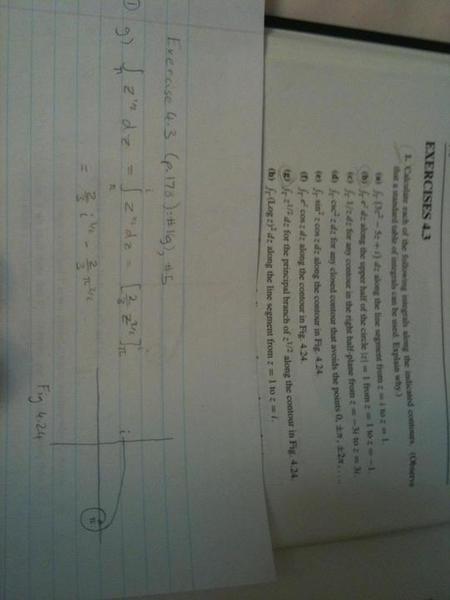
Its question 1(g) in the picture. My work is shown there as well. This has to do with independence of path of a contour. Reason I am suspicious is that first there is a different answer online and second it says "principal branch" which I have not understood. Does that mean a straight line for start to end point?

The contour starts at pi and ends at i on the complex plane. Also the function integrated is z^1/2.

Here is the picture:
uk5cR.jpg


sorry idk why image is flipped side ways when uploading, i fear this will make it even more challenging for someone to want to answer this question.
 
Physics news on Phys.org
Principle branch normally refers to Log, are you sure you are looking at the right problem?

Also what textbook are you using? I'm curious.

Ignore the above, I forgot how fractional exponents are defined.
 
Last edited:
Skrew said:
Principle branch normally refers to Log

This isn't true. There is a principal branch for the square root as well.
 
Dickfore said:
This isn't true. There is a principal branch for the square root as well.

You're right, I forgot how fractional exponets were defined(as it involves log..).
 
Textbook is Fundamentals of Complex Analysis with Applications to Engineering and Science by E. B. Saff & A. D. Snider. Also what has the principal have to do with fractional exponents? Is there a region where it isn't defined?
 
The antiderivative of z^1/2 = 2/3*z^3/2.

Now 2/3*z^3/2 = 2/3*e^ln(z^3/2) = 2/3*e^(3/2*ln(z)) (if I remmember correctly)

Now the fundamental theoreom of calculus in the complex case says that the path is independent in any domain where an antiderivativie exists.

The principle branch of ln is the complex plane excluding the orgin and the negative axis.
 
So the contour in the diagram should have no interference with the principal branch right?
 

Similar threads

  • · Replies 3 ·
Replies
3
Views
2K
Replies
3
Views
2K
Replies
8
Views
3K
Replies
32
Views
4K
  • · Replies 4 ·
Replies
4
Views
3K
  • · Replies 1 ·
Replies
1
Views
2K
Replies
9
Views
2K
  • · Replies 2 ·
Replies
2
Views
1K
  • · Replies 13 ·
Replies
13
Views
3K
Replies
4
Views
2K