Complex logarithm as primitive

Click For Summary

Homework Help Overview

The problem involves calculating the integral $$ \int_{\gamma} \frac{z}{z^2+4} \ dz $$ along a line segment from ## z=2+2i ## to ## z=-2-2i ##. The original poster is attempting to use substitution and a primitive function related to ## \frac{1}{u} ##, while expressing concerns about the branch of the complex logarithm due to the path passing through the origin.

Discussion Character

  • Exploratory, Assumption checking, Problem interpretation

Approaches and Questions Raised

  • Participants discuss the substitution of variables and the implications of the path taken in the complex plane. There are questions about whether the path for ## u ## goes through the origin and how to handle the argument of the logarithm. Some participants express uncertainty about the nature of the path after substitution and whether it forms a loop or remains a line segment.

Discussion Status

The discussion is ongoing, with various interpretations of the path and its implications for the integral. Some participants suggest that the path remains a straight line, while others question whether it encloses any singularities. There is no explicit consensus, but multiple perspectives are being explored regarding the behavior of the integral along the defined path.

Contextual Notes

Participants note the importance of understanding the behavior of the integral around singularities and the implications of the path taken in relation to the complex logarithm. There is a focus on the original poster's preference to avoid alternative methods and instead delve deeper into the current approach.

Rectifier
Gold Member
Messages
313
Reaction score
4
The problem
I am trying to calculate the integral $$ \int_{\gamma} \frac{z}{z^2+4} \ dz $$

Where ## \gamma ## is the line segment from ## z=2+2i ## to ## z=-2-2i ##.

The attempt
I would like to solve this problem using substitution and a primitive function to ## \frac{1}{u} ##. I am not interested in alternative ways of solving this problem right now, thank you for your understanding.

## \int_{\gamma} \frac{z}{z^2+4} \ dz = [u=z^2+4 \, \ \ du = 2z dz] = \\
= \frac{1}{2} \int_{\gamma} \frac{1}{u} \ du = \frac{1}{2} \left[ log(u) \right]_{\gamma} ##

## log(u) = ln|u| + iarg(u) ##

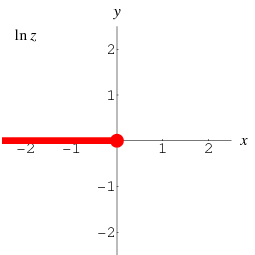
The trouble is: I am not used to line segments that pass through the origin. I don't now which branch to choose for the argument of the complex logarithm since I was thought that when you make the cuts for the branches you cut out 0 and go to infinity on one of the axes. (Is that perhaps wrong?)

Example:
Principal branch for angles ##-\pi<Arg<\pi##
NaturalLogBranchCut_1000.gif


How do I proceed?
 

Attachments

  • NaturalLogBranchCut_1000.gif
    NaturalLogBranchCut_1000.gif
    1.6 KB · Views: 1,174
Physics news on Phys.org
But the path for ##u##, does that go through the origin ?
 
  • Like
Likes   Reactions: Rectifier
Wait, what?
giphy.gif
Could you please elaborate a tiny bit more? I think that I almost get it.

EDIT:
Do you mean that ##u=z^2+4## doesn't go through origo or ## \frac{1}{z}## ?
 
In the original integral you would express ##d{\bf z}\ ## as ##dx+ idy##.

You change variable from ##\bf z## to ##\bf u##

You want to follow a path ##\gamma## so you have to somehow express that in terms of ##u##
 
  • Like
Likes   Reactions: Rectifier
Is it possible to express that without parameterizing the line segment?
BvU said:
You want to follow a path ##\gamma## so you have to somehow express that in terms of ##u##
 
I calculated ##u=z^2+4## when ## z=2+2i ## goes to ## z=-2-2i ## and got that line now goes from ##u=4+8i## to ##u=4+8i##. I am not sure how to interpret this.
 
Well, you can conlude it's still a straight line ... Going from ##u=4+8i## to ##u=4+8i## indeed, but halfway it is at ##u=4+0 i##
 
  • Like
Likes   Reactions: Rectifier
I had to look up a few things to refresh my memory. Liked 26.4 and 29.1 http://www.personal.soton.ac.uk/jav/soton/HELM/helm_workbooks.html
 
  • Like
Likes   Reactions: Rectifier
If you integrate a function around a closed loop (one that ends up where it started), then you will always get zero unless the loop encloses a singularity. So your loop in ##u## is closed. Does it enclose a singularity?
 
  • Like
Likes   Reactions: Rectifier
  • #10
Rectifier said:
The problem
I am trying to calculate the integral $$ \int_{\gamma} \frac{z}{z^2+4} \ dz $$

Where ## \gamma ## is the line segment from ## z=2+2i ## to ## z=-2-2i ##.

The attempt
I would like to solve this problem using substitution and a primitive function to ## \frac{1}{u} ##. I am not interested in alternative ways of solving this problem right now, thank you for your understanding.

## \int_{\gamma} \frac{z}{z^2+4} \ dz = [u=z^2+4 \, \ \ du = 2z dz] = \\
= \frac{1}{2} \int_{\gamma} \frac{1}{u} \ du = \frac{1}{2} \left[ log(u) \right]_{\gamma} ##

## log(u) = ln|u| + iarg(u) ##

The trouble is: I am not used to line segments that pass through the origin. I don't now which branch to choose for the argument of the complex logarithm since I was thought that when you make the cuts for the branches you cut out 0 and go to infinity on one of the axes. (Is that perhaps wrong?)

Example:
Principal branch for angles ##-\pi<Arg<\pi##
View attachment 223291

How do I proceed?


Why are you doing it the hard way? Is it not a lot easier to note that on the path from##z = 2 + 2i## to ##z = -2 - 2i## we have ##z = 2+2i - (1+i)t = (1+i)(2-t), 0 \leq t \leq 4?##
 
  • Like
Likes   Reactions: Rectifier
  • #11
Well Ray, apparently ours is not to reason why :smile:
Rectifier said:
I am not interested in alternative ways of solving this problem right now, thank you for your understanding.
 
  • Like
Likes   Reactions: Rectifier
  • #12
BvU said:
Well, you can conlude it's still a straight line ... Going from ##u=4+8i## to ##u=4+8i## indeed, but halfway it is at ##u=4+0 i##

How did you get that the value is ##u=4+0## halfway? The halfway point of the line in the beginning is at ##z=0 + 0i = 0##. Then I guess you set ##z=0## here: ##u=z^2+4## and got ##u=4##

stevendaryl said:
If you integrate a function around a closed loop (one that ends up where it started), then you will always get zero unless the loop encloses a singularity. So your loop in ##u## is closed. Does it enclose a singularity?

Is it a loop or is it a line segment again after the variable substitution? I have figured out that it starts and ends at the same point and that the halfway point is ##u=4##. ## \frac{1}{u} ## has a pole at u=0 but I am not sure wether the pole is outside or inside the loop since I am not sure how the line segment/loop behaves in between.

stevendaryl said:
So your loop in ##u## is closed. Does it enclose a singularity?

The only thing I could think of is to set ##u=0## here ## u=z^2+4 ##. That way I get ## z = \pm 2i ##. I interpret this as: when ## z = \pm 2i ## then the pole ## u=0 ## is included, but since the line segment doesn't include either of the values that means that ##u=0## is not inside the loop or on the line segment, right?

So now that (I assume that) the loop/line segment is in the first quadrant I could choose the principal branch without worrying about ##u=0##.
 
  • #13
Ray Vickson said:
Why are you doing it the hard way? Is it not a lot easier to note that on the path from##z = 2 + 2i## to ##z = -2 - 2i## we have ##z = 2+2i - (1+i)t = (1+i)(2-t), 0 \leq t \leq 4?##
I already know how to solve this problem that way. Thank you for your suggestion nevertheless.

Trying to solve problems differently highlights errors in my understanding of other concepts in that area. I am not interested in solving problems just to get it right but I would like to learn from my mistakes and my inability to preform certain calculations.
 
Last edited:
  • #14
Rectifier said:
Is it a loop or is it a line segment again after the variable substitution? I have figured out that it starts and ends at the same point and that the halfway point is ##u=4##. ## \frac{1}{u} ## has a pole at u=0 but I am not sure wether the pole is outside or inside the loop since I am not sure how the line segment/loop behaves in between.
The original z path is on radial lines to and from the origin. When z is squared, that becomes a path that goes to the origin along a ray and then back out on the same ray to where it started. Adding 4 just shifts that path. So there is no "loop" except a degenerate one that goes on a line to 4 and turns around to go straight back to where it started. The figure below shows the actual paths with Z and U half way along the path.

complexLines.png
 

Attachments

  • complexLines.png
    complexLines.png
    2.9 KB · Views: 468
  • Like
Likes   Reactions: Rectifier

Similar threads

Replies
13
Views
2K
Replies
1
Views
2K
Replies
23
Views
2K
Replies
8
Views
3K
  • · Replies 1 ·
Replies
1
Views
2K
  • · Replies 14 ·
Replies
14
Views
3K
  • · Replies 2 ·
Replies
2
Views
3K
  • · Replies 14 ·
Replies
14
Views
3K
  • · Replies 8 ·
Replies
8
Views
2K
  • · Replies 8 ·
Replies
8
Views
1K