Complex ion oxidation state (with pic)

7 replies · 3K views · last reply
r12214001
Messages
24
Reaction score
2
Homework Statement
What are the oxidation states of the cobalt ions?
Relevant Equations
N/A
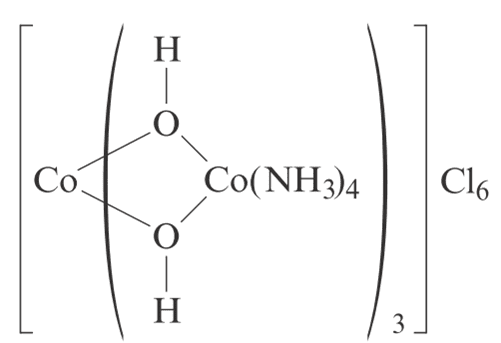
question fig:
Structural formula of a bridged cobalt complex in square brackets: two Co atoms joined through two bridging OH groups, one Co bonded to four NH3 ligands, with subscript 3 outside and Cl6 outside the brackets.

solution manual:
Typed solution text stating all three cobalt complexes are Co(III), each ligand has 2 OH- and 4 NH3 groups, giving each ligand a +1 charge and a +6 total balanced by six Cl- ions.

my solution:
oxidation state of central cobalt is +6 due to 6 oxygen surrounding it,The other cobalt is +2 due to 2 oxygen surrounding it with NH3 ligand which is no count for oxidation state.
 
First of all, please remember oxidation state doesn't exist - it is merely an accounting device helping in electron bookkeeping, in most cases there is no measurable property of an atom that can be measured and called "oxidation state".

Then, assigning oxidation states to atoms in large complexes doesn't make much sense. They don't exist in separation but are all part of molecule and are bonded with molecular orbitals. Using arbitrary rules to assign some number to an atom doesn't produce any real insight into what is really happening. We can measure charge density with some spectroscopic methods, but it will show electron cloud that can't be easily split into "charges on atoms".
 
  • Like
Likes   Reactions: Bystander
On the other hand...

Let us evaluate your answer. You say that the central Co is +6 and each of the three “ligand” Co complexes contains a Co+2. This gives a total charge of 6+2+2+2=+12. This total charge is balanced by only 6 Cl-1?
 
I agree with Borek as a theoretical chemist, but from practical chemistry side, there are many examples where oxidation state is useful beyond electron counting. E.g. there are compounds like Fe3O4 where the iron ions are in differently coordinated sites and also differ in their spectroscopic behaviour so that the compound is better regarded as an Fe(II) Fe(III)2 O4 than a Fe(2.66)3O4.
 
Borek said:
First of all, please remember oxidation state doesn't exist - it is merely an accounting device helping in electron bookkeeping, in most cases there is no measurable property of an atom that can be measured and called "oxidation state".

Then, assigning oxidation states to atoms in large complexes doesn't make much sense. They don't exist in separation but are all part of molecule and are bonded with molecular orbitals. Using arbitrary rules to assign some number to an atom doesn't produce any real insight into what is really happening. We can measure charge density with some spectroscopic methods, but it will show electron cloud that can't be easily split into "charges on atoms".
According to textbook, what you said is true but I still have to tackle the exam...please educate me why its oxidation number is 3 for all cobalts
 
  • Like
Likes   Reactions: chemisttree
You would have to know that Co+6 is not a known oxidation state of cobalt. That unknown ion (maybe you will find it in the sun’s coronasphere) would be isoelectronic with scandium. [Ar]4s23d1 would be pretty unusual for Co, right? And try to add six pairs of electrons to that and see if it looks right to you?