Undergrad Complex-Linear Matrices & C-Linear Transformations .... Tapp, Propn 2.4 ....

Click For Summary
The discussion revolves around proving the assertion that a function F is complex-linear if and only if F(i · X) = i · F(X) for all X in C^n, as stated in Kristopher Tapp's Proposition 2.4. The initial query seeks clarification on this proof, particularly how to establish the complex-linear condition from the real-linear properties of F. After some reflection, it is noted that if F is complex-linear, the condition follows directly. The proof then elaborates on how to demonstrate the required condition using the definitions of real and complex linearity, ultimately confirming the correctness of the approach. The discussion concludes with affirmation of the proof's validity.
Math Amateur
Gold Member
MHB
Messages
3,920
Reaction score
48
TL;DR
I am reading Kristopher Tapp's book: Matrix Groups for Undergraduates.

I am currently focused on and studying Section 1 in Chapter2, namely:

"1. Complex Matrices as Real Matrices".

I need help in fully understanding how to prove an assertion related to Tapp's Proposition 2.4.
I am reading Kristopher Tapp's book: Matrix Groups for Undergraduates.

I am currently focused on and studying Section 1 in Chapter2, namely:

"1. Complex Matrices as Real Matrices".

I need help in fully understanding how to prove an assertion related to Tapp's Proposition 2.4.

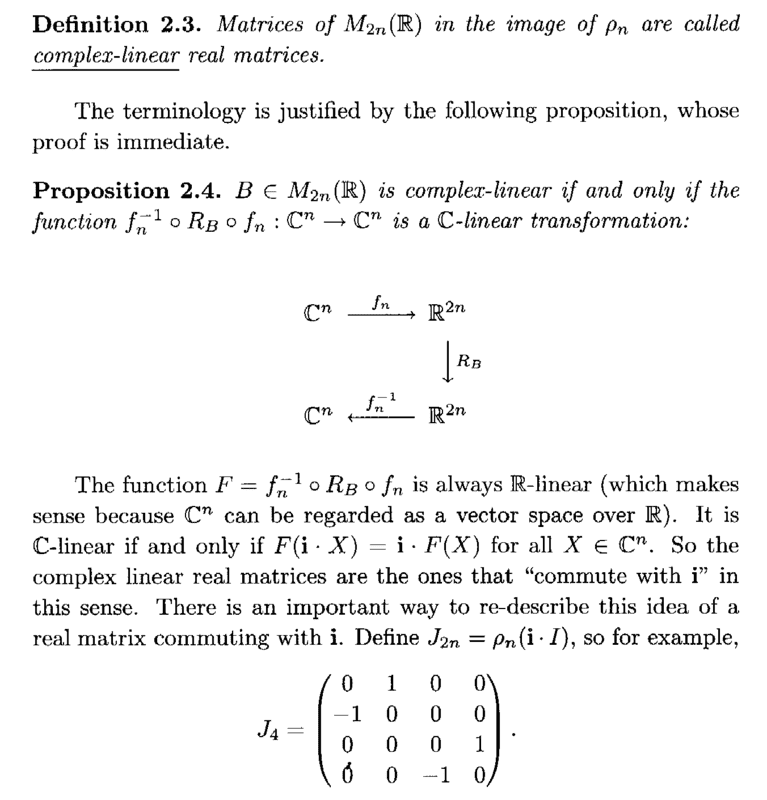
Proposition 2.4 and some comments following it read as follows:
Tapp - Defn 2.3 & Proposition 2.4 ... .png


In the remarks following Proposition 2.4 we read the following:

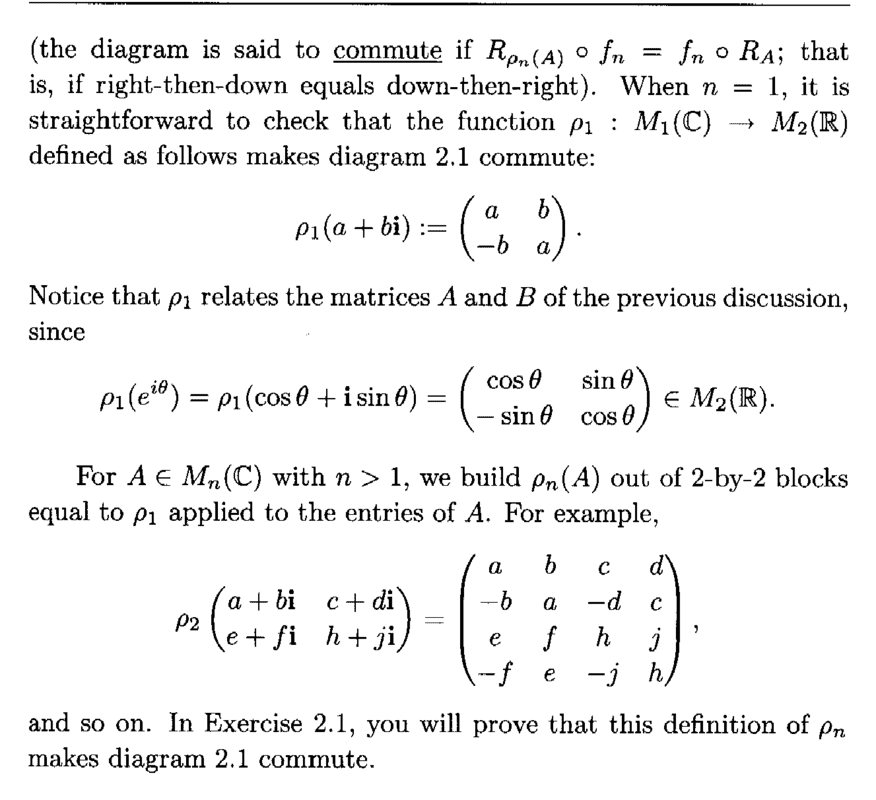
" ... ... It (##F##) is ##\mathbb{C}##-linear if and only if ##F(i \cdot X) = i \cdot F(X)## for all ##X \in \mathbb{C}^n## ... "My question is as follows ... can someone please demonstrate a proof of the fact that ##F## is ##\mathbb(C)##-linear if and only if ##F(i \cdot X) = i \cdot F(X)## for all ##X \in \mathbb{C}^n## ...
Help will be much appreciated ...

Peter===================================================================================
*** EDIT ***

After a little reflection it appears that " ... ##F## is ##\mathbb{C}##-linear ##\Longrightarrow F(i \cdot X) = i \cdot F(X)## ... " is immediate as ...

... taking ##c = i## we have ...

##F(c \cdot X ) = c \cdot F(X) \Longrightarrow F(i \cdot X) = i \cdot F(X)## for ##c \in \mathbb{C}##Is that correct?

Peter

=======================================================================================
=======================================================================================

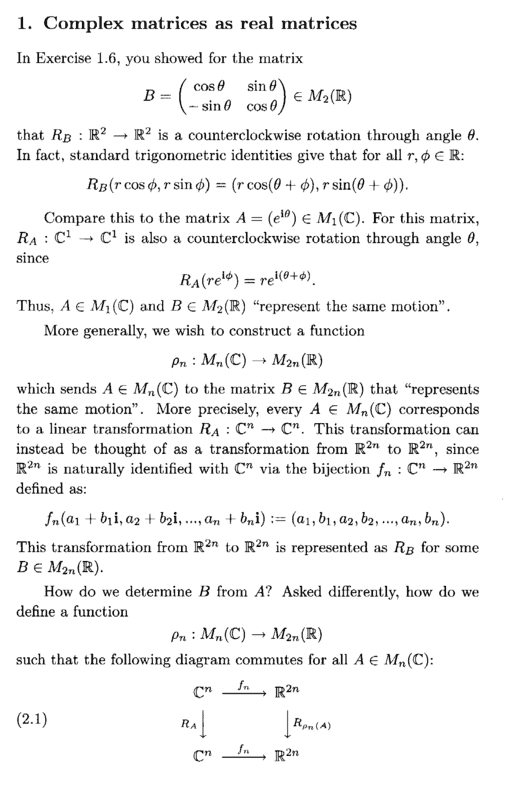
Note that Tapp defines##\rho_n## and ##f_n## in the following text ... ...
Tapp - 1 - Chapter 2, Section 1 - PART 1 ... .png

Tapp - 2 - Chapter 2, Section 1 - PART 2 ... .png

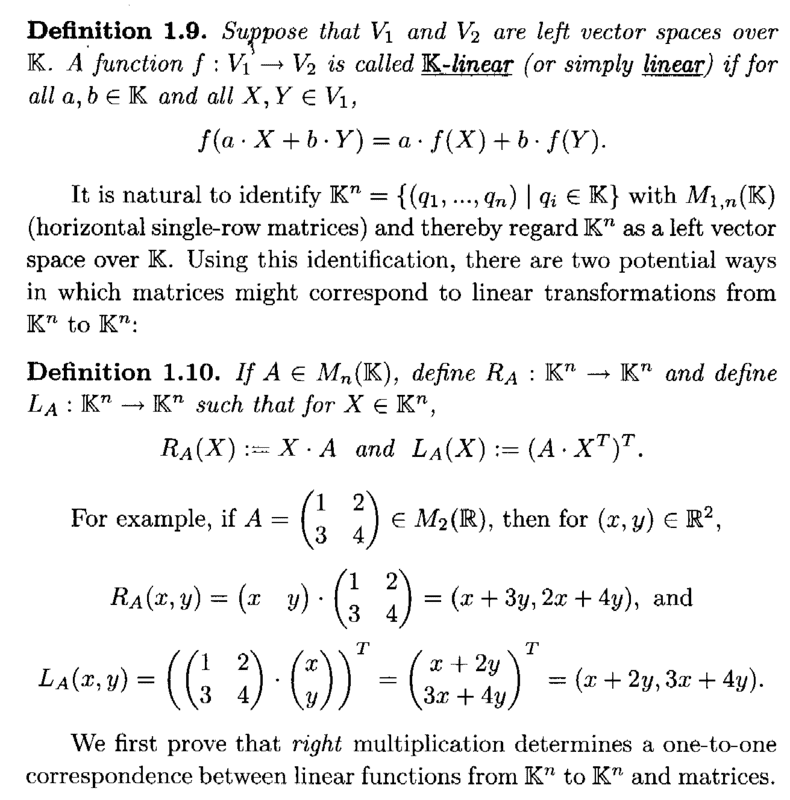
Also note that ##R_B## (actually ##R_A##) is defined in the following text ...
Tapp - Defn 1.9 & Defn 1.10 ... .png
Hope the provision of the above text helps with definitions, notation and context ...

Peter
 
Physics news on Phys.org
The proof uses that a map ##T:V\to W## between ##\mathbb{C}##-vector spaces is ##\mathbb{C}##-linear if and only if if ##\mathbb{R}##-linear and ##T(iv)=iT(v)## for all ##v\in V##.

From left to right is obvious by the definition, from right to left requires a little easy two-line proof.

Note that in the proof one says that ##T## is ##\mathbb{C}## linear if and only if ##T(iv) = iT(v)## for all ##v\in V## since it was already established that ##T## was ##\mathbb{R}##-linear.
 
Last edited by a moderator:
  • Like
Likes Math Amateur
Math_QED said:
The proof uses that a map ##T:V\to W## between ##\mathbb{C}##-vector spaces is ##\mathbb{C}##-linear if and only if if ##\mathbb{R}##-linear and ##T(iv)=iT(v)## for all ##v\in V##.

From left to right is obvious by the definition, from right to left requires a little easy two-line proof.

Note that in the proof one says that ##T## is ##\mathbb{C}## linear if and only if ##T(iv) = iT(v)## for all ##v\in V## since it was already established that ##T## was ##\mathbb{R}##-linear.
Thanks for the post and the hint ...

We are considering ##F \ : \ \mathbb{C}^n \to \mathbb{C}^n## where ##F = f_n^{ -1 } \circ R_B \circ f_n## ...

We know that ##F## is ##\mathbb{R}##-linear ... that is ...

##F(X + Y) = F(X) + F(Y)## for all ##X, Y \in \mathbb{C}^n## ... ... ... ... ... (1)

... and ...

##F(rX) = r F(X)## for all ##X \in \mathbb{C}^n## and ##r \in \mathbb{R}## ... ... ... ... ... (2)We have to prove that ##F## is ##\mathbb{C}##-linear ... ...

... that is ...

##F(X + Y) = F(X) + F(Y)## for all ##X, Y \in \mathbb{C}^n## ...

... which holds from the ##\mathbb{R}##-linear case ...

and ...

##F(cX) = cF(X)## for all ##X \in \mathbb{C}^n## and ##c \in \mathbb{C}## ... ... ... ... ... (3)So ... essentially we have to prove (3) ...

So then ... let ##c = a + bi## ... and proceed as follows ...

##F(cX) = F( (a+bi)X)##

##= F(aX + biX)##

##= F(aX) + F(biX)## since ##F## is ##\mathbb{R}##-linear

##= F(aX) + iF(bX)## since ##F(iY) = iF(Y)##

##= aF(X) + biF(X)## since ##F## is ##\mathbb{R}##-linear

##= (a +bi)F(X)##

##= cF(X)##Hope the above is correct ... ...

Peter
 
Math Amateur said:
Thanks for the post and the hint ...

We are considering ##F \ : \ \mathbb{C}^n \to \mathbb{C}^n## where ##F = f_n^{ -1 } \circ R_B \circ f_n## ...

We know that ##F## is ##\mathbb{R}##-linear ... that is ...

##F(X + Y) = F(X) + F(Y)## for all ##X, Y \in \mathbb{C}^n## ... ... ... ... ... (1)

... and ...

##F(rX) = r F(X)## for all ##X \in \mathbb{C}^n## and ##r \in \mathbb{R}## ... ... ... ... ... (2)We have to prove that ##F## is ##\mathbb{C}##-linear ... ...

... that is ...

##F(X + Y) = F(X) + F(Y)## for all ##X, Y \in \mathbb{C}^n## ...

... which holds from the ##\mathbb{R}##-linear case ...

and ...

##F(cX) = cF(X)## for all ##X \in \mathbb{C}^n## and ##c \in \mathbb{C}## ... ... ... ... ... (3)So ... essentially we have to prove (3) ...

So then ... let ##c = a + bi## ... and proceed as follows ...

##F(cX) = F( (a+bi)X)##

##= F(aX + biX)##

##= F(aX) + F(biX)## since ##F## is ##\mathbb{R}##-linear

##= F(aX) + iF(bX)## since ##F(iY) = iF(Y)##

##= aF(X) + biF(X)## since ##F## is ##\mathbb{R}##-linear

##= (a +bi)F(X)##

##= cF(X)##Hope the above is correct ... ...

Peter

Yes, completely correct. Well done!
 
  • Like
Likes Math Amateur
I am studying the mathematical formalism behind non-commutative geometry approach to quantum gravity. I was reading about Hopf algebras and their Drinfeld twist with a specific example of the Moyal-Weyl twist defined as F=exp(-iλ/2θ^(μν)∂_μ⊗∂_ν) where λ is a constant parametar and θ antisymmetric constant tensor. {∂_μ} is the basis of the tangent vector space over the underlying spacetime Now, from my understanding the enveloping algebra which appears in the definition of the Hopf algebra...

Similar threads

Replies
2
Views
2K
Replies
10
Views
3K
  • · Replies 7 ·
Replies
7
Views
2K
  • · Replies 5 ·
Replies
5
Views
2K
  • · Replies 23 ·
Replies
23
Views
2K
  • · Replies 3 ·
Replies
3
Views
2K
  • · Replies 2 ·
Replies
2
Views
2K
  • · Replies 2 ·
Replies
2
Views
2K
  • · Replies 2 ·
Replies
2
Views
1K
  • · Replies 3 ·
Replies
3
Views
2K