Yankel
- 390
- 0
Hello all,
I am trying to find the algebraic representation of the following numbers:
\[rcis(90^{\circ}+\theta )\]
and
\[rcis(90^{\circ}-\theta )\]
The answers in the book are:
\[-y+ix\]
and
\[y+ix\]
respectively.
I don't get it...
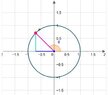
In the first case, if I take 90 degrees (working with degrees, not radians in this question) plus the angel, I get a point in the second quadrant. Why isn't the answer -x+iy ?
View attachment 6854
Thank you !
I am trying to find the algebraic representation of the following numbers:
\[rcis(90^{\circ}+\theta )\]
and
\[rcis(90^{\circ}-\theta )\]
The answers in the book are:
\[-y+ix\]
and
\[y+ix\]
respectively.
I don't get it...
In the first case, if I take 90 degrees (working with degrees, not radians in this question) plus the angel, I get a point in the second quadrant. Why isn't the answer -x+iy ?
View attachment 6854
Thank you !
Attachments