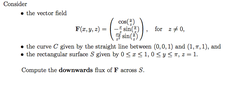
Compute the downwards flux of F

  • Topic:
  • Thread starter Thread starter Uniman
  • Start date Start date
  • Tags Tags
    Flux
Join the discussion
Registration is free. Start your own thread to ask a follow-up.
1 reply · 2K views
Uniman
Messages
11
Reaction score
0
Attachments
  • Screen Shot 2012-10-19 at 6.19.57 PM.png
    Screen Shot 2012-10-19 at 6.19.57 PM.png
    11.3 KB · Views: 119
Physics news on Phys.org
Uniman said:
https://www.physicsforums.com/attachments/418
The work done so far

https://www.dropbox.com/s/qmfidqot3nttlw5/phpQd8GGH.png
https://www.dropbox.com/s/xn4t5m2aleopwy7/phpldZ0KX.png

Is the answer correct...

Hi Univman, :)

The links to your work on the problem seem not to work. Anyway, you have been given the vector field,

\[\mathbf{F}(x,y,z)=\mathbf{i} \cos\left( \frac{y}{z}\right)-\mathbf{j} \frac{x}{z} \sin \left(\frac{y}{z}\right)+\mathbf{k} \frac{xy}{z^2} \sin \left( \frac{y}{z} \right)\]

The downward flux of \(\mathbf{F}\) over \(S\) is given by,

\[\iint_{S}\mathbf{F}.(-\mathbf{k})\,dS=-\iint_{S}\mathbf{F}.\mathbf{k}\,dS=-\iint_{S}\frac{xy}{z^2}\sin\left(\frac{y}{z}\right)\,dS\]

On the surface \(S\); \(z=1\). Therefore we have,

\[\iint_{S}\mathbf{F}.(-\mathbf{k})\,dS=-\iint_{S}xy\sin y\,dS=-\int_{x=0}^{1}\int_{y=0}^{\pi}xy\sin y\,dy\,dx\]

Hope you can continue. :)

Kind Regards,
Sudharaka.