fab13
- 300
- 7
I try to get a correct result for the radius of a standard white dwark (roughly 10000 km).
I just want the order of magnitude , i.e with the common values of a solar mass into Earth radius sphere.
From http://www.astro.umontreal.ca/~bergeron/CoolingModels/Synthetic_Calibration.pdf page 1223, I took the following (typical ?) values to compute this radius :
##\Phi_{\text{bolometric}}=10^{-9}\,\text{erg}.\text{cm}^{-2}.\text{s}^{-1}##
##T_{\text{surface}}=10000 K##, ##\text{D}=140## parsec,
and by using the following formula :
##R=\sqrt{\dfrac{ \Phi_{\text{bolometric}} D^{2}}{\sigma T^{4}}}##
Then I calculate the radius with all these values in (SI) units ##(1\,erg.cm^{-2} = 10^{-7} 10^{4}\,J.m^{-2}=10^{-3}\,J.m^{-2}##
$$Radius = \sqrt{\dfrac{(10^{-9}*10^{-7}*10^4*(140*3.26*3600*24*365*3*10^8)^2)}{(5.67*10^{-8}*(10000^4)}}$$
and I get ##Radius = 1.8134\,10^8 \,\text{meters} = 1.8134\,10^{5} \,\text{kilometers}##
That's too high as result, I expect rather a scale ##10^{3}## km < Radius < ##10^{4}## km.
If someone could tell me where is my error to get a standard value of radius for a white dwarf ?
UPDATE :
I get expected results with a flux equal to : ##\Phi_{\text{bolometric}}=10^{-12}## erg.s^-1.cm^-2
such that :
##Radius = \sqrt{\dfrac{(10^{-12}*10^{-7}*10^4*(140*3.26*3600*24*365*3*10^8)^2)}{(5.67*10^{-8}*(10000^4)}}##
= 5.7343 10^3 km
Anyone could confirm me the typical value of a bolometric flux (apparent brightness) equal to ##10^{-12}##erg.s^-1.cm^-2 for a white dwarf distant from 140 pc ?
I have difficulties to do the link between the monochromatic spectral flux (exprimed in erg.cm^-2.s^-1.Angstrom^-1) and the total flux ( in erg.cm^-2.s^-1, i.e the monochromatic spectral flux integrated on all wavelength), like for example in this figure :
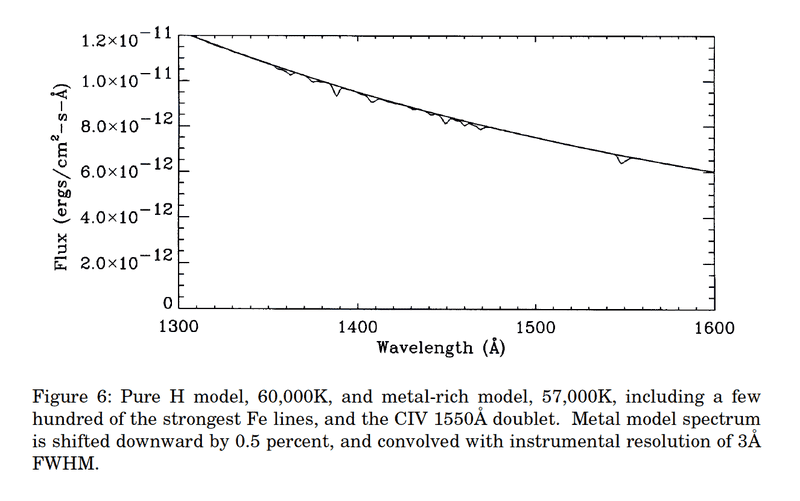
But from this figure, I can only get the total flux between 1300 and 1600 Angstrom, not the total flux over all wavelengths (##\Phi_{\text{bolometric}}(1300<\lambda<1600)\,\approx\,8*10^{-12}*300\,\approx\,2.4*10^{-9}\, erg.cm^-2.s^-1##)
Any help or suggestion is welcome, regards
I just want the order of magnitude , i.e with the common values of a solar mass into Earth radius sphere.
From http://www.astro.umontreal.ca/~bergeron/CoolingModels/Synthetic_Calibration.pdf page 1223, I took the following (typical ?) values to compute this radius :
##\Phi_{\text{bolometric}}=10^{-9}\,\text{erg}.\text{cm}^{-2}.\text{s}^{-1}##
##T_{\text{surface}}=10000 K##, ##\text{D}=140## parsec,
and by using the following formula :
##R=\sqrt{\dfrac{ \Phi_{\text{bolometric}} D^{2}}{\sigma T^{4}}}##
Then I calculate the radius with all these values in (SI) units ##(1\,erg.cm^{-2} = 10^{-7} 10^{4}\,J.m^{-2}=10^{-3}\,J.m^{-2}##
$$Radius = \sqrt{\dfrac{(10^{-9}*10^{-7}*10^4*(140*3.26*3600*24*365*3*10^8)^2)}{(5.67*10^{-8}*(10000^4)}}$$
and I get ##Radius = 1.8134\,10^8 \,\text{meters} = 1.8134\,10^{5} \,\text{kilometers}##
That's too high as result, I expect rather a scale ##10^{3}## km < Radius < ##10^{4}## km.
If someone could tell me where is my error to get a standard value of radius for a white dwarf ?
UPDATE :
I get expected results with a flux equal to : ##\Phi_{\text{bolometric}}=10^{-12}## erg.s^-1.cm^-2
such that :
##Radius = \sqrt{\dfrac{(10^{-12}*10^{-7}*10^4*(140*3.26*3600*24*365*3*10^8)^2)}{(5.67*10^{-8}*(10000^4)}}##
= 5.7343 10^3 km
Anyone could confirm me the typical value of a bolometric flux (apparent brightness) equal to ##10^{-12}##erg.s^-1.cm^-2 for a white dwarf distant from 140 pc ?
I have difficulties to do the link between the monochromatic spectral flux (exprimed in erg.cm^-2.s^-1.Angstrom^-1) and the total flux ( in erg.cm^-2.s^-1, i.e the monochromatic spectral flux integrated on all wavelength), like for example in this figure :
But from this figure, I can only get the total flux between 1300 and 1600 Angstrom, not the total flux over all wavelengths (##\Phi_{\text{bolometric}}(1300<\lambda<1600)\,\approx\,8*10^{-12}*300\,\approx\,2.4*10^{-9}\, erg.cm^-2.s^-1##)
Any help or suggestion is welcome, regards
Attachments
