Discussion Overview
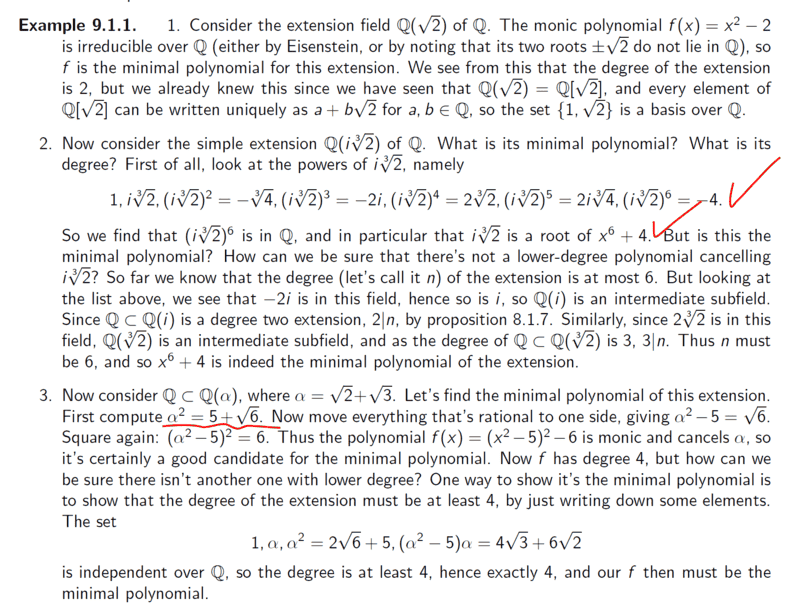
The discussion revolves around the computation of the minimal polynomial in the context of ring theory, specifically addressing a potential mistake in a mathematical text regarding the expression for ##\alpha^2##. Participants also explore proofs related to the irrationality of ##\sqrt{2}##, referencing Eisenstein's theorem and alternative approaches.
Discussion Character
- Technical explanation
- Debate/contested
Main Points Raised
- One participant identifies a potential mistake in a mathematical text regarding the expression for ##\alpha^2##, suggesting it should be ##\alpha^2=5+2\sqrt{6}##.
- Another participant agrees with the correction, stating that the highlighted part is indeed a mistake and confirms the value is correct in another part of the text.
- A participant mentions a proof of the irrationality of ##\sqrt{2}## using Eisenstein's theorem, noting that the polynomial ##x^2 - 2## has no rational solutions.
- Another participant challenges the reliance on Eisenstein's theorem, arguing that the proof can be established without it by demonstrating a contradiction based on the properties of integers.
Areas of Agreement / Disagreement
There is agreement on the correction of the expression for ##\alpha^2##, but there is disagreement regarding the necessity of Eisenstein's theorem in proving the irrationality of ##\sqrt{2}##, with differing opinions on the sufficiency of alternative methods.
Contextual Notes
The discussion includes varying interpretations of mathematical proofs and theorems, with some participants relying on specific properties of integers and others on established theorems, indicating a nuanced understanding of the topic.