Example of an Inseparable Polynomial .... Lovett, Page 371 ...

  • Context: Undergrad 
  • Thread starter Thread starter Math Amateur
  • Start date Start date
  • Tags Tags
    Example Polynomial
Click For Summary

Discussion Overview

The discussion revolves around Example 7.7.4 from "Abstract Algebra: Structures and Applications" by Stephen Lovett, focusing on the concept of inseparable polynomials and field extensions. Participants seek clarification on the minimal polynomial of certain elements and the nature of the field extensions involved.

Discussion Character

  • Exploratory
  • Technical explanation
  • Debate/contested

Main Points Raised

  • Peter seeks clarification on how Lovett establishes that the minimal polynomial is ##m(t) = t^3 - x##, questioning the definitions of ##t## and ##x## and their respective fields.
  • Some participants assert that the example illustrates an inseparable field extension, emphasizing the need for a prime characteristic, specifically ##p=3##, and the use of the field ##F_3##.
  • There is a contention regarding the element being adjoined; some participants clarify that it is ##\sqrt[3]{x}## rather than ##\sqrt[3]{2}##, which they argue is a critical distinction.
  • Participants discuss the implications of the characteristic of the field, noting that in ##F_3(x)##, the polynomial equation holds due to the properties of the Frobenius homomorphism.
  • Peter acknowledges a typographical error in his original post regarding the element ##\sqrt[3]{2}##, which he corrects to ##\sqrt[3]{x}##, indicating that this changes the context of the discussion significantly.

Areas of Agreement / Disagreement

Participants express differing views on the nature of the elements involved and the implications for the minimal polynomial. There is no consensus on the interpretation of the example, and multiple competing views remain regarding the definitions and properties of the polynomials discussed.

Contextual Notes

Participants note that the understanding of inseparable extensions and minimal polynomials is contingent on the definitions of the elements involved and the characteristics of the fields. The discussion highlights the complexity of field extensions and the importance of precise terminology.

Math Amateur
Gold Member
MHB
Messages
3,920
Reaction score
48
I am reading "Abstract Algebra: Structures and Applications" by Stephen Lovett ...

I am currently focused on Chapter 7: Field Extensions ... ...

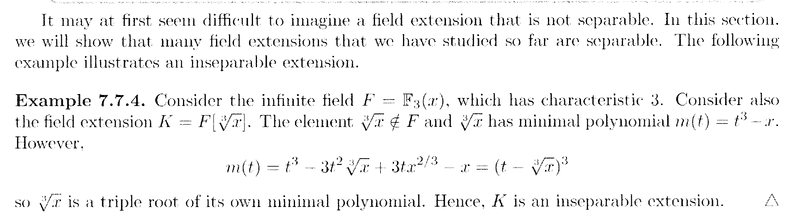
I need help with Example 7.7.4 on page 371 ...Example 7.7.4 reads as follows:
?temp_hash=385979292a0bb64e3c80730401d6092c.png


In the above text from Lovett we read the following:" ... ... The element ##\sqrt[3]{2} \notin F## and ##\sqrt[3]{2}## has minimal polynomial ...##m(t) = t^3 - x##.However,##m(t) = t^3 - 3t^2 \sqrt[3]{2} + 3t x^{ 2/3 } - x = (t - \sqrt[3]{2} )^3##... ... ... ... "
My questions are as follows:
Question 1

How does Lovett establish that the minimum polynomial is

##m(t) = t^3 - x##?Indeed, what exactly is ##t##? ... what is ##x##? Which fields/rings do ##t, x## belong to?[My apologies for asking basic questions ... but unsure of the nature of this example!]
Question 2How does Lovett establish that##m(t) = t^3 - 3t^2 \sqrt[3]{2} + 3t x^{ 2/3 } - x = (t - \sqrt[3]{2} )^3##
Help will be appreciated ...

Peter
[NOTE: I understand that the issues in this example are similar to those of other of my posts ... but ... for clarity and to avoid mixing/confusing conversational threads and issues I have decided to post this example separately ... ... ]
 

Attachments

  • Lovett - Example of an Insepable Extension ... Section 7.7, page 371 ... ....png
    Lovett - Example of an Insepable Extension ... Section 7.7, page 371 ... ....png
    19.5 KB · Views: 539
Physics news on Phys.org
Hi Peter,

this is the same example I quoted in your other post on the subject. Seems to be the standard example for an inseparable field extension.

First of all, as characteristic zero fields and finite fields are all separable, we need a prime characteristic, here ##p=3## and an infinite field. Therefore Lovett considers ##F_3## as ground field and ##F_3(x)## as field extension. Now you may consider ##x## as an indeterminate or a transcendental number over ##F_3##. It doesn't make a difference. (See my post here: https://www.physicsforums.com/threads/field-extensions-and-free-parameters.916207/#post-5778146)

Math Amateur said:
" ... ... The element ##\sqrt[3]{2} \notin F## and ##\sqrt[3]{2}## has minimal polynomial ...
No. He adjoins ##\sqrt[3]{x}##, not ##\sqrt[3]{2}##. This is an essential difference here!
##m(t) = t^3 - x##.
However,
##m(t) = t^3 - 3t^2 \sqrt[3]{2} + 3t x^{ 2/3 } - x = (t - \sqrt[3]{2} )^3##
... ... ... ... "
No. Again, he adjoins ##\sqrt[3]{x}##, not ##\sqrt[3]{2}##. This is an essential difference here!
My questions are as follows:

Question 1
How does Lovett establish that the minimum polynomial is
##m(t) = t^3 - x##?
Indeed, what exactly is ##t##? ... what is ##x##? Which fields/rings do ##t, x## belong to?
Set ##\alpha := \sqrt[3]{x} ##. What is the minimal polynomial of it over ##F_3(x)##? ## \alpha^3 =x ## so ##\alpha^3-x=0## and ##t^3-x## is the minimal polynomial, an element of ##F_3(x)[t]## where ##t## is the indeterminate, the variable of the polynomial ring. ##x## is already used as transcendental number, or if you like as another indeterminate, that constitutes the field ##F_3(x)##. However, ##\sqrt[3]{2}## does not, because ##2 \cdot 2 \cdot 2= 2## which means ##2 \in F_3## has a third root in ##F_3##, namely ##2## itself.
Question 2
How does Lovett establish that
##m(t) = t^3 - 3t^2 \sqrt[3]{2} + 3t x^{ 2/3 } - x = (t - \sqrt[3]{2} )^3##
No. Again, he adjoins ##\sqrt[3]{x}##, not ##\sqrt[3]{2}##. This is an essential difference here!
[NOTE: I understand that the issues in this example are similar to those of other of my posts ... but ... for clarity and to avoid mixing/confusing conversational threads and issues I have decided to post this example separately ... ... ]

I suggest to read the post I quoted. It is from today so should be new to you. Lovett simply needs two different variables: one as the indeterminate for a polynomial ring, the other as either an indeterminate of a quotient field ##F_3(x)## of the polynomial ring ##F_3[x]## or as transcendental number (over ##F_3##) if you like this better. It is the same. You can also simply take ##x:=\pi## which will work the same way.

Edit (ad question 2):

As a field extension is inseparable if and only if there is a ##p-##th root (here ##p=3##) of an element that does not lie in the field already, we have to consider polynomials of the kind ##t^3-x## where ##x## is that element. The polynomial equation holds, because ##3=0## in a field ##F_3(x)## of characteristic ##3##. This is called the Frobenius homomorphism. It is the a ring homomorphism ##a \mapsto a^p##. And since all terms in between are divisible by ##p##, we have ##(t-\sqrt[p]{x})^p=t^p-x##.
 
Last edited:
  • Like
Likes   Reactions: Math Amateur
fresh_42 said:
Hi Peter,

this is the same example I quoted in your other post on the subject. Seems to be the standard example for an inseparable field extension.

First of all, as characteristic zero fields and finite fields are all separable, we need a prime characteristic, here ##p=3## and an infinite field. Therefore Lovett considers ##F_3## as ground field and ##F_3(x)## as field extension. Now you may consider ##x## as an indeterminate or a transcendental number over ##F_3##. It doesn't make a difference. (See my post here: https://www.physicsforums.com/threads/field-extensions-and-free-parameters.916207/#post-5778146)No. He adjoins ##\sqrt[3]{x}##, not ##\sqrt[3]{2}##. This is an essential difference here!

No. Again, he adjoins ##\sqrt[3]{x}##, not ##\sqrt[3]{2}##. This is an essential difference here!

Set ##\alpha := \sqrt[3]{x} ##. What is the minimal polynomial of it over ##F_3(x)##? ## \alpha^3 =x ## so ##\alpha^3-x=0## and ##t^3-x## is the minimal polynomial, an element of ##F_3(x)[t]## where ##t## is the indeterminate, the variable of the polynomial ring. ##x## is already used as transcendental number, or if you like as another indeterminate, that constitutes the field ##F_3(x)##. However, ##\sqrt[3]{2}## does not, because ##2 \cdot 2 \cdot 2= 2## which means ##2 \in F_3## has a third root in ##F_3##, namely ##2## itself.

No. Again, he adjoins ##\sqrt[3]{x}##, not ##\sqrt[3]{2}##. This is an essential difference here!I suggest to read the post I quoted. It is from today so should be new to you. Lovett simply needs two different variables: one as the indeterminate for a polynomial ring, the other as either an indeterminate of a quotient field ##F_3(x)## of the polynomial ring ##F_3[x]## or as transcendental number (over ##F_3##) if you like this better. It is the same. You can also simply take ##x:=\pi## which will work the same way.

Edit (ad question 2):

As a field extension is inseparable if and only if there is a ##p-##th root (here ##p=3##) of an element that does not lie in the field already, we have to consider polynomials of the kind ##t^3-x## where ##x## is that element. The polynomial equation holds, because ##3=0## in a field ##F_3(x)## of characteristic ##3##. This is called the Frobenius homomorphism. It is the a ring homomorphism ##a \mapsto a^p##. And since all terms in between are divisible by ##p##, we have ##(t-\sqrt[p]{x})^p=t^p-x##.
Thanks fresh_42 ... still thinking over what you have said ...

By the way ... no idea why I wrote ##\sqrt[3]{2}## instead of ##\sqrt[3]{x}## ... was a "typo" ... I wrote out the post then typed it up ... wasn't paying attention when I typed it ... apologies ...

But ... what you have written is most helpful to me ... thanks for your support in my understanding of field extensions ...

Peter
 
Math Amateur said:
By the way ... no idea why I wrote ##\sqrt[3]{2}## instead of ##\sqrt[3]{x}## ... was a "typo" ... I wrote out the post then typed it up ... wasnt paying attention when I typed it ... apologies ...
No need for apologies, but here it changes the entire situation. ##F_3(x)## is the ground field in this example.

##F_3(x)(\sqrt[3]{x})## is inseparable (over ##F_3(x)##), because ##F_3(x)## doesn't contain a third root of ##x##.

##F_3(x)(\sqrt[3]{2}) = F_3(x)## because ##F_3(x) \supseteq F_3 \ni 2 = 1+1 \notin \{0,1\}## and ##2^3=2## which means ##\sqrt[3]{2}=2##. So in this case we wouldn't get a proper extension. We also have ##t^3-2 = (t-2)^3## so the "minimal polynomial" is ##t-2## which also shows that ##\sqrt[3]{2}=2## is the only third root of ##2##.
 
  • Like
Likes   Reactions: Math Amateur

Similar threads

  • · Replies 5 ·
Replies
5
Views
3K
Replies
2
Views
2K
  • · Replies 4 ·
Replies
4
Views
2K
  • · Replies 1 ·
Replies
1
Views
2K
  • · Replies 4 ·
Replies
4
Views
2K
  • · Replies 2 ·
Replies
2
Views
2K
  • · Replies 6 ·
Replies
6
Views
2K
  • · Replies 2 ·
Replies
2
Views
2K
  • · Replies 2 ·
Replies
2
Views
2K
  • · Replies 15 ·
Replies
15
Views
2K