Concentration boundary layer thickness

Click For Summary

Discussion Overview

The discussion revolves around the relationship between concentration boundary layer thickness and air velocity in the context of an experiment involving warm air blown parallel to a stagnant water surface. Participants explore the scaling of concentration boundary layer thickness and its correlation with other boundary layers, such as momentum and thermal boundary layers.

Discussion Character

  • Exploratory
  • Technical explanation
  • Debate/contested

Main Points Raised

  • One participant is investigating the scaling of concentration boundary layer thickness with air velocity and has found literature on momentum boundary layer thickness but not on concentration.
  • Another participant mentions a correlation of concentration boundary layer thickness with Reynolds number and Schmidt number, suggesting a mathematical relationship involving constants.
  • Concerns are raised about the conceptual nature of boundary layers, questioning whether they are real physical phenomena or merely explanatory concepts, particularly regarding the thickness of overlapping layers.
  • A participant provides an example where the thermal boundary layer thickness is zero due to no temperature difference, while the momentum boundary layer still has a finite thickness, highlighting the differences between these boundary layers.
  • There is a suggestion to refer to comprehensive texts on boundary layer flows for deeper understanding, as the topic is considered complex and not fully covered by simpler resources like PowerPoint slides.

Areas of Agreement / Disagreement

Participants express differing views on the nature and reality of boundary layers, with some questioning their physical existence while others assert their importance in fluid dynamics. The discussion remains unresolved regarding the specific scaling relationship for concentration boundary layer thickness.

Contextual Notes

Participants acknowledge the complexity of the topic and the potential limitations of relying solely on simplified resources. There is an indication that further exploration of boundary layer theory is necessary to fully understand the relationships discussed.

gfd43tg
Gold Member
Messages
949
Reaction score
48
Hello,

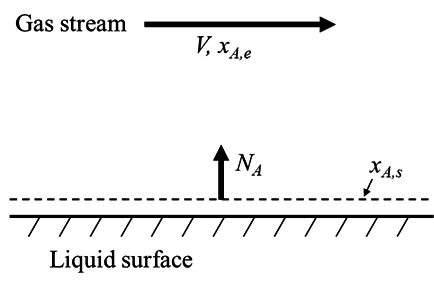
I'm doing an experiment where I will be blowing warm air parallel to a stagnant water surface, and I will investigate the scaling of air velocity with mass transfer coefficient. I am trying to find some kind of scaling of the concentration boundary layer thickness with air velocity, and have been unable to find any literature that gives that scaling. Anyone know what that relationship is, or where I can find it? Thanks.
upload_2015-10-18_15-6-50.png

I should note I have found derivations of the momentum boundary layer thickness, but not the concentration. Perhaps there is some correlation between momentum and concentration boundary layer thickness?
 
Last edited:
Engineering news on Phys.org
Nevermind, I found some powerpoint slides. It can be correlated with the Reynold's number and Schmidt number to various powers multiplied by some constant. As a follow up, I understand that the momentum, concentration, and thermal boundary layer thicknesses are not the same, but I wonder if these are real or are they just concepts used to explain the phenomena. How can one layer of air be thicker than another layer, like they are overlapping each other? Seems strange.
 
Maylis said:
As a follow up, I understand that the momentum, concentration, and thermal boundary layer thicknesses are not the same, but I wonder if these are real or are they just concepts used to explain the phenomena. How can one layer of air be thicker than another layer, like they are overlapping each other? Seems strange.

Suppose you have air flow over a solid object but there is no temperature difference between the air and the object. The thermal boundary layer thickness will be zero, but the momentum thickness will have some finite value. The momentum boundary layer says something about how far away from the object your velocity reaches the free-stream velocity. The thermal boundary layer says something about how far away from the object your temperature reaches the free-stream temperature. These boundary layers are usually not the same.

Please, do not depend only on powerpoint slides for such a difficult topic. There are very good books on boundary layer flows and the questions you ask are all covered by most of these books. Finding out why the Sherwood number for mass transfer looks the way it does is an advanced topic, but for the quoted questions above, you can study the first chapter on laminar boundary layer flow in any book that covers boundary layer theory
 
  • Like
Likes   Reactions: gfd43tg
Maylis said:
I should note I have found derivations of the momentum boundary layer thickness, but not the concentration. Perhaps there is some correlation between momentum and concentration boundary layer thickness?

While not directly applicable to your problem, this I found gives a brief synopsis of how some of the boundary layers work.

http://nature.berkeley.edu/biometlab/espm129/notes/Lecture%2024%20Leaf%20Boundary%20Layer%20Resistances%20and%20Mass%20and%20Momentum%20Exchange%20notes.pdf
 
Last edited by a moderator:
  • Like
Likes   Reactions: gfd43tg

Similar threads

  • · Replies 1 ·
Replies
1
Views
3K
  • · Replies 7 ·
Replies
7
Views
2K
  • · Replies 1 ·
Replies
1
Views
2K
  • · Replies 5 ·
Replies
5
Views
1K
Replies
1
Views
2K
  • · Replies 7 ·
Replies
7
Views
2K
  • · Replies 7 ·
Replies
7
Views
10K
  • · Replies 9 ·
Replies
9
Views
4K
  • · Replies 4 ·
Replies
4
Views
4K
  • · Replies 4 ·
Replies
4
Views
5K