Concept: Question on formation of parallel capacitors

Click For Summary

Homework Help Overview

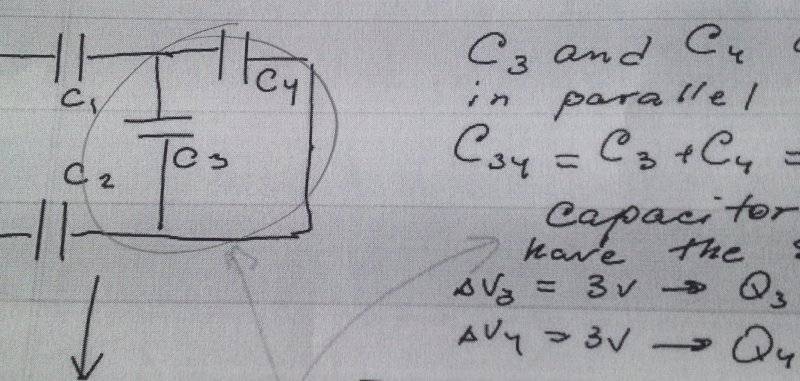
The discussion revolves around the concept of parallel capacitors in electrical circuits, specifically addressing a problem involving the arrangement of capacitors C3 and C4. The original poster expresses confusion regarding the classification of these capacitors as parallel due to their geometric arrangement.

Discussion Character

  • Conceptual clarification

Approaches and Questions Raised

  • The original poster questions the definition of parallel capacitors, suggesting that a direct alignment is necessary for them to be considered parallel. Some participants clarify that connectivity, rather than geometry, determines the parallel configuration.

Discussion Status

Participants are actively engaging in clarifying the concept of parallel capacitors. One participant has provided a perspective that emphasizes connectivity over geometry, which appears to aid the original poster's understanding. Additional suggestions for visualizing the arrangement of the capacitors have been made.

Contextual Notes

The original poster's confusion stems from a specific geometric interpretation of capacitor arrangement, which may not align with standard definitions in circuit theory. There is an implication of a learning environment where assumptions about configurations are being examined.

physicslearner
Messages
2
Reaction score
0
1. So my teacher gave us examples of how to solve capacitor problems. I know how to solve the problem but I don't this problem's particular "formation" of parallel capacitors. In this problem, my teacher says C3 and C4 are parallel but when I did the problem, I assumed it was series. Can anyone explain how C3 and C4 are parallel? I assumed there needed to be another capacitor directly across from them to become parallel, rather than in a 90 degree formation like C3 and C4.
IMG_1631.JPG

Homework Equations

The Attempt at a Solution

 
Physics news on Phys.org
In electrical circuits, the geometry is not relevant, only the connectivity. If you have two components with two contacts each, parallel means each contact on one is connected to a contact on the other, i.e. they are side by side as far as the network is concerned. Electrons in the circuit can pass through either. Series means electrons have to pass through both.
 
haruspex said:
In electrical circuits, the geometry is not relevant, only the connectivity. If you have two components with two contacts each, parallel means each contact on one is connected to a contact on the other, i.e. they are side by side as far as the network is concerned. Electrons in the circuit can pass through either. Series means electrons have to pass through both.

OH! When you put it that way, it makes sense now. Thanks Haruspex.
 
Try "sliding" C4 to the right and around the corner into the vertical wire.
 

Similar threads

Replies
5
Views
1K
Replies
2
Views
1K
Replies
20
Views
2K
  • · Replies 1 ·
Replies
1
Views
4K
Replies
2
Views
2K
  • · Replies 8 ·
Replies
8
Views
2K
  • · Replies 2 ·
Replies
2
Views
14K
  • · Replies 14 ·
Replies
14
Views
2K
  • · Replies 3 ·
Replies
3
Views
3K
Replies
4
Views
2K