Condition to three vectors being collinear

  • Thread starter Thread starter LCSphysicist
  • Start date Start date
  • Tags Tags
    Condition Vectors
Click For Summary

Homework Help Overview

The discussion revolves around the condition for three vectors, u, v, and w, to be collinear within a vector space context. Participants are exploring the implications of the equation (w-u) = λ(u-v) and its relationship to collinearity.

Discussion Character

  • Conceptual clarification, Assumption checking

Approaches and Questions Raised

  • Participants are examining the meaning of the equation and questioning whether it serves as a valid condition for collinearity. There is a focus on understanding the implications of scalar multiples in vector differences.

Discussion Status

Some participants are clarifying the interpretation of the condition, noting that it describes a scenario where collinearity leads to the equation being true, rather than the equation implying collinearity. There is an ongoing exploration of the definitions and assumptions involved.

Contextual Notes

Participants are discussing the use of terminology in English regarding vector definitions and the implications of the vectors being in R2 as a subspace of R3. There is an acknowledgment of potential confusion regarding the relationship between the vectors and their graphical representation.

LCSphysicist
Messages
644
Reaction score
163
Homework Statement
Find a condition, just using operation of vector space, such that the vectors u,v,w belong to the subspace E be colinear
Relevant Equations
\n
Now i am rather confused, the answer apparently is that ##(w-u) = \lambda(u-v)##

But, i could find a way that disprove the answer, that is:
Be u v and w vectors belong to R2, a subspace of R3:
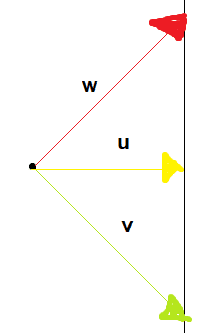
1605746066491.png


What do you think? This is rather strange.
 
Physics news on Phys.org
LCSphysicist said:
Homework Statement:: Find a condition, just using operation of vector space, such that the vectors u,v,w belong to the subspace E be colinear
Relevant Equations:: \n

Now i am rather confused, the answer apparently is that ##(w-u) = \lambda(u-v)##
What this is saying is that ##\vec w - \vec u## is a scalar multiple of ##\vec u - \vec v##. In other words, the two vector differences point in the same or opposite directions.
LCSphysicist said:
But, i could find a way that disprove the answer, that is:
Be u v and w vectors belong to R2, a subspace of R3:

View attachment 272763

What do you think? This is rather strange.
Your example is not a counterexample: it does not disproved the book's solution.
From your drawing ##\vec w - \vec u## can be drawn from the common point (the point where all three vectors start), and pointing straight up. ##\vec u - \vec v## can be drawn also from the common point and pointing straight up.
To draw ##\vec w - \vec u##, that's really the same as ##\vec w + (-1)\vec u##, so go out to the end of ##vec w## and then go backwards the length of ##\vec u. That should take you to a point directly above the common point.

BTW, in English we don't say "Be u v and w vectors" -- we say "Let u, v, and w be vectors that belong to ..."
 
  • Like
Likes   Reactions: member 587159 and LCSphysicist
Mark44 said:
What this is saying is that ##\vec w - \vec u## is a scalar multiple of ##\vec u - \vec v##. In other words, the two vector differences point in the same or opposite directions.

Your example is not a counterexample: it does not disproved the book's solution.
From your drawing ##\vec w - \vec u## can be drawn from the common point (the point where all three vectors start), and pointing straight up. ##\vec u - \vec v## can be drawn also from the common point and pointing straight up.
To draw ##\vec w - \vec u##, that's really the same as ##\vec w + (-1)\vec u##, so go out to the end of ##vec w## and then go backwards the length of ##\vec u. That should take you to a point directly above the common point.

BTW, in English we don't say "Be u v and w vectors" -- we say "Let u, v, and w be vectors that belong to ..."
Yes, reading again with your information makes me realize that the question is not saying that ##\vec w - \vec u## is a scalar multiple of ##\vec u - \vec v## IMPLIES the collinear condition, but it is saying that if the vectors are collinear, so this is true.
While i was using "iff", the book was using the right "if"

"BTW, in English we don't say "Be u v and w vectors" -- we say "Let u, v, and w be vectors that belong to ..."
Thank you for this clarification.
 
LCSphysicist said:
the question is not saying that w→−u→ is a scalar multiple of u→−v→ IMPLIES the collinear condition
It is saying that.
"a condition such that [if satisfied by the vectors then] the vectors u,v,w [are] colinear"
You may be confused by the way collinearity is being used here. They mean that the points represented by the vectors are collinear, as in your diagram.
 

Similar threads

  • · Replies 1 ·
Replies
1
Views
3K
  • · Replies 2 ·
Replies
2
Views
2K
  • · Replies 15 ·
Replies
15
Views
2K
Replies
2
Views
2K
  • · Replies 1 ·
Replies
1
Views
2K
  • · Replies 8 ·
Replies
8
Views
2K
  • · Replies 6 ·
Replies
6
Views
11K
  • · Replies 4 ·
Replies
4
Views
3K
Replies
8
Views
2K
  • · Replies 1 ·
Replies
1
Views
1K