Confused about force body diagram for 2 body collision

Click For Summary
SUMMARY

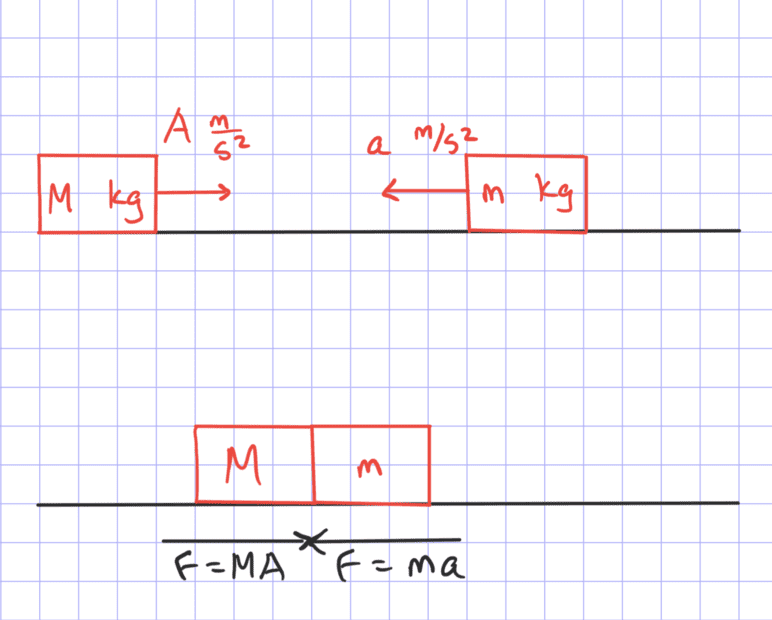
This discussion focuses on understanding Newton's third law in the context of two-body collisions, specifically addressing the forces experienced by two colliding bodies with masses M and m, traveling in opposite directions with respective accelerations A and a. The key conclusion is that during a collision, both bodies experience equal and opposite forces, which can be represented in a free body diagram with arrows indicating the forces acting on each body. The discussion emphasizes the importance of initial velocities, accelerations, and the duration of the collision in calculating the forces involved, as well as the conservation of momentum.

PREREQUISITES
  • Understanding of Newton's laws of motion
  • Knowledge of basic physics concepts such as momentum and energy conservation
  • Familiarity with free body diagrams and vector representation
  • Ability to perform calculations involving mass, acceleration, and force
NEXT STEPS
  • Study the principles of elastic and inelastic collisions in detail
  • Learn how to calculate forces during collisions using F=ma
  • Explore the concept of impulse and its relationship to force and time during collisions
  • Investigate the effects of varying collision durations on force calculations
USEFUL FOR

Physics students, educators, and anyone interested in mechanics, particularly those studying dynamics and collision analysis.

PhysicsQuestions
Messages
3
Reaction score
0
I'm trying to understand Newton's third law in the context of collisions. Assume that one body has mass M kg and is traveling in the positive x direction with acceleration A m/s^2. Assume that the second body has mass m kg and is traveling in the negative x direction with acceleration a m/s^2. At the moment of collision (elastic or inelastic), when you measure the force exerted on each object, both bodies will experience the same force. Is this force going to be F = MA + ma and how would you go about drawing this force body diagram? If the total force were F = MA + ma, would you just have that arrow going from the first body to the second and vice versa? Or would you separate out the arrows into F = MA and F = ma?

Screen Shot 2021-12-19 at 11.20.33 AM.png
 
Physics news on Phys.org
The acceleration of each mass must be due to some external forces. These are not directly related to the equal and opposite forces between the objects during a collision.

Normally a collision is studied using the relative velocity between the objects. There is no need to have external forces accelerating the objects towards each other.
 
You have specified that both objects are accelerating towards one another, but that is not enough information: we need initial velocities as well as the accelerations, and we need the duration of the collision.

To see this, consider that even if the accelerations were zero (the two objects are moving towards one another at a constant speed) there would be a non-zero force, greater if the speeds are greater so we need the initial speeds as well as the acceleration. We also need the duration of the collision because the longer it lasts the smaller the force needed to produce the same effect.
 
Nugatory said:
You have specified that both objects are accelerating towards one another, but that is not enough information: we need initial velocities as well as the accelerations, and we need the duration of the collision.

To see this, consider that even if the accelerations were zero (the two objects are moving towards one another at a constant speed) there would be a non-zero force, greater if the speeds are greater so we need the initial speeds as well as the acceleration. We also need the duration of the collision because the longer it lasts the smaller the force needed to produce the same effect.
If we assign numbers for the sake of clarity, let's say the left block has mass 10 kg, initial velocity 4 m/s, and acceleration 4.5 m/s^2. Let's say the right block has mass 20 kg, initial velocity -4 m/s, and acceleration -4.5 m/s^2. And finally assume the collision lasts .5 seconds.

If they start at 0 and 2 meters, they will meet at the 1 meter mark. The 10kg block will have velocity ## \sqrt{4^2 + 2(4.5)(1)} = 5 m/s ## and the 20 kg block will have velocity -5 m/s. How can we use this information to figure out the force as you suggested?
 
PhysicsQuestions said:
How can we use this information to figure out the force as you suggested?
We calculate the change of speed of either object during the collision (from conservation of energy and momentum and whether the collision is elastic or not - somewhat simpler if it is), divide that change by the elapsed time to get the average acceleration, and then F=ma gives us the force acting on that object to produce that change.
 
  • Like
Likes   Reactions: PhysicsQuestions
Nugatory said:
We calculate the change of speed of either object during the collision (from conservation of energy and momentum and whether the collision is elastic or not - somewhat simpler if it is), divide that change by the elapsed time to get the average acceleration, and then F=ma gives us the force acting on that object to produce that change.
This explanation makes a lot of sense thanks! When drawing the free body diagram, should I draw just two arrows then? One from the left to the right and one from the right to the left, both with the magnitude of the force calculated above?
 
If the forces acting is only due to their mutual interaction, then Newton's 3rd Law holds. This example seems to be for one-dimensional motion. That's why we work with only one component of the vectors. So the equation of motion for the bodies read
$$m a=F_1, \quad M A=F_2.$$
Then Newton's 3rd Law tells you that
$$F_2=-F_1.$$
The most important conclusion is that total momentum is conserved. Indeed
$$m a+MA = F_1+F_2=0.$$
But ##a= \dot{v}## and ##A=\dot{V}##. So you can integrate this equation to
$$m v+MV = P=\text{const}.$$
It is important to realize that the two forces in Newton's 3rd Law act on the two different bodies, respectively!
 
  • Like
Likes   Reactions: sysprog

Similar threads

  • · Replies 10 ·
Replies
10
Views
887
  • · Replies 12 ·
Replies
12
Views
3K
  • · Replies 29 ·
Replies
29
Views
2K
  • · Replies 29 ·
Replies
29
Views
3K
  • · Replies 2 ·
Replies
2
Views
2K
  • · Replies 23 ·
Replies
23
Views
3K
  • · Replies 9 ·
Replies
9
Views
2K
  • · Replies 3 ·
Replies
3
Views
2K
  • · Replies 6 ·
Replies
6
Views
2K
  • · Replies 14 ·
Replies
14
Views
2K