Undergrad Confusion about special case of Jacobian

  • Thread starter Thread starter nomadreid
  • Start date Start date
  • Tags Tags
    Confusion Jacobian
Click For Summary
The discussion centers on the definition of the Jacobian as presented by R. Shankar in "Basic Training in Mathematics," which appears to differ from the conventional understanding of the Jacobian matrix for multi-valued functions. The user expresses confusion about how Shankar's definition aligns with the traditional Jacobian, particularly in the context of single-variable cases. There is a debate over the appropriateness of labeling a simple derivative as the Jacobian, even in degenerate cases. The conversation concludes with the acknowledgment that the differences may not be significant and expresses gratitude for the clarification. Overall, the thread highlights the nuances in mathematical definitions and their implications in understanding derivatives.
nomadreid
Gold Member
Messages
1,761
Reaction score
246
TL;DR
An author gives a definition of a Jacobian which is probably a special case of the usual Jacobian matrix, but I don't see it.
I am used to the usual definition of the Jacobian (when the talk is about derivatives) as the Jacobian matrix for multi-valued functions. However, in the 1995 edition of the introductory book "Basic Training in Mathematics: A fitness program for science students" on page 45 , equations 2.2.22 and 2.2.12 , the author R. Shankar defines the Jacobian as follows,
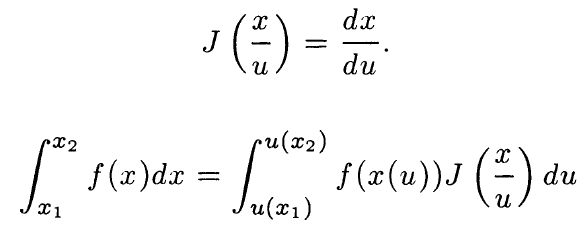
Jacobian.png

I am not sure how the two definitions correspond. If it is blindingly obvious, then my apologies but I would be very grateful if one could spell it out for me anyway. Thanks in advance.
 
Physics news on Phys.org
thats the usual n variable jacobian for n=1, isn't it?
 
mathwonk said:
thats the usual n variable jacobian for n=1, isn't it?
Thanks, mathwonk. Ihat is, just the derivative. why would one label the simple derivative the Jacobian even if it is the degenerate case? Like referring to points as lines, because they are degenerate lines. If there is nothing hidden behind this besides perhaps wanting to perhaps later generalize it, then my question was trying to read between the lines when there was nothing to read, leaving me looking a bit foolish. In that case, the thread ends with my thanks.
 
There are probably loads of proofs of this online, but I do not want to cheat. Here is my attempt: Convexity says that $$f(\lambda a + (1-\lambda)b) \leq \lambda f(a) + (1-\lambda) f(b)$$ $$f(b + \lambda(a-b)) \leq f(b) + \lambda (f(a) - f(b))$$ We know from the intermediate value theorem that there exists a ##c \in (b,a)## such that $$\frac{f(a) - f(b)}{a-b} = f'(c).$$ Hence $$f(b + \lambda(a-b)) \leq f(b) + \lambda (a - b) f'(c))$$ $$\frac{f(b + \lambda(a-b)) - f(b)}{\lambda(a-b)}...

Similar threads

  • · Replies 1 ·
Replies
1
Views
2K
  • · Replies 8 ·
Replies
8
Views
2K
  • · Replies 2 ·
Replies
2
Views
2K
  • · Replies 1 ·
Replies
1
Views
2K
Replies
5
Views
4K
  • · Replies 7 ·
Replies
7
Views
2K
  • · Replies 10 ·
Replies
10
Views
639
  • · Replies 5 ·
Replies
5
Views
3K
  • · Replies 1 ·
Replies
1
Views
3K
  • · Replies 12 ·
Replies
12
Views
505