Undergrad Congruence for Symmetric and non-Symmetric Matrices for Quadratic Form

Click For Summary
Matrices A and B represent the same quadratic form but are not congruent, which contradicts the theorem stating that congruence implies representation of the same bilinear/quadratic form. The discussion clarifies that congruence requires symmetric representations, and since B is not symmetric, it fails to meet the criteria for congruence with A. The confusion arises from terminology, as bilinear forms do not necessarily imply symmetry. Ultimately, the resolution highlights the importance of using symmetric representations when applying theorems related to bilinear and quadratic forms. Understanding these distinctions is crucial for accurate mathematical reasoning in this context.
CGandC
Messages
326
Reaction score
34
I learned that for a bilinear form/square form the following theorem holds:
matrices ## A , B ## are congruent if and only if ## A,B ## represent the same bilinear/quadratic form.

Now, suppose I have the following quadratic form ## q(x,y) = x^2 + 3xy + y^2 ##. Then, the matrix representing this quadratic form can be ## B = \pmatrix{1 & 3 \\ 0 & 1 } ## and also ## A = \pmatrix{1 & \frac{3}{2} \\ \frac{3}{2} & 1 } ##.

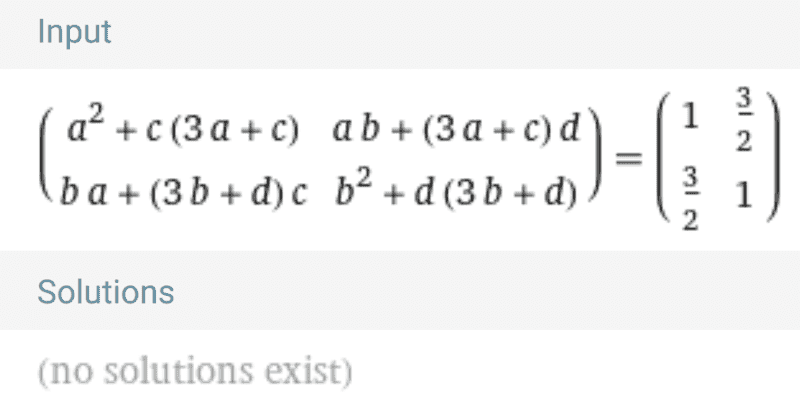
I tried showing that ## A, B ## are congruent, meaning that there exists an invertible matrix ## M ## such that ## B = M^T \cdot A \cdot M ##, but such matrix ## M ## does not exist, here's the calculation for example:
## M = \pmatrix{ a & b \\ c & d } ##

1670931401506.png

And according to Wolfram:
1670931427316.png


Yet, ## A,B ## represent the same quadratic form, but they are not congruent, so this is a contradiction to the theorem above.

Question:
How is this possible? These matrices should be congruent since they do represent the same quadratic form.
( And yes, I know that for every matrix ## A ##, ## \frac{1}{2} ( A + A^T ) ## is symmetric, but this doesn't answer why the above congruence fails to hold )
 
Physics news on Phys.org
##B## does not represent the quadratic form.
 
martinbn said:
##B## does not represent the quadratic form.
Yes it does because: ## \pmatrix{ x & y } \pmatrix{1 & 3 \\ 0 & 1 } \pmatrix{ x \\ y } = \pmatrix{ x & y }\pmatrix{x + 3y \\ y } = x(x+3y) +y^2 = x^2 + 3xy + y^2 ##
 
I think you have some terminology confusion.

Given a bilinear form on a vector space, if you pick a basis it has a unique symmetric representation.

Two matrices are congruent if they are representatives of the same bilinear form with different choices of basis.

Note the representatives are always symmetric.
 
Office_Shredder said:
I think you have some terminology confusion.

Given a bilinear form on a vector space, if you pick a basis it has a unique symmetric representation.

Two matrices are congruent if they are representatives of the same bilinear form with different choices of basis.

Note the representatives are always symmetric.
You mean a quadratic form?, because bilinear form isn't necessarily symmetric
 
CGandC said:
You mean a quadratic form?, because bilinear form isn't necessarily symmetric
Sorry, you are correct, quadratic form
 
Ok but if
## \pmatrix{ x & y } B\pmatrix{ x \\ y } = \pmatrix{ x & y } \pmatrix{1 & 3 \\ 0 & 1 } \pmatrix{ x \\ y } = \pmatrix{ x & y }\pmatrix{x + 3y \\ y } = x(x+3y) +y^2 = x^2 + 3xy + y^2 ##
And
## \pmatrix{ x & y } A\pmatrix{ x \\ y } = \pmatrix{ x & y } \pmatrix{1 & \frac{3}{2} \\ \frac{3}{2} & 1 } \pmatrix{ x \\ y } = \pmatrix{ x & y }\pmatrix{x + \frac{3}{2}y \\ \frac{3}{2}x+y } = x(x+\frac{3}{2}y) +y(\frac{3}{2}x+y) ##
## = x^2 + \frac{3}{2}xy + \frac{3}{2}yx + y^2 = x^2 +3xy+y^2 ##

Then according to what you said ## A ## is a representative of the quadratic form since it is symmetric.
But what is ## B ## then? is it also defined as a representative of the quadratic form?
 
Ok, I've asked on mathexchange and I was told that when dealing with symmetric bilinear-forms/quadratic-forms then when using the theorems related to these, one should assume he's looking at the symmetric representation of these forms, otherwise most of the theorems for symmetric bilinear-forms/quadratic-forms will fail to hold and it'll be nonsense.

For example, in the above example if one assumes ## B = M^T A M ## to be symmetric then ## B^T = M^T A^T M = M^T A M = B ##, but this is a contradiction since ## B^T \neq B ##, so ##A,B ## are not congruent.
So everything's clear now, thanks for the help!
 

Similar threads

  • · Replies 4 ·
Replies
4
Views
3K
  • · Replies 13 ·
Replies
13
Views
2K
  • · Replies 6 ·
Replies
6
Views
1K
  • · Replies 2 ·
Replies
2
Views
1K
  • · Replies 4 ·
Replies
4
Views
6K
  • · Replies 16 ·
Replies
16
Views
2K
  • · Replies 4 ·
Replies
4
Views
2K
  • · Replies 2 ·
Replies
2
Views
3K
  • · Replies 1 ·
Replies
1
Views
3K
  • · Replies 3 ·
Replies
3
Views
1K