Connect isolated ground to Earth?

Click For Summary
SUMMARY

The discussion centers on connecting an isolated common ground to the metal enclosure of a high power class E amplifier, which is powered by two isolated power supplies. The enclosure is already connected to earth through one power supply's metal case. Participants emphasize the importance of grounding to mitigate electromagnetic interference and noise, while also cautioning against potential ground loops caused by resistance in the earth. Recommendations include experimenting with both direct connections and capacitor coupling (0.01μF to 0.1μF) to optimize noise performance.

PREREQUISITES
  • Understanding of electromagnetic interference (EMI) principles
  • Knowledge of grounding techniques in electronic circuits
  • Familiarity with class E amplifier design
  • Experience with capacitor selection and placement in circuits
NEXT STEPS
  • Research grounding techniques to prevent ground loops in electronic systems
  • Learn about the effects of resistance in grounding systems
  • Explore the use of capacitors for noise filtering in power supplies
  • Investigate best practices for connecting isolated grounds to chassis
USEFUL FOR

Electronics engineers, audio amplifier designers, and technicians working on high power circuits who need to manage grounding and noise issues effectively.

Mzzed
Messages
67
Reaction score
5
I am currently working on a high power class E amplifier which will sit inside a metal enclosure. It is powered by two power supplies - both are isolated but one of the power supplies is mounted in the same enclosure. The power supply itself is in a metal case and that case is connected to 'earth'. So, through one of the PSU chassis, the entire metal enclosure of my project is connected to earth.

I have read that people connect common ground to their chassis because this helps prevent emission of electromagnetic waves due to the operation of the circuit inside the enclosure. More importantly (in my case) doing this helps to prevent interference from outside sources and noise on any input signals.

My question is: Should I connect the isolated common ground to the project enclosure (and hence also connect the isolated common ground to earth)? I have drawn a quick diagram of my circumstances where the blue dashed line represents the new wire that I am thinking of connecting between Earth and isolated ground.
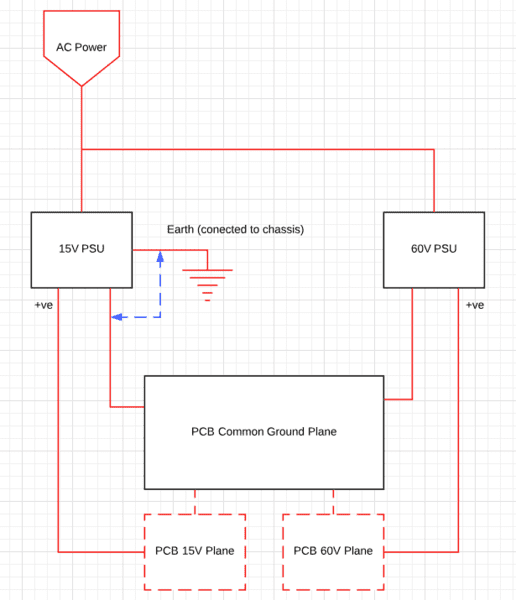
upload_2018-10-7_17-4-11.png


Thanks.
 

Attachments

  • upload_2018-10-7_17-4-11.png
    upload_2018-10-7_17-4-11.png
    12.6 KB · Views: 654
Engineering news on Phys.org
Just remember that there is resistance in the Earth and it can create potential differences between two grounds to earth. That can cause "ground loops". A good metal conductor between two grounds to Earth and differential signals are often necessary.
 
Last edited:
  • Like
Likes   Reactions: Mzzed
FactChecker said:
Just remember that there is resistance in the Earth and it can create potential differences between two grounds to earth. That can cause "ground loops". A good metal conductor between two grounds to Earth and differential signals are often necessary.
Thats a good point. Aside from that, does that system look to be ok if I connect the isolated ground to the chassis and earth?
 
Often keeping them isolated is a better bet, but not always. It depends a lot on the details of the particular installation; some of which you have little control over.

Try it both ways and use whichever has the least noise problem.

A third possibility is to connect the electronics ground to chassis with a capacitor, 0.01μF to 0.1μF.

For power supply noise getting into the amplifier, also try 0.01μF to 0.1μF across the power supply output leads, and/or from the supply "+" to chassis (use short leads at the power supplies).

If using capacitors, use short leads on them; longer leads reduce effectiveness at higher frequencies.

Cheers,
Tom
 

Similar threads

  • · Replies 28 ·
Replies
28
Views
1K
  • · Replies 9 ·
Replies
9
Views
3K
Replies
6
Views
4K
  • · Replies 13 ·
Replies
13
Views
11K
  • · Replies 13 ·
Replies
13
Views
6K
  • · Replies 11 ·
Replies
11
Views
3K
  • · Replies 32 ·
2
Replies
32
Views
4K
  • · Replies 11 ·
Replies
11
Views
6K
Replies
2
Views
3K
  • · Replies 8 ·
Replies
8
Views
2K