Conservation of angular momentum / finding change in rotational kinetic energy

Click For Summary
SUMMARY

The discussion focuses on the conservation of angular momentum and the calculation of change in rotational kinetic energy for two disks of identical mass but different radii (r and 2r) spinning in opposite directions at the same angular speed ωo. The final angular velocity after they come together is determined to be (3/5)ωo. The participants clarify that the correct formula for kinetic energy is K = (1/2)Iω2, and they work through the calculations for initial and final kinetic energies, ultimately leading to a change in kinetic energy of ΔK = (57/100)mr2ωo2.

PREREQUISITES
  • Understanding of angular momentum conservation principles
  • Familiarity with rotational kinetic energy equations
  • Knowledge of moment of inertia calculations for disks
  • Basic algebra skills for manipulating equations
NEXT STEPS
  • Study the derivation of moment of inertia for various shapes, particularly disks
  • Learn about the conservation of angular momentum in different systems
  • Explore examples of rotational kinetic energy calculations
  • Investigate the effects of friction on angular momentum and energy transfer
USEFUL FOR

Physics students, educators, and anyone interested in understanding the principles of rotational dynamics and energy conservation in mechanical systems.

ezperkins
Messages
17
Reaction score
0
Two disks of identical mass but different radii (r and 2r) are spinning on frictionless bearings at the same angular speed ωo, but in opposite directions. The two disks are brought slowly together. The resulting frictional force between the surfaces eventually brings them to a common angular velocity.
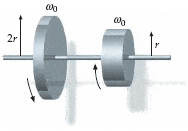
10-p-052.gif


(a) What is the magnitude of that final angular velocity in terms of ωo
\frac{3}{5}ωo < - I know that's right.


(b) What is the change in rotational kinetic energy of the system? (Take K as the initial kinetic energy.) This is what I need help with.


I used Ke=Iω2, coupled the system, considered one direction negative and one positive, and got \frac{9}{50}mr2ωo2, which is apparently wrong. . .

Thank you ahead of time!
 
Physics news on Phys.org
One mistake you made is that the kinetic energy is equal to K=(1/2)Iω2, not Iω2. If that alone isn't the problem, show the details of your calculation so we can see where you might have gone wrong.

ezperkins said:
Two disks of identical mass but different radii (r and 2r) are spinning on frictionless bearings at the same angular speed ωo, but in opposite directions. The two disks are brought slowly together. The resulting frictional force between the surfaces eventually brings them to a common angular velocity.

10-p-052.gif


(a) What is the magnitude of that final angular velocity in terms of ωo
\frac{3}{5}ωo < - I know that's right.


(b) What is the change in rotational kinetic energy of the system? (Take K as the initial kinetic energy.) This is what I need help with.


I used Ke=Iω2, coupled the system, considered one direction negative and one positive, and got \frac{9}{50}mr2ωo2, which is apparently wrong. . .

Thank you ahead of time!
 
Well, I tried it quite a few different ways, that was just the last wrong answer I got before deciding to ask for help. Here's what I did:

1) \DeltaKe = Kf - Ki

2) \DeltaKe = \frac{1}{2}If\omegaf2 - \frac{1}{2}Ii\omegao2

3) \frac{1}{2}((2m)(3r2))\omegaf2 - \frac{1}{2}((2m)(3r2))\omegaf2

4) \frac{1}{2}(6mr2)\omegaf2 - \frac{1}{2}(6mr2)\omegao2

5) 3mr2\frac{3}{5}\omegao2 - 3mr2\omegao2

et cetera

I guess I missed some steps the first way through, but I'm sure it's wrong just the same.
 
I don't follow how you calculated the moment of inertia. Could you explain that?
 
Perhaps I can just start you out on the right path. :smile: First off, the moment of inertia of a disk is

I _{\mbox{disk}} = \frac{mr^2}{2}

From there, I suggest that you write out the individual initial kinetic energies of each disk, at least as a start. You can always simplify later.

K_i = \frac{1}{2}I_1 \omega_0^2 + \frac{1}{2}I_2 \omega_0^2

Once you have this written out (as above) you can then simplify it a little now, or simplify it later.

Either way, note that

I_1 = \frac{mr^2}{2}

and

I_2 = \frac{m(2r)^2}{2}

Adding these together does not give the ((2m)(3r2)) that you were using in your previous post.
 
I know how to calculate the moment of inertia. What I don't get is what you did.
 
collinsmark said:
Perhaps I can just start you out on the right path. :smile: First off, the moment of inertia of a disk is

I _{\mbox{disk}} = \frac{mr^2}{2}

From there, I suggest that you write out the individual initial kinetic energies of each disk, at least as a start. You can always simplify later.

K_i = \frac{1}{2}I_1 \omega_0^2 + \frac{1}{2}I_2 \omega_0^2

Once you have this written out (as above) you can then simplify it a little now, or simplify it later.

Either way, note that

I_1 = \frac{mr^2}{2}

and

I_2 = \frac{m(2r)^2}{2}

Adding these together does not give the ((2m)(3r2)) that you were using in your previous post.

so K_i = \frac{3}{4}mr^2\omega_0^2 ?
and K_f = \frac{9}{50}mr^2\omega_0^2
thus \Delta K = \frac{57}{100}mr^2\omega_0^2}

I feel like such an idiot. . .
 
vela said:
I know how to calculate the moment of inertia. What I don't get is what you did.

Oh, I'm sorry. I basically treated the disks as one big disk.
 
  • #10
I have spent more than two and a half hours on this problem and have gotten nowhere. I give up. Thank you vela and collinsmark for your help.
 
  • #11
ezperkins said:
I have spent more than two and a half hours on this problem and have gotten nowhere. I give up. Thank you vela and collinsmark for your help.
You're really close; you're just not calculating the rotational masses correctly, probably just algebra mistakes. Once you clear that up, you'll get the right answer. It might be good to take a break and come back to it later. Errors you can't see right now may pop out clear as day later.
 
  • #12
vela said:
You're really close; you're just not calculating the rotational masses correctly, probably just algebra mistakes. Once you clear that up, you'll get the right answer. It might be good to take a break and come back to it later. Errors you can't see right now may pop out clear as day later.

I tried that already, on Monday and Tuesday.

I guess I'm just not "physics material."

I really appreciate your time though.
 

Similar threads

Replies
2
Views
1K
Replies
9
Views
3K
  • · Replies 17 ·
Replies
17
Views
1K
Replies
6
Views
1K
Replies
26
Views
1K
Replies
2
Views
1K
  • · Replies 33 ·
2
Replies
33
Views
3K
Replies
17
Views
2K
  • · Replies 4 ·
Replies
4
Views
1K