Conservation of angular momentum?

Click For Summary
SUMMARY

The discussion centers on the conservation of angular momentum in a scenario involving a rotating disc and an iron sphere that is instantaneously welded to it. Participants emphasize the importance of the parallel axis theorem in calculating the system's angular momentum. The disc is assumed to be fixed at its center, while the sphere is initially at rest when attached. The correct application of angular momentum conservation equations is crucial for determining the final angular velocity of the combined system.

PREREQUISITES
  • Understanding of angular momentum conservation principles
  • Familiarity with the parallel axis theorem
  • Knowledge of moment of inertia calculations
  • Basic mechanics of rotational motion
NEXT STEPS
  • Study the parallel axis theorem in detail
  • Learn how to calculate moment of inertia for composite bodies
  • Explore angular momentum conservation in non-isolated systems
  • Investigate the effects of external forces on rotational dynamics
USEFUL FOR

Physics students, mechanical engineers, and anyone interested in understanding the principles of rotational dynamics and angular momentum conservation.

jisbon
Messages
475
Reaction score
30
Homework Statement
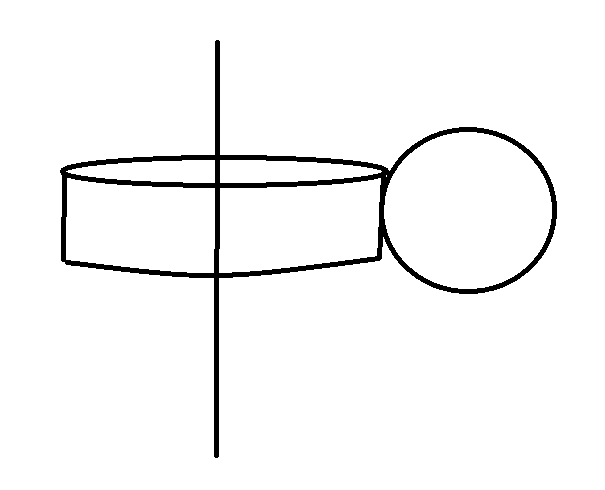
A disc is spinning at 6.8 rad/s about the centre of the disc. A solid iron sphere is then attached to the edge of the disc and rotate together, find the angular velocity of the whole system now.
Relevant Equations
-
Not sure what to do here, except using the conversation of angular momentum. Even then, is angular momentum conserved in this case even after attaching an external object here? Else, what laws can I use to solve this problem?
Using conversation of angular momentum:

$$\dfrac {1}{2}M_{disc}R^{2}_{disc}\left( 6.8\right) =\left( M_{disc}R^{2}_{disc}W\right) +\left( \dfrac {2}{5}M_{sphere}\left( R_{disc}+R_{sphere}\right) ^{2}W\right) $$

Is this correct?

Diagram:
1573556704134.png
 
Physics news on Phys.org
Judging by the 6.8 in your proposed solution, it seems that there was more information present in the original problem statement than you have provided here.

No. Your solution is not correct. The parallel axis theorem should figure prominently in your calculations.

We need to understand the situation better. Is the iron sphere supposed to be moving already on a perfectly tangent trajectory when it brushes up against the rim of the disc and is instantly welded into place? Or is it at rest when it is instantly welded into place and thereby jerked into motion?

Is the disc fixed to an axle at its center? Or is it spinning freely in space? If the latter is the case, where is the new axis of rotation of the unbalanced disc after the sphere has been attached?
 
  • Like
Likes   Reactions: jisbon
jbriggs444 said:
Judging by the 6.8 in your proposed solution, it seems that there was more information present in the original problem statement than you have provided here.

No. Your solution is not correct. The parallel axis theorem should figure prominently in your calculations.

We need to understand the situation better. Is the iron sphere supposed to be moving already on a perfectly tangent trajectory when it brushes up against the rim of the disc and is instantly welded into place? Or is it at rest when it is instantly welded into place and thereby jerked into motion?

Is the disc fixed to an axle at its center? Or is it spinning freely in space? If the latter is the case, where is the new axis of rotation of the unbalanced disc after the sphere has been attached?
The question simply states:
A iron sphere is attracted to the edge of the disc and they rotate together. I will assume it is at rest when it is instantly welded into place and thereby jerked into motion.
I will assume the disc fixed to an axle at its center, so r shouldn't change?

EDIT: Got the answer. In this case, disc is fixed an ball is instantly attracted.
 
jisbon said:
disc is fixed an ball is instantly attracted.
I don't understand that clarification. The disc is rotating or fixed??
But do you now see what was wrong with your application of the parallel axis theorem?
 
My guess:

## L_i = L_f ##
## [Iω]_i = [Iω]_f ##
## [\frac{1}{2}M_{disk} R^{2}_{disk}] [6.8 \frac{rad}{s}] = {[\frac{1}{2}M_{disk} R^{2}_{disk} + M_{sphere} ({R_{disk}+R_{sphere}})^{2}][ω_f]}##

Now, solve for ##ω_f##.
 
lightlightsup said:
## L_i = L_f ##
## [Iω]_i = [Iω]_f ##
## [\frac{1}{2}M_{disk} R^{2}_{disk}] [6.8 \frac{rad}{s}] = {[\frac{1}{2}M_{disk} R^{2}_{disk} + M_{sphere} ({R_{disk}+R_{sphere}})^{2}][ω_f]}##
That appears to be correct for a point mass ##M_{sphere}## in magnitude attached to a point ##R_{sphere}## further out than the physical rim of the disk. It does not account for the moment of inertia of the sphere about its own axis.
 
jbriggs444 said:
That appears to be correct for a point mass ##M_{sphere}## in magnitude attached to a point ##R_{sphere}## further out than the physical rim of the disk. It does not account for the moment of inertia of the sphere about its own axis.
For this (slightly theoretical) problem, I don't think the sphere is rotating about its own axis. It just gets directly attached to a point with instant glue and a powerful magnet. o0)
Otherwise, we would need to start considering friction and what not?
 
lightlightsup said:
For this (slightly theoretical) problem, I don't think the sphere is rotating about its own axis. It just gets directly attached to a point with instant glue and a powerful magnet. o0)
Otherwise, we would need to start considering friction and what not?
If the sphere is insta-welded onto the disk, it will most certainly begin rotating about its own axis at the same rate that the disk is rotating about its axis. That is to say, it will rotate along with the disk rather than presenting a fixed face to the distant stars.
 
  • Like
Likes   Reactions: haruspex
lightlightsup said:
I don't think the sphere is rotating about its own axis
In its 365¼ day journey around the Sun, how many times does Earth rotate on its own axis?
 
  • Like
Likes   Reactions: jbriggs444
  • #10
haruspex said:
In its 365¼ day journey around the Sun, how many times does Earth rotate on its own axis?
I think, in this case, we're supposed to image a direct connection between the sphere and the disc?
They're rotating like they're the same object? We just need to calculate the difference in ##I##?
 
  • #11
lightlightsup said:
I think, in this case, we're supposed to image a direct connection between the sphere and the disc?
They're rotating like they're the same object?
Yes. And if they rotate together, they both rotate.
 
  • #12
jbriggs444 said:
Yes. And if they rotate together, they both rotate.
And the axis-of-rotation is remaining the same? (through the center of the disc, if seen from above)
 
  • #13
lightlightsup said:
And the axis-of-rotation is remaining the same? (through the center of the disc, if seen from above)
Post #3 seems to indicate that the disc is anchored with an axle at its center, yes.
 
  • #14
lightlightsup said:
I think, in this case, we're supposed to image a direct connection between the sphere and the disc?
They're rotating like they're the same object? We just need to calculate the difference in ##I##?
Sure, but the Earth-Sun arrangement illustrates that rotation about a remote axis as though part of a rigid body encompassing and rotating about that axis is still a rotation. The 365¼ rotations as seen from the sun are additional to this, so the answer to my question is 366¼ times.
A better analogy would have been Earth-Moon. In going around the Earth each month, the Moon presents the same face to us, so it also rotates once a month.
 
  • #15
haruspex said:
Sure, but the Earth-Sun arrangement illustrates that rotation about a remote axis is still a rotation. The answer to my question is 366¼ times.
A better analogy would have been Earth-Moon. In going around the Earth each month, the Moon presents the same face to us, so it also rotates once a month.

I'm no expert but I thought that the angular momentum of an orbiting body (earth around the sun or moon around the earth) has a lot to do with the angular momentum the body had to begin with. This angular momentum does change due to gravity. I believe this has something to do with tidal locking and precession. But, once again, I don't know enough about these things to talk about them.
See: https://www.sciencefocus.com/space/why-can-we-only-see-one-side-of-the-moon/
 
  • #16
lightlightsup said:
I'm no expert but I thought that the angular momentum of an orbiting body (earth around the sun or moon around the earth) has a lot to do with the angular momentum the body had to begin with. This angular momentum does change due to gravity. I believe this has something to do with tidal locking and precession. But, once again, I don't know enough about these things to talk about them.
See: https://www.sciencefocus.com/space/why-can-we-only-see-one-side-of-the-moon/
My post had nothing to do with momentum or forces. It is just a question of what constitutes a rotation of a body. If you walk around a circle, always facing ahead, then you have rotated once on your own axis. If you walk around it always facing East then you have not.
 
  • #17
haruspex said:
My post had nothing to do with momentum or forces. It is just a question of what constitutes a rotation of a body. If you walk around a circle, always facing ahead, then you have rotated once on your own axis. If you walk around it always facing East then you have not.
So, in this example, there has been 1 rotation around its own axis for the sphere, for every 1 revolution, because it is locked in?
 
  • #18
lightlightsup said:
So, in this example, there has been 1 rotation around its own axis for the sphere, for every 1 revolution, because it is locked in?
Yes.
 
  • #19
haruspex said:
I don't understand that clarification. The disc is rotating or fixed??
But do you now see what was wrong with your application of the parallel axis theorem?
disc rotating about fixed axis.
Yep, I understood :)
 
  • #20
The sphere is rotating strictly about an axis to the center of the disk?
 
  • #21
lightlightsup said:
The sphere is rotating strictly about an axis to the center of the disk?
The sphere is moving in a circle around the center of the disk. And it is rotating as it moves so that the point of attachment stays firmly attached to the disk.

If you want to call that "rotating strictly", that is fine. But both the motion in a circle and the rotation add to the angular momentum of the sphere.
 

Similar threads

  • · Replies 17 ·
Replies
17
Views
930
Replies
17
Views
2K
Replies
26
Views
1K
  • · Replies 7 ·
Replies
7
Views
2K
  • · Replies 50 ·
2
Replies
50
Views
4K
Replies
335
Views
16K
  • · Replies 12 ·
Replies
12
Views
2K
  • · Replies 12 ·
Replies
12
Views
2K
Replies
5
Views
1K
  • · Replies 2 ·
Replies
2
Views
2K