Conservation of Mechanical Energy: Equations not equivalent?

Click For Summary

Homework Help Overview

The discussion revolves around a physics problem involving a diver on a diving board, focusing on the concepts of elastic potential energy and gravitational potential energy. Participants explore the relationship between these forms of energy and question the equivalence of different approaches to solving the problem.

Discussion Character

  • Exploratory, Conceptual clarification, Assumption checking

Approaches and Questions Raised

  • Participants discuss the method of calculating elastic potential energy and question the necessity of using the spring constant. There is confusion about the conditions under which gravitational potential energy is conserved and how it relates to elastic potential energy in the context of the diver's situation.

Discussion Status

The discussion is active, with participants providing insights into the mechanics of the system and the implications of energy conservation. Some participants suggest that the diver's stationary position indicates energy transformation into other forms, while others explore the implications of maximum compression and the role of forces in the system.

Contextual Notes

Participants note that the diver's interaction with the diving board may involve energy losses, and there is an ongoing examination of the conditions under which energy conservation applies. The discussion also touches on the nature of inelastic collisions and their relevance to the scenario presented.

elijugh
Messages
7
Reaction score
0
1. The problem
A very simple question on a quiz given to me states that,
"A 63 kg diver is standing on a diving board waiting to commence her dive. The diving board has compressed 0.08 m. Determine the elastic potential energy of the diver." 2. The attempt at a solution

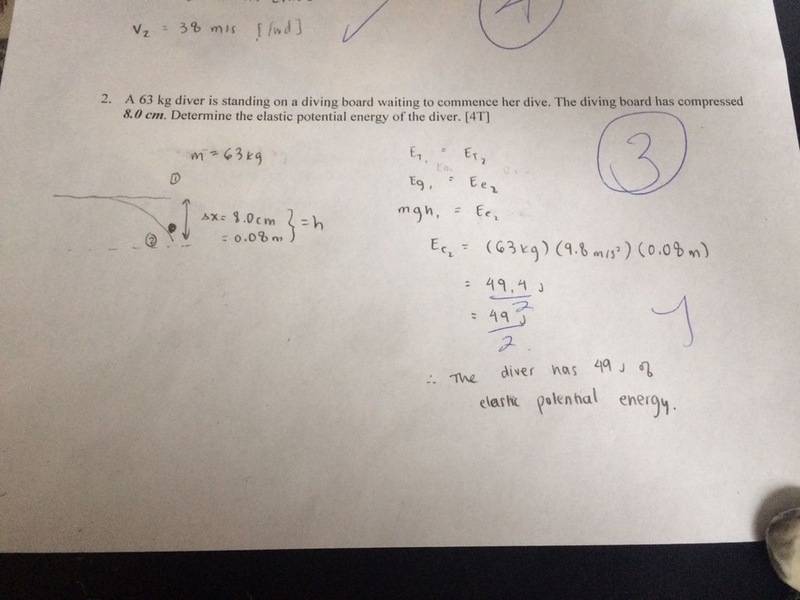
I thought this question was simple enough. The gravitational potential energy simply gets converted into elastic potential energy:
e6d9e9c8-baa3-4745-9728-21a281439081.jpg
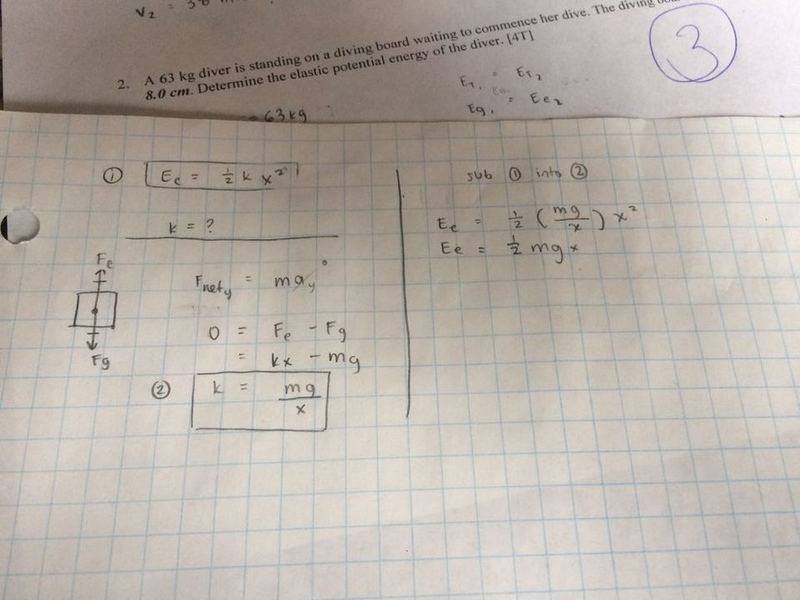
However, apparently the correct solution is first finding the equation of the spring constant, k, from the net force equation, then substituting it into the equation for the elastic potential energy, E = 1/2(kx^2):
1efaa98d-349b-4492-bb00-c8bcd740b0f3.jpg


I find no issue with both solutions, but the equations produced in both solutions are not equivalent to each other! The only difference is multiplying by 1/2. How can this be explained?
 
Physics news on Phys.org
Think about the diving board being slowly bent to its final deflection. At the end of its travel the board's restoring force exactly matches the diver's weight and the diver and board have reached equilibrium. But how about the restoring force along the way? Was it always the same value?
 
Yeah, I understand how the elastic force increases as the displacement of the spring increases. I just don't get how it applies to this question in particular. Is the elastic potential energy not equivalent to the initial gravitational potential energy?
 
elijugh said:
Yeah, I understand how the elastic force increases as the displacement of the spring increases. I just don't get how it applies to this question in particular. Is the elastic potential energy not equivalent to the initial gravitational potential energy?
Nope. Can you think of what might have happened to any excess energy? Why isn't the diver oscillating around the equilibrium point rather than standing still?
 
Then I assume the energy is transformed into waste forms like thermal or sound energy...

Is the key point that the diver is standing still and not about to oscillate...?

So let's say I change the question and say:
"I hold a 63 kg mass on top of a spring then release it so that the spring is compressed 0.08m, find the elastic potential energy at this moment."
Would my method of stating that the initial gravitational potential energy is conserved become correct? And would the method of using the net forces not work?
 
elijugh said:
Then I assume the energy is transformed into waste forms like thermal or sound energy...

Is the key point that the diver is standing still and not about to oscillate...?
Yes.
So let's say I change the question and say:
"I hold a 63 kg mass on top of a spring then release it so that the spring is compressed 0.08m, find the elastic potential energy at this moment."
Would my method of stating that the initial gravitational potential energy is conserved become correct? And would the method of using the net forces not work?
Would you expect the 63 kg mass to be stationary at the given instant? You need to specify that. Perhaps the 0.08 m displacement represents the maximum compression. Otherwise the mass will still have a share of the energy in the form of KE.

Unless there are external forces or frictional losses you expect energy conservation to hold, with energy being traded back and forth between different "containers". When you release the mass, three types of energy are involved in the bargaining process: Gravitational PE, Elastic PE, and KE of the moving mass.
 
gneill said:
Yes.

Would you expect the 63 kg mass to be stationary at the given instant? You need to specify that. Perhaps the 0.08 m displacement represents the maximum compression. Otherwise the mass will still have a share of the energy in the form of KE.

Unless there are external forces or frictional losses you expect energy conservation to hold, with energy being traded back and forth between different "containers". When you release the mass, three types of energy are involved in the bargaining process: Gravitational PE, Elastic PE, and KE of the moving mass.

I totally forgot to consider that. So what if the 0.08 m represents the maximum compression? Then I assume that the conservation of energy remains true, and the elastic potential energy at that moment equals the initial gravitational potential energy.

Would the method of using the net forces not work anymore then? If not, why?
 
Last edited:
elijugh said:
Would the method of using the net forces not work anymore then? If not, why?
Unless the system is at equilibrium the forces will be unbalanced. There will be acceleration involved. You could still use net forces if you account for inertial forces, but then you would be writing and solving a differential equation rather than a static equilibrium.
 
gneill said:
Unless the system is at equilibrium the forces will be unbalanced. There will be acceleration involved. You could still use net forces if you account for inertial forces, but then you would be writing and solving a differential equation rather than a static equilibrium.

I'm a bit confused now. At maximum compression does the system not have balanced forces and an acceleration of 0? I thought that the force of gravity balances the elastic force, which is why the velocity is 0 at that given point.
 
  • #10
elijugh said:
I'm a bit confused now. At maximum compression does the system not have balanced forces and an acceleration of 0? I thought that the force of gravity balances the elastic force, which is why the velocity is 0 at that given point.
Nope. In fact it has maximum acceleration at that point. Just the velocity happens to be zero at that instant.

Consider a similar situation where you throw an object vertically upwards. At its maximum height the velocity is instantaneously zero. Would you also say that the acceleration is zero?

The forces in the spring system will be balanced only when the system is at equilibrium. If it has KE at that point it won't remain at equilibrium, it'll pass through it and head towards a maximum extension.
 
  • #11
gneill said:
Nope. In fact it has maximum acceleration at that point. Just the velocity happens to be zero at that instant.

Consider a similar situation where you throw an object vertically upwards. At its maximum height the velocity is instantaneously zero. Would you also say that the acceleration is zero?

The forces in the spring system will be balanced only when the system is at equilibrium. If it has KE at that point it won't remain at equilibrium, it'll pass through it and head towards a maximum extension.

Ah, it all makes sense now.
I guess I just need to analyze more carefully where the conservation of mechanical energy applies.

Just one more question--in class we learned about inelastic collisions and how it doesn't conserve energy but only momentum.
Because the diver remains in contact with the diving board, is this an example of that? Is that why energy is not conserved for this scenario?
 
  • #12
elijugh said:
Ah, it all makes sense now.
I guess I just need to analyze more carefully where the conservation of mechanical energy applies.

Just one more question--in class we learned about inelastic collisions and how it doesn't conserve energy but only momentum.
Because the diver remains in contact with the diving board, is this an example of that? Is that why energy is not conserved for this scenario?
It's a form of inelastic collision. In this case the diving board will have some damping that will "kill" oscillations over a short time interval.
 
  • Like
Likes   Reactions: elijugh
  • #13
Ahh great! I think I understand everything now.
Thank you so much!
 

Similar threads

  • · Replies 9 ·
Replies
9
Views
2K
Replies
2
Views
1K
Replies
3
Views
7K
  • · Replies 7 ·
Replies
7
Views
2K
  • · Replies 4 ·
Replies
4
Views
2K
Replies
3
Views
2K
  • · Replies 7 ·
Replies
7
Views
2K
  • · Replies 3 ·
Replies
3
Views
2K
  • · Replies 15 ·
Replies
15
Views
2K
  • · Replies 10 ·
Replies
10
Views
2K